All species › Swifts › Hummingbirds › Green-backed Hillstar
Green-backed Hillstar | Urochroa leucura
Groenrugbergnimf | Estrella de dorso verde | Estrela-de-dorso-verde
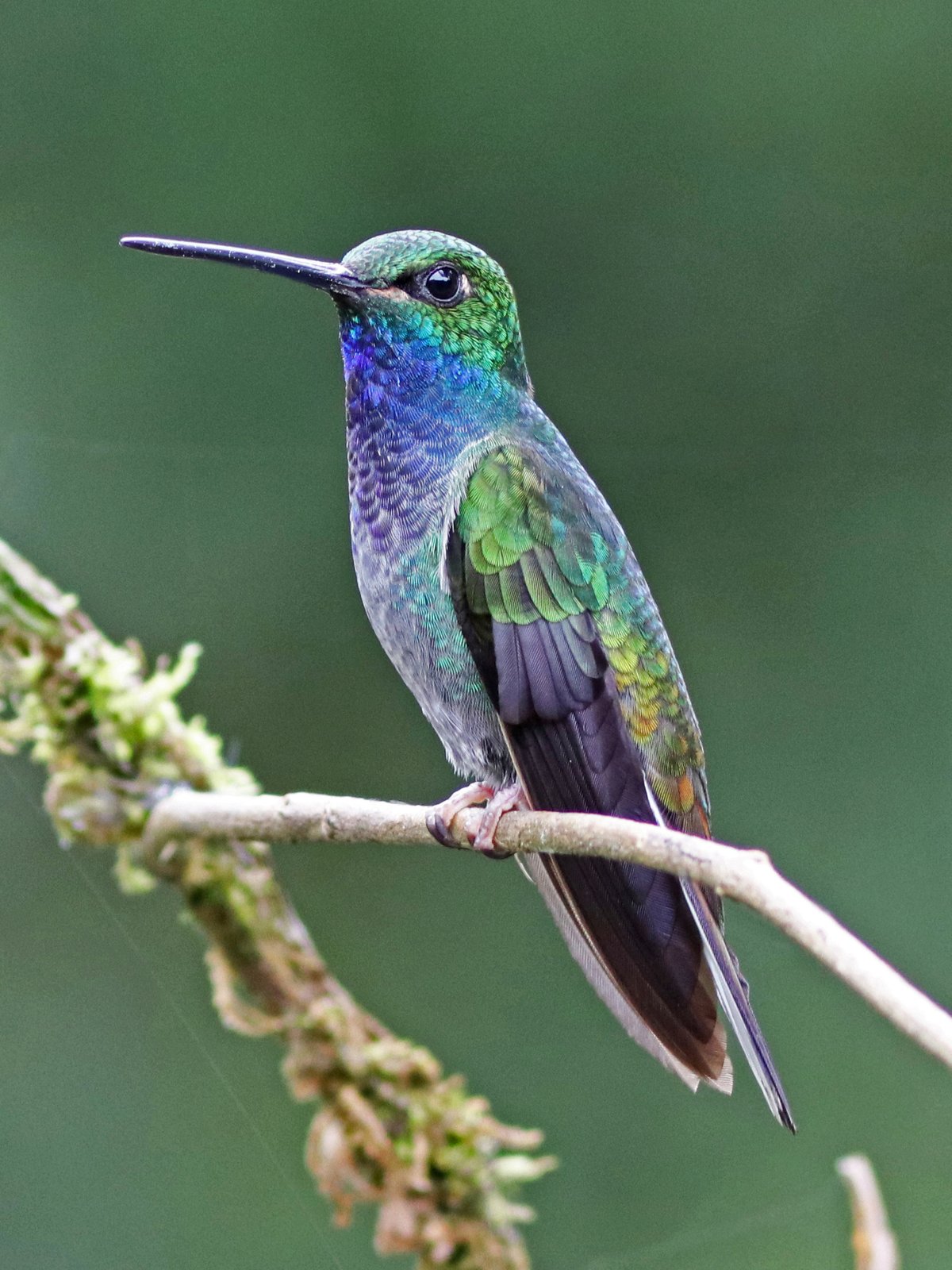
The Green-backed Hillstar is the eastern-slope counterpart of the Rufous-gaped Hillstar. It lives along fast-flowing streams and rivers in montane forest, where it perches on rocks and branches above the water. The largely white tail shows well in flight and on landing.
Voice
A loud, sharp tseek, often repeated and audible above the noise of the water. In chases a rapid, high twitter.
Recording: Mitch Lysinger — CC BY-NC-SA 4.0 · xeno-canto
Identification
12–13 cm, with a long, straight black bill. The upperparts are glossy green. The throat and breast are glittering blue, and the belly is dark greyish green. A rufous gape patch is absent or at most small and faint. The tail is white, with dark central feathers and dark edges to the outer ones. The female is duller, with less blue on the throat and breast.
Confusion species
Rufous-gaped Hillstar Urochroa bougueri has a more bronzy back, a distinct rufous stripe from the gape and lives on the western slope. Collared Inca Coeligena torquata also shows white in the tail, but has a white breast band and a blackish plumage, and lives higher in the forest. Blue-fronted Lancebill Doryfera johannae also frequents streams, but is dark, with a short, dark tail.
Habitat
Fast-flowing, boulder-strewn streams and rivers in humid foothill and lower montane forest, and forest edges along the water, roughly between 1000 and 2500 m. It perches on stones or overhanging branches, catches insects over the water and visits flowering shrubs and trees along the bank. The nest is usually built above or close to running water.
Where the bird is most at home, classified by the vegetation units of the Andes and the west coast.


Range and movements
In Colombia on the eastern slope in the far south. In Ecuador on the eastern slope of the Andes along the whole length of the country. In Peru on the eastern slope in the north. Absent from Bolivia and the Galápagos. Does not occur outside the guide area.
- Resident
- dark = core range, pale = thinly spread
How and when to look
Along the rivers and streams of the eastern slope of Ecuador, for example around Baeza and along the road from Baños to Puyo. Look for birds on rocks in the stream or at flowering trees along the bank.
Conservation status
Least Concern. The species depends on streams with riverine forest; deforestation and dam construction affect its habitat locally.
Scientific name
Urochroa leucura | Lawrence, 1864
Lawrence described the species in 1864 and placed it straight away in the genus where it still stands. The genus Urochroa was introduced in 1856 by Gould. The genus name combines Greek oura, 'tail', with khroa, 'colour' or 'complexion'. The specific name comes from Greek leukos, 'white', and oura, 'tail': white-tailed. The specimen the first description was based on came from Ecuador.