All species › Swifts › Hummingbirds › Rufous-gaped Hillstar
Rufous-gaped Hillstar | Urochroa bougueri
Roestteugelbergnimf | Colibrí gorgirrufo | Estrela-de-comissura-ruiva
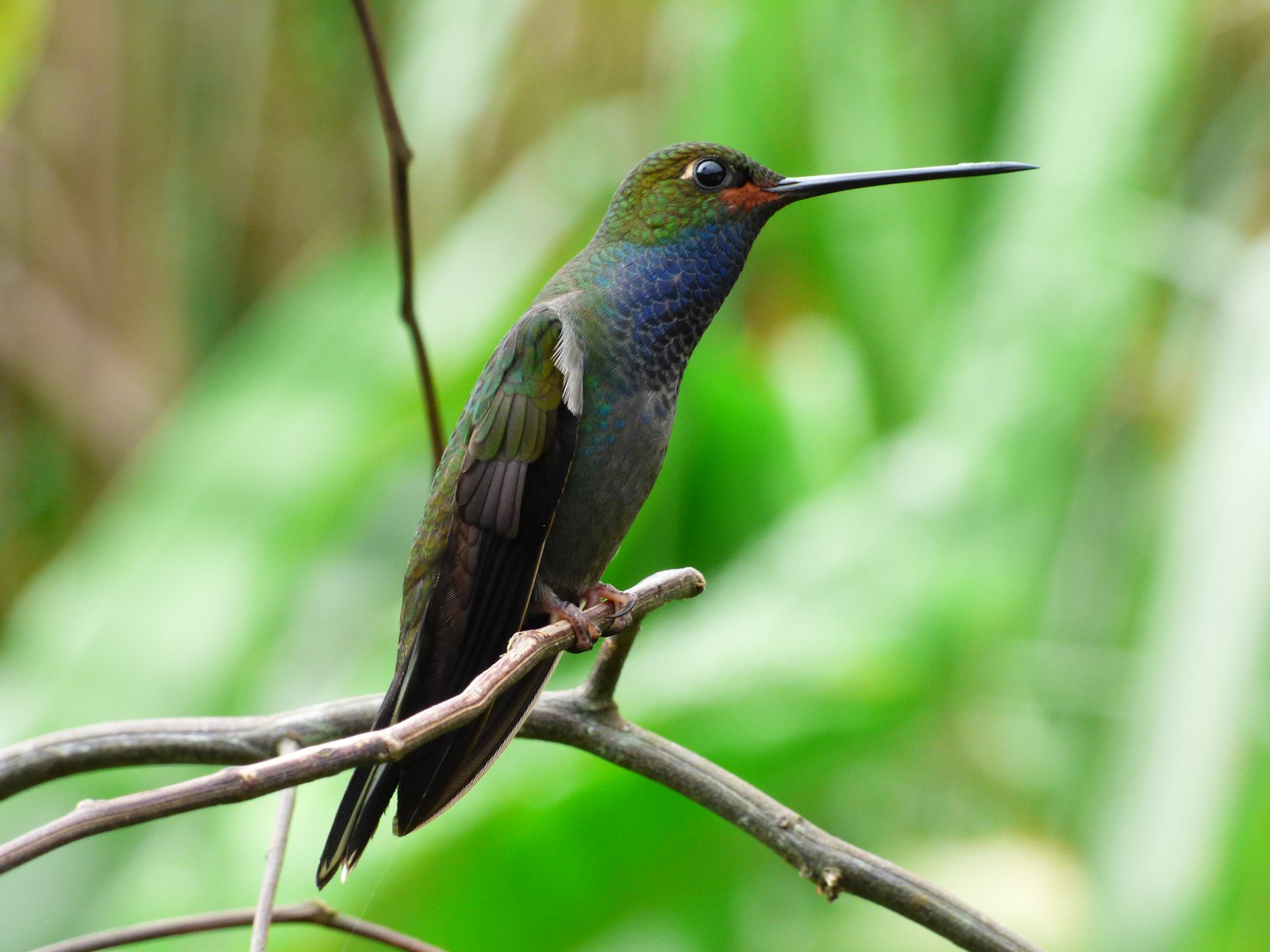
The Rufous-gaped Hillstar is a large hummingbird of fast-flowing streams and rivers on the western slope of the Andes in Colombia and Ecuador. It likes to perch on rocks or branches above the water and stands out by its largely white tail. The rufous patch at the gape separates it from the related Green-backed Hillstar of the eastern slope.
Voice
A loud, sharp tseek, often repeated, audible even above the noise of the water. In chases a rapid, high twitter.
Recording: John V. Moore — CC BY-NC-SA 4.0 · xeno-canto
Identification
12–13 cm, with a long, straight black bill. The upperparts are dark bronzy green. The throat and breast are glittering blue, and the belly is dark greyish green. A rufous stripe runs from the gape across the cheek. The tail is white, with dark central feathers and dark edges and tips to the outer ones. The female is duller, with less blue on the throat and breast. Young birds are duller and have a smaller rufous patch.
Confusion species
Green-backed Hillstar Urochroa leucura has a greener back, lacks the rufous gape patch and lives on the eastern slope. Velvet-purple Coronet Boissonneaua jardini also has a white tail, but a short bill and a dark violet breast. White-necked Jacobin Florisuga mellivora has a blue head, a white nape patch and a white belly, and lives lower.
Habitat
Fast-flowing, boulder-strewn streams and rivers in humid foothill and lower montane forest, and forest edges along the water, roughly between 400 and 2000 m. It perches on stones or overhanging branches, catches insects over the water and visits flowering shrubs and trees along the bank. The nest is usually built above or close to running water.
Where the bird is most at home, classified by the vegetation units of the Andes and the west coast.


Range and movements
In Colombia on the Pacific slope of the Western Andes, mainly in the south-west. In Ecuador on the western slope, in the north and centre of the country. Absent from Peru, Bolivia and the Galápagos. Does not occur outside the guide area.
- Resident
- dark = core range, pale = thinly spread
How and when to look
Along mountain streams on the western slope of Ecuador, for example around Mindo and along the road to the coast. Look for birds on rocks in mid-stream or on branches above the water.
Conservation status
Least Concern. The species depends on streams with riverine forest; deforestation and river pollution affect its habitat locally.
Scientific name
Urochroa bougueri | (Bourcier, 1851)
Bourcier described the species in 1851 as Trochilus Bougueri; because it was later moved to another genus, the author and year stand in brackets. The genus Urochroa was introduced in 1856 by Gould. The genus name combines Greek oura, 'tail', with khroa, 'colour' or 'complexion'. The specific name honours the French mathematician Pierre Bouguer, who visited what was then Peru from 1736 to 1742. The specimen the first description was based on came from Nanegal, Pichincha, Ecuador.