All species › Swifts › Hummingbirds › Rufous-booted Racket-Tail
Rufous-booted Racket-Tail | Ocreatus addae
Vlagstaartroestpluimbroekje | Colibrí de raquetas boliviano | Beija-flor-de-raquete-de-calças-ruivas
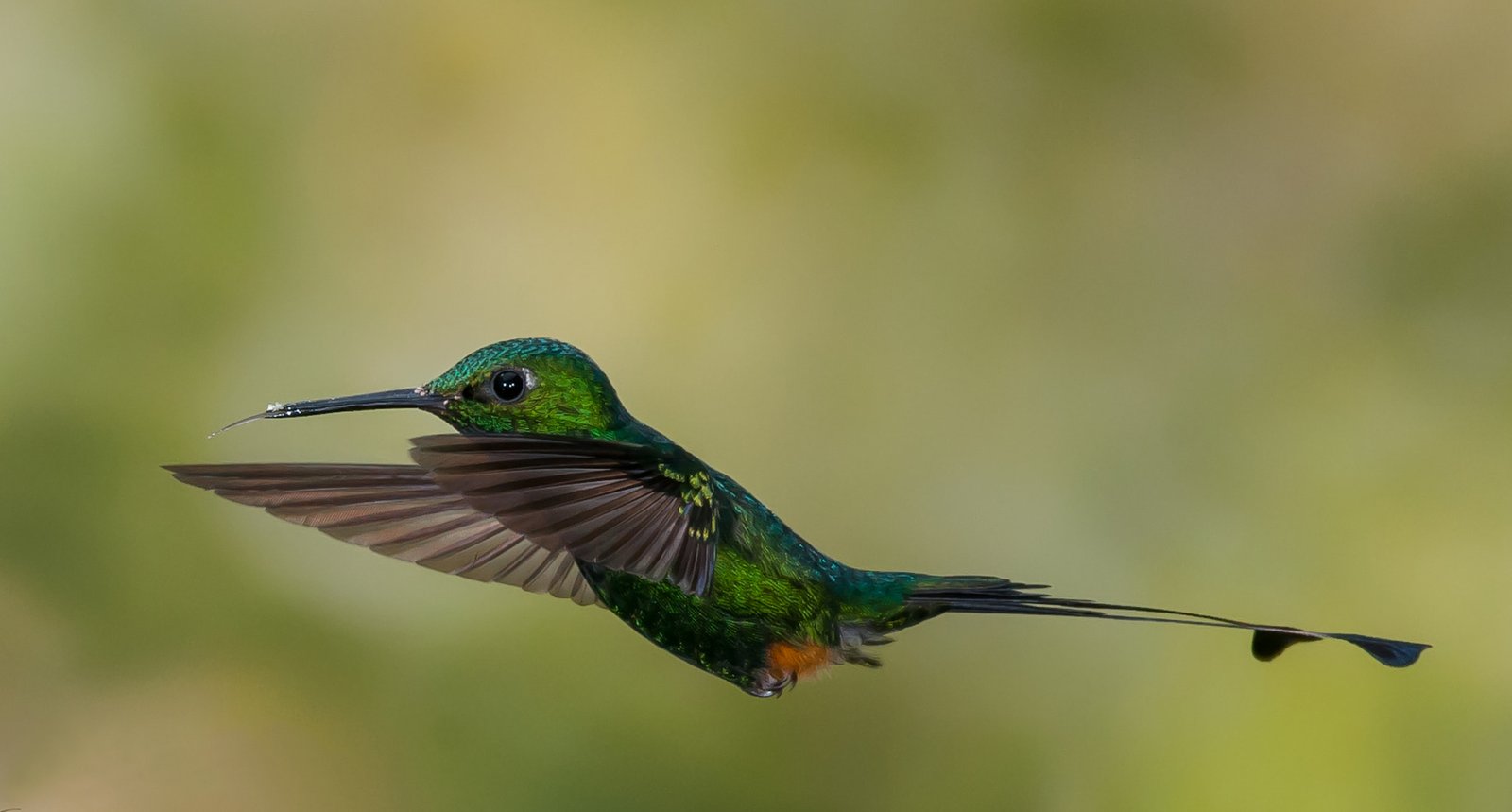
The Rufous-booted Racket-Tail is the southernmost of the racket-tails, a tiny hummingbird of the Yungas on the eastern slope of the Andes. As in its relatives, the male has two long, bare outer tail feathers ending in a dark racket. The downy leg puffs are rufous to cinnamon in this species.
Voice
A short, high tsip, often in flight, and a soft, dry twitter. The flight is buzzy and insect-like; in display the male swings the rackets back and forth.
Recording: Rolf A. de By — CC BY-NC-SA 4.0 · xeno-canto
Identification
8–15 cm: the male including the elongated tail feathers 12–15 cm, the female 7–9 cm. Short, straight black bill and a small white spot behind the eye. The male is glossy green, with a glittering green throat and breast and a deeply forked tail with two long, bare outer feathers ending in blue-black, oval rackets. The leg puffs are rufous to cinnamon. The female is green above and white below with green spots, with a short, forked, white-tipped tail and smaller, paler leg puffs.
Confusion species
Peruvian Racket-Tail Ocreatus peruanus has pale buff leg puffs and lives further north. Pufflegs of the genus Eriocnemis have white leg puffs, a normal tail without rackets and usually live higher. The female resembles small coquettes, but these have a pale band across the rump.
Habitat
Edges and clearings of humid Yungas montane forest, old secondary growth, wooded ravines and gardens, roughly between 1000 and 2500 m. It feeds at small flowers in the middle and lower strata, often along a regular route, and visits feeders. The nest is a small cup of moss and plant down on a twig or leaf.
Where the bird is most at home, classified by the vegetation units of the Andes and the west coast.


Range and movements
In Peru on the eastern slope in the centre and south of the country. In Bolivia in the Yungas of La Paz, Cochabamba and Santa Cruz. Absent from Colombia, Ecuador and the Galápagos. Does not occur outside the guide area.
- Resident
- dark = core range, pale = thinly spread
How and when to look
Along forest edges and at feeders in the Yungas, for example along the roads to Manu in Peru and near Coroico in Bolivia. The male can be recognised by the rackets behind the hovering bird.
Conservation status
Not Evaluated in the current circumscription of the species. It tolerates secondary forest and forest edges; deforestation in the Yungas affects its habitat locally.
Scientific name
Ocreatus addae | (Bourcier, 1846)
Bourcier described the species in 1846 as Trochilus Addae; because it was later moved to another genus, the author and year stand in brackets. The genus Ocreatus was introduced in 1846 by Gould. The genus name comes from Latin ocreatus, 'wearing greaves', after the conspicuous leg puffs. The species name honours Adeline 'Adda' Wilson (1819–1891), wife of the American financier William Savory Wilson in Paris. The specimen the first description was based on came from Bolivia.