All species › Passerines › Tyrant flycatchers and allies › Piratic Flycatcher
Piratic Flycatcher | Legatus leucophaius
Piraattiran | Papamoscas pirata | Bem-te-vi-pirata
The Piratic Flycatcher builds no nest of its own but takes over the hanging or domed nests of other birds, such as oropendolas, caciques and kiskadees. A pair drives off the owners by persistent calling and harassment and throws out their eggs. It calls from high in the treetops at the forest edge.
Voice
A high, plaintive, often repeated pee-yee and a rising series pee-ree-ree-ree, often for hours from a high bare branch.
Recording: Faustino Hollmann — CC BY-NC-SA 4.0 · xeno-canto
Identification
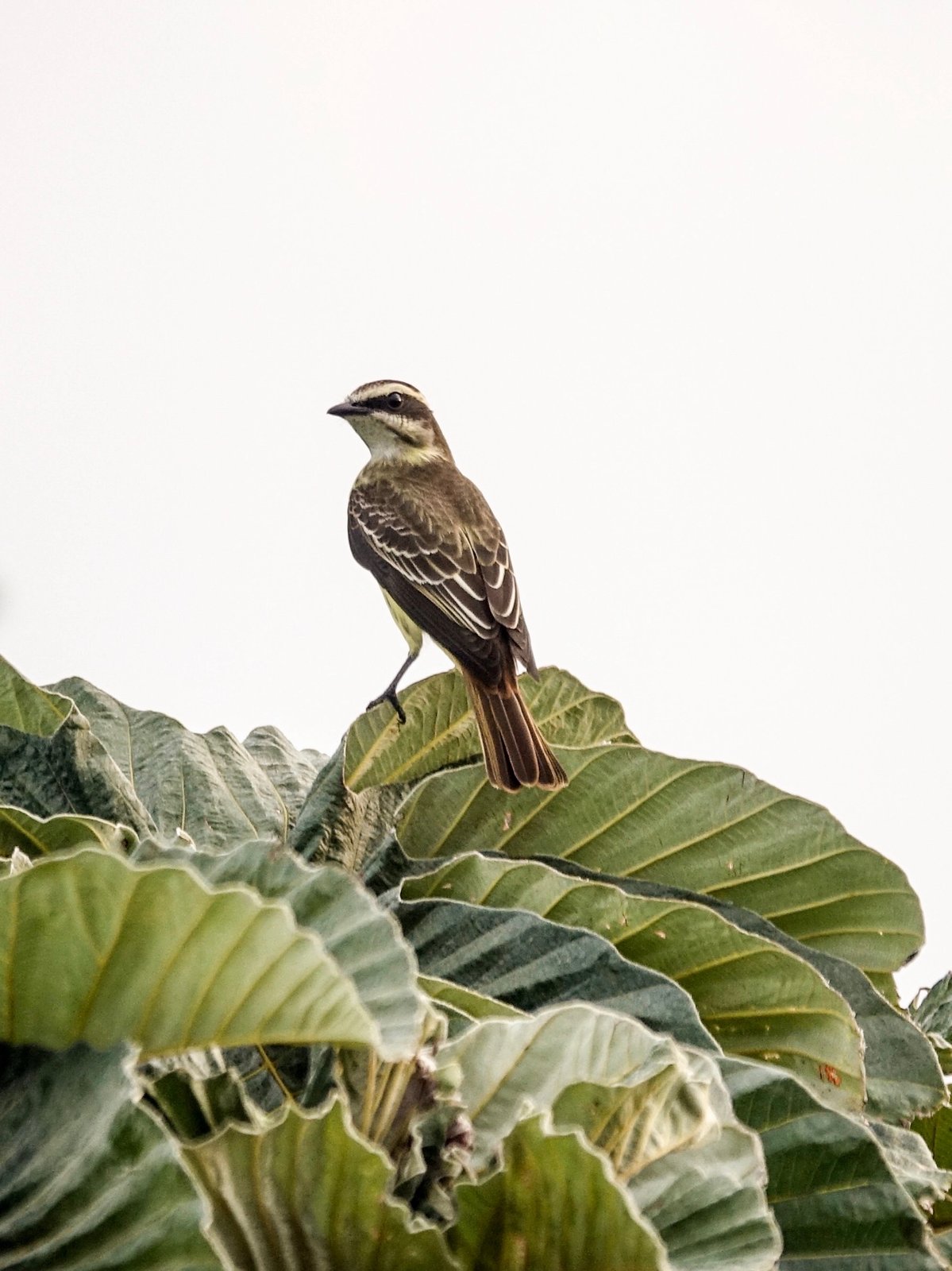
15 cm. A small, compact flycatcher with a short, broad, black bill. The upperparts are uniform dark greyish-brown, without rufous in wing or tail. The head shows a broad dark eye-stripe, a white supercilium, a white cheek-stripe and a dark malar stripe; the crown has a concealed yellow patch. The throat is white, the breast dull white with blurry dark streaks, the belly pale yellow. Sexes alike; juveniles have rufous edges to the wings and tail.
Confusion species
Variegated Flycatcher Empidonomus varius is larger, with a longer bill, sharper breast streaking and rufous edges to the rump and tail. Streaked Flycatcher Myiodynastes maculatus and Sulphur-bellied Flycatcher Myiodynastes luteiventris are much larger, with a heavy bill and a rufous tail. Crowned Slaty Flycatcher Empidonomus aurantioatrocristatus is grey, without breast streaking.
Habitat
Forest edges, clearings in humid forest, secondary forest, riverbanks, várzea and semi-open country with tall trees, also plantations and gardens. From the lowlands to about 1500 m. It eats mainly fruit, especially mistletoe and other berries, as well as insects. It breeds in nests taken over from other species.
Where the bird is most at home, classified by the vegetation units of the Andes and the west coast.


Range and movements
Colombia: widespread in the lowlands and foothills west and east of the Andes. Ecuador: in the western lowlands and in the eastern lowlands and foothills. Peru: in the lowlands and foothills east of the Andes. Bolivia: in the lowlands of the north and east, mainly in the rainy season. Absent from the Galápagos. Outside the guide area from Mexico to Argentina; the northernmost and southernmost birds move to Amazonia outside the breeding season.
- Resident
- dark = core range, pale = thinly spread
How and when to look
Listen at forest edges and near oropendola colonies for the high, plaintive call; the bird is then usually perched on a high, bare branch.
Conservation status
Least Concern. Widespread and benefits from clearings and forest edges.
Scientific name
Legatus leucophaius | (Vieillot, 1818)
Vieillot described the species in 1818 as Platyrhynchos leucophaius; because it was later moved to another genus, the author and year stand in brackets. The genus Legatus was introduced in 1859 by Sclater. The genus name comes from Latin legatus, 'governor, deputy', from legare, 'to appoint'; why Sclater chose this name is not certain. The species name comes from Greek leukos, 'white', and phaios, 'dusky, grey-brown'. The specimen the first description was based on came from Cayenne, French Guiana.