All species › Passerines › Tyrant flycatchers and allies › Red-billed Tyrannulet
Red-billed Tyrannulet | Zimmerius cinereicapilla
Roodsnavelvliegenpikker | Mosquerito piquirrojo | Poiaeiro-de-bico-vermelho
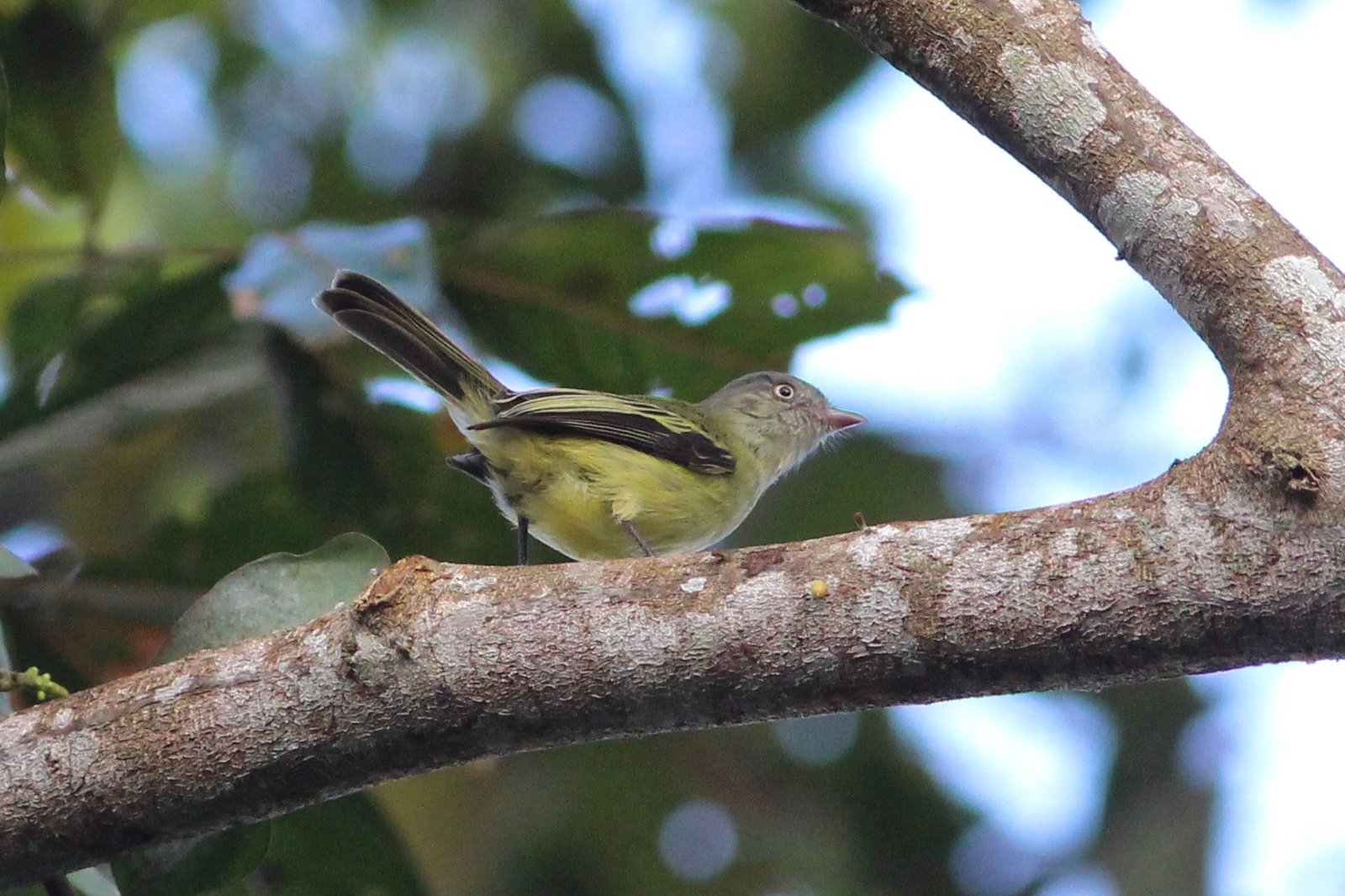
The Red-billed Tyrannulet is a small, olive tyrant flycatcher of the canopy of foothill forest on the east slope of the Andes. It has a grey crown, a pale iris and a red to pinkish lower mandible. Like the other tyrannulets of the genus Zimmerius it eats many mistletoe berries.
Voice
A high, clear, slightly rising whistle and short series of high tsee notes.
Recording: Lelis Navarrete — CC BY-NC-SA 4.0 · xeno-canto
Identification
12 cm, with a short bill and a rather long tail that is often slightly cocked. The crown and sides of the head are grey, the back olive-green. The flight feathers and wing coverts have distinct yellow edges, but there are no true wing bars. The iris is pale, cream to whitish, the lower mandible red to pink. The throat and breast are greyish white, the belly pale yellow. The sexes are alike.
Confusion species
Slender-footed Tyrannulet Zimmerius gracilipes is smaller, with a dark bill, and lives in the Amazonian lowlands. Bolivian Tyrannulet Zimmerius bolivianus is more uniformly olive, without the grey crown and red bill, and lives higher in montane forest. Golden-faced Tyrannulet Zimmerius chrysops and Peruvian Tyrannulet Zimmerius viridiflavus have a yellow face and a dark iris. White-lored Tyrannulet Ornithion inerme has white lores and rows of white spots on the wing.
Habitat
The canopy and edges of humid foothill and lower montane forest, also old secondary forest and clearings with scattered trees, roughly between 500 and 1500 m. It eats small insects and many berries, especially of mistletoes, and joins mixed flocks. The nest has been little described.
Where the bird is most at home, classified by the vegetation units of the Andes and the west coast.


Range and movements
Ecuador: rare and local in the foothills of the east slope. Peru: scattered along the base of the east slope over almost the whole length of the country. Bolivia: in the foothills of La Paz and Cochabamba. Absent from Colombia and the Galápagos. Occurs little or not at all outside the guide area.
- Resident
- dark = core range, pale = thinly spread
How and when to look
Search the treetops along forest edges in the foothills, for example on the lower part of the Manu road in Cuzco or in the Yungas of La Paz, and watch for birds feeding on mistletoe berries; the red lower mandible and pale iris can be seen at close range.
Conservation status
Least Concern. The species tolerates some disturbance and also occurs in secondary forest.
Scientific name
Zimmerius cinereicapilla | (Cabanis, 1873)
Cabanis described the species in 1873 as Phyllomyias cinereicapilla; because it was later moved to another genus, the author and year stand in brackets. The genus Zimmerius was introduced in 1977 by Traylor. The genus name honours the American ornithologist John Todd Zimmer (1889–1957), who did much work on the classification of Neotropical birds. The specific name comes from Latin cinereus, 'ash-grey', and capillus, 'hair of the head': 'grey-capped'. The specimen the first description was based on came from Monterico, Ayacucho, Peru.