All species › Passerines › Tyrant flycatchers and allies › Mishana Tyrannulet
Mishana Tyrannulet | Zimmerius villarejoi
Mishanavliegenpikker | Mosquerito de Villarejo | Poiaeiro-de-mishana
The Mishana Tyrannulet is a small, grey-green tyrant flycatcher described only in 2001, from the white-sand forest at Mishana south-west of Iquitos. It occurs only in Peru and is largely tied to forest on poor, white sandy soil. The scientific name honours the naturalist Avencio Villarejo, who worked in Loreto.
Voice
A short series of clear whistles and a few high calls; the voice differs clearly from that of Slender-footed Tyrannulet and is the best field mark.
Recording: Guilherme Melo Becher — CC BY-NC-SA 4.0 · xeno-canto
Identification
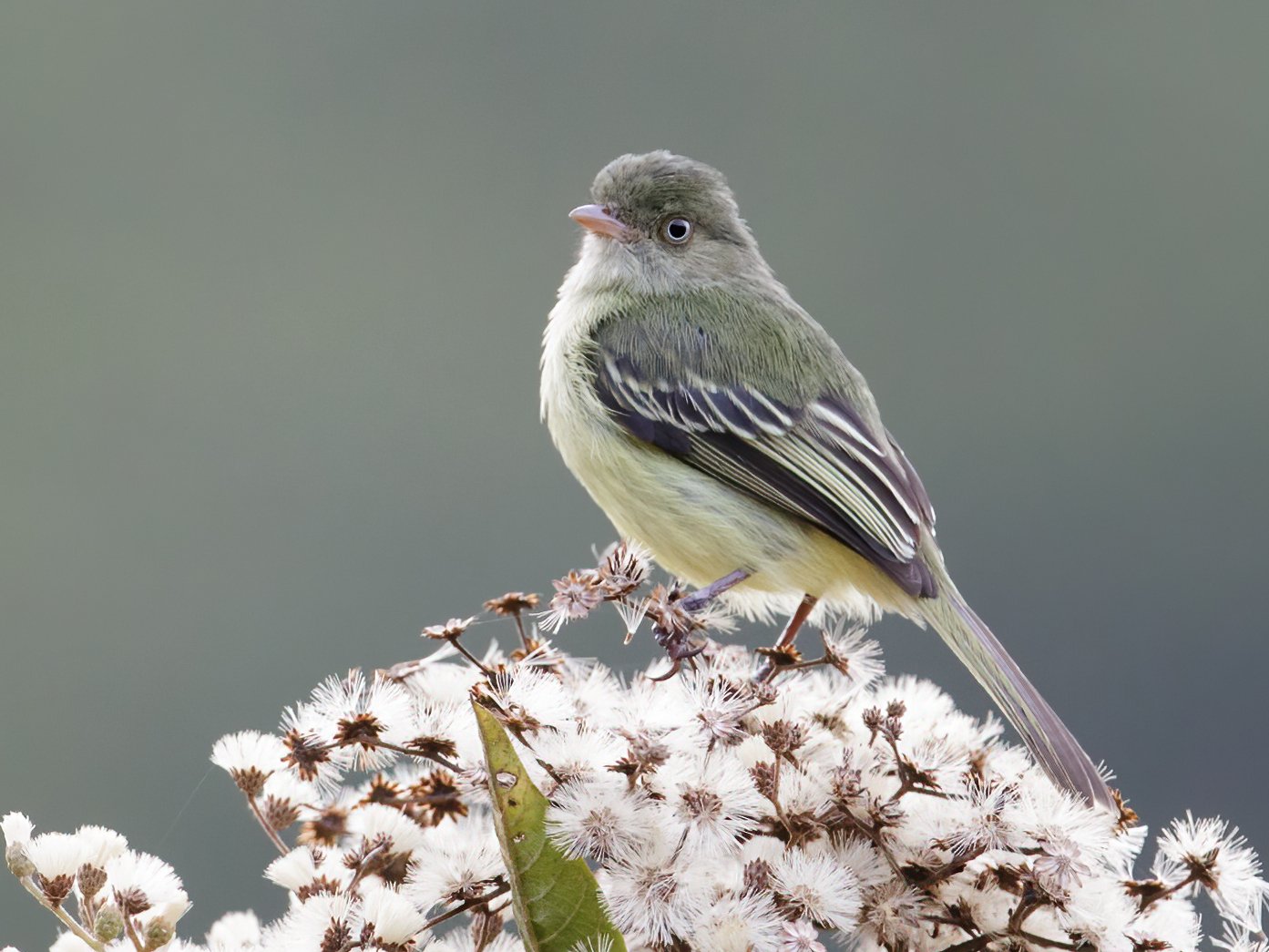
10 cm, with a small, short bill, the lower mandible often pale pink to orangey at the base, and a rather long tail. The crown and upperparts are greyish olive, the head slightly greyer. The wing feathers have narrow yellow edges, without true wing bars. The throat and breast are pale grey, the belly dull yellowish white. The sexes are alike.
Confusion species
Slender-footed Tyrannulet Zimmerius gracilipes, which occurs in the same area, has a greyer crown and an all-dark bill; in the field the difference is mainly heard in the voice. Red-billed Tyrannulet Zimmerius cinereicapilla is larger, with a grey crown and a red lower mandible, and lives in the foothills. White-lored Tyrannulet Ornithion inerme has white lores and rows of white spots on the wing.
Habitat
The canopy of low, open forest on white sand (varillal) and of adjacent taller lowland forest; in San Martín similar forest on poor soil at middle elevations, up to about 1100 m. It eats small insects and berries, including those of mistletoes. The nest has been little described.
Where the bird is most at home, classified by the vegetation units of the Andes and the west coast.


Range and movements
Peru: in Loreto in the white-sand forest around Iquitos, including the Allpahuayo-Mishana reserve, and locally in San Martín, including the Alto Mayo valley. Absent from Colombia, Ecuador, Bolivia and the Galápagos. Does not occur outside the guide area.
- Resident
- dark = core range, pale = thinly spread
How and when to look
The Allpahuayo-Mishana reserve near Iquitos is the best-known site; listen in the early morning along the trails through the white-sand forest for the whistles from the treetops.
Conservation status
Least Concern in the current assessment. The species has a small, fragmented range in a specialised habitat, which around Iquitos is under pressure from logging and the growth of the city.
Scientific name
Zimmerius villarejoi | Álvarez A & Whitney, 2001
Álvarez A & Whitney described the species in 2001 and placed it straight away in the genus where it still stands. The genus Zimmerius was introduced in 1977 by Traylor. The genus name honours the American ornithologist John Todd Zimmer (1889–1957), who did much work on the classification of Neotropical birds. The specific name honours the Augustinian priest Avencio Villarejo (1910–2000), who travelled the Peruvian Amazon in the 1930s and 1940s and documented its nature and indigenous peoples. The specimen the first description was based on came from Allpahuayo-Mishana, Loreto, Peru.