All species › Passerines › Tyrant flycatchers and allies › Venezuelan Tyrannulet
Venezuelan Tyrannulet | Zimmerius improbus
Venezuelavliegenpikker | Moscareta venezolana | Poiaeiro-venezuelano
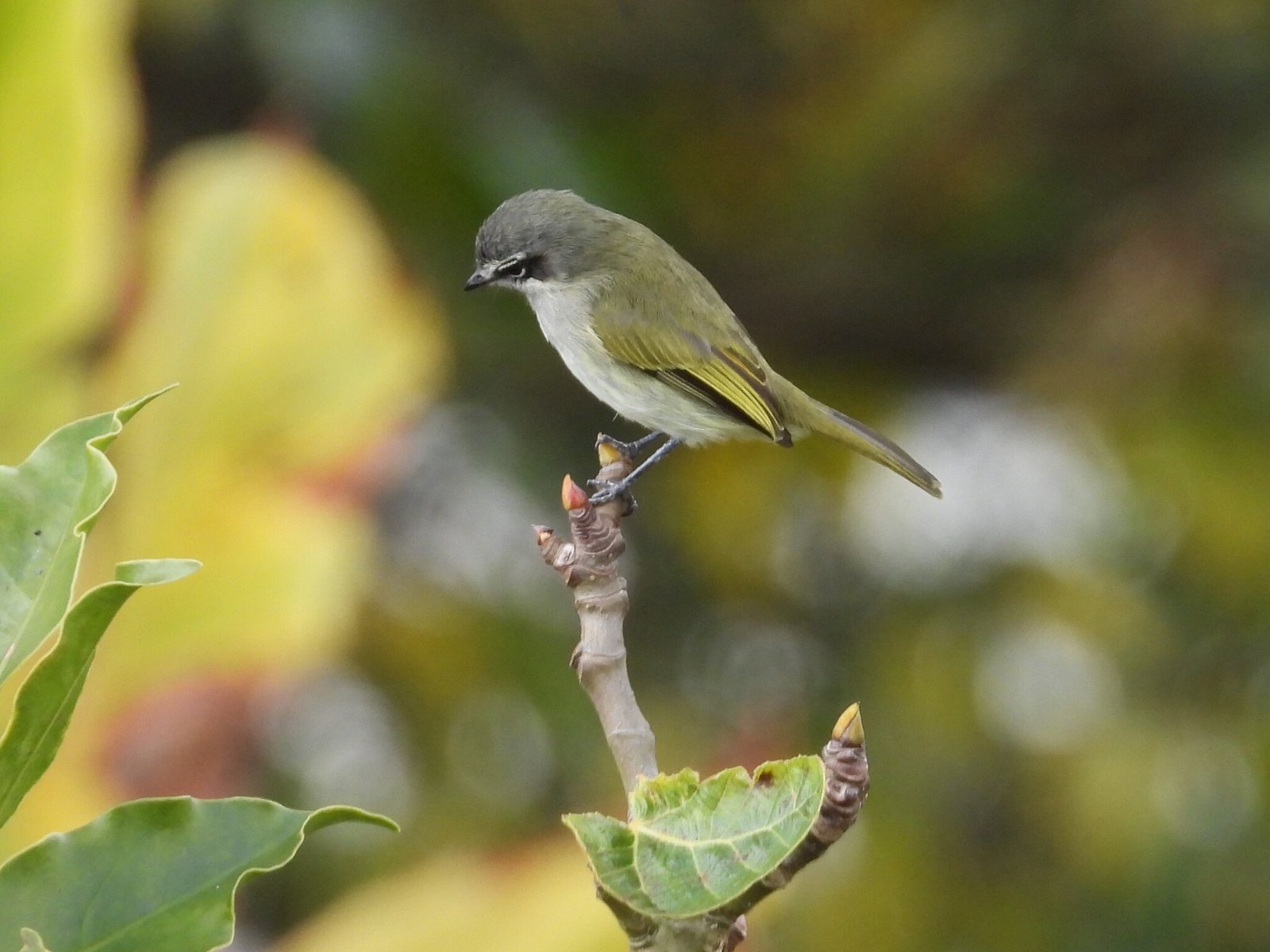
The Venezuelan Tyrannulet is a small, olive tyrant flycatcher of montane forest in northern Colombia and western Venezuela. It closely resembles Golden-faced Tyrannulet, with a yellow face and yellow-edged wing feathers, and was long included in that species.
Voice
A clear, somewhat plaintive whistle and short series of higher notes.
Recording: Joe Klaiber — CC BY-NC-SA 4.0 · xeno-canto
Identification
11 cm, with a short, dark bill and a rather long tail that is often slightly cocked. The lores and eyebrow are yellow, the crown and upperparts olive-green. The wing feathers have distinct yellow edges, without true wing bars. The iris is dark. The underparts are greyish white, with a yellow wash on the belly and flanks. The sexes are alike.
Confusion species
Golden-faced Tyrannulet Zimmerius chrysops is very similar and differs mainly in voice and range; it lives further south in the Colombian Andes. Yellow-crowned Tyrannulet Tyrannulus elatus has a yellow crown stripe, grey cheeks and wing bars, and lives in the lowlands. Southern Beardless Tyrannulet Camptostoma obsoletum has a small crest and pale wing bars.
Habitat
The canopy and edges of humid montane forest, old secondary forest and semi-open country with trees, also shade coffee plantations, roughly between 600 and 2500 m. It eats small insects and many berries, especially of mistletoes, alone, in pairs or in mixed flocks. The nest has been little described.
Where the bird is most at home, classified by the vegetation units of the Andes and the west coast.


Range and movements
Colombia: in the Sierra Nevada de Santa Marta, the Serranía de Perijá and the northern East Andes in Norte de Santander. Absent from Ecuador, Peru, Bolivia and the Galápagos. Outside the guide area in the mountains of western and northern Venezuela.
- Resident
- dark = core range, pale = thinly spread
How and when to look
In the Sierra Nevada de Santa Marta search along the road from Minca to San Lorenzo, in forest edges and gardens with trees; watch for birds feeding on mistletoe berries and listen for the clear whistle.
Conservation status
Least Concern. The species also occurs in secondary forest and shade coffee plantations.
Scientific name
Zimmerius improbus | (Sclater & Salvin, 1871) (GBIF: Zimmerius vilissimus)
Sclater & Salvin described the species in 1871 as Tyranniscus improbus; because it was later moved to another genus, the author and year stand in brackets. The genus Zimmerius was introduced in 1977 by Traylor. The genus name honours the American ornithologist John Todd Zimmer (1889–1957), who did much work on the classification of Neotropical birds. The specific name is Latin improbus, 'inferior', from in-, 'not', and probus, 'good'. The specimen the first description was based on came from Mérida, Venezuela.