All species › Passerines › Antpittas › Plain-backed Antpitta
Plain-backed Antpitta | Grallaria haplonota
Bruinrugmierpitta | Tororoí dorsillano | Tovacuçu-de-dorso-liso
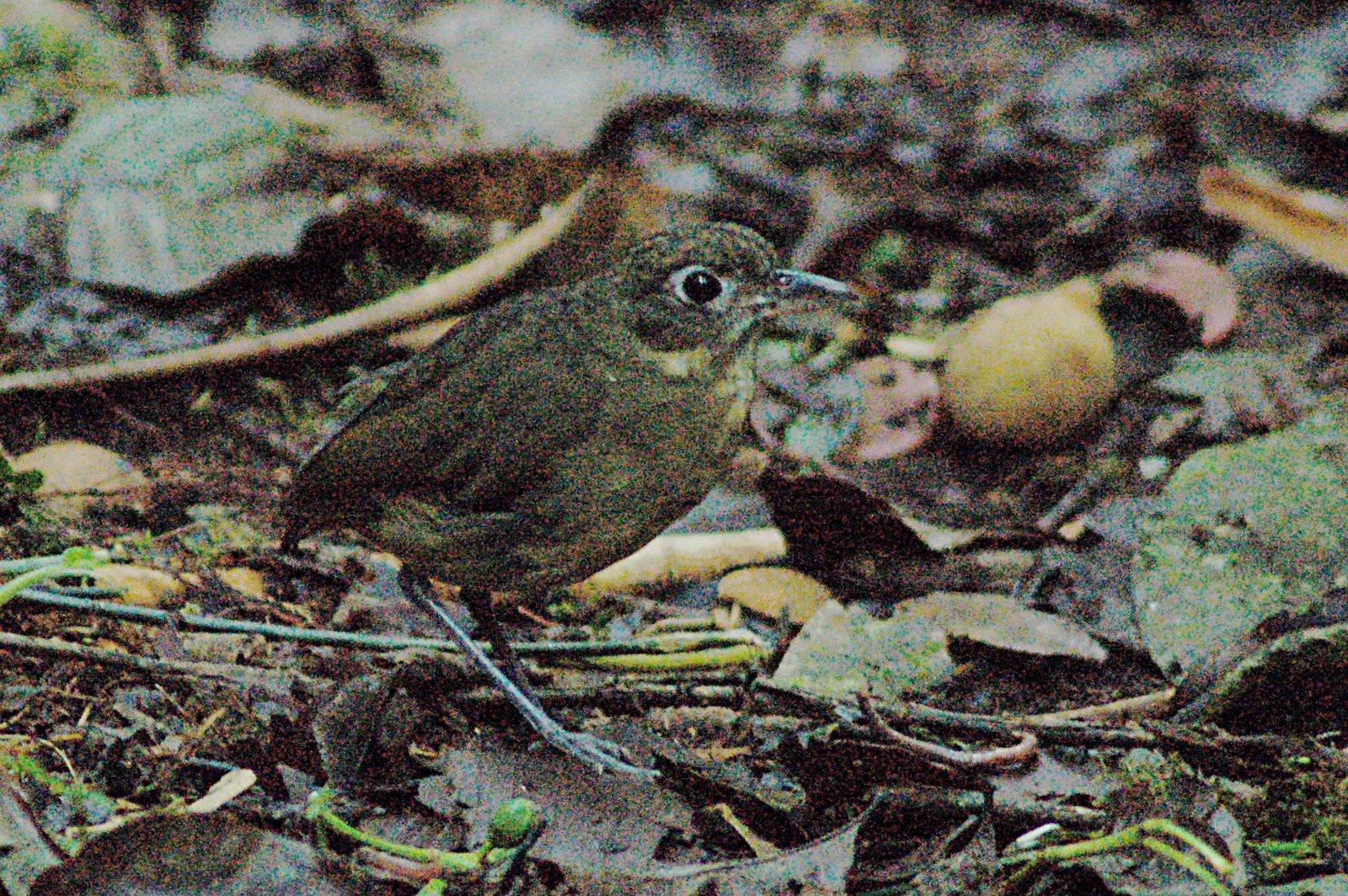
The Plain-backed Antpitta is an antpitta with plain olive-brown upperparts, lacking scales or streaks. It lives on the floor of lower montane forest and is noticed mainly by its long, swelling whistled series. Relatively little is known about its life history.
Voice
A long series of hollow, whistled notes that gradually rises in pitch and volume and drops slightly at the end, lasting a few seconds.
Recording: Iván Lau — CC BY-NC-SA 4.0 · xeno-canto
Identification
16–17 cm, round and short-tailed, on long grey legs. The upperparts are plain olive-brown, the crown sometimes slightly greyer. The throat is white to pale yellow, bordered by a narrow dark malar stripe; the lores and eye-ring are pale. The breast and flanks are ochre-brown, the belly paler yellow to white. There are no scales or streaks. The sexes are alike.
Confusion species
Scaled Antpitta Grallaria guatimalensis has black-scaled upperparts, darker rufous-brown underparts and usually lives higher. Moustached Antpitta Grallaria alleni has a slate-grey crown and a bright white moustachial stripe. Thrush-like Antpitta Myrmothera campanisona of the lowlands is smaller, with a faintly streaked, greyish-white breast.
Habitat
Humid foothill and lower montane forest, often in steep ravines with dense undergrowth, at roughly 700 to 2000 m. It forages on the forest floor for insects and other invertebrates.
Where the bird is most at home, classified by the vegetation units of the Andes and the west coast.


Range and movements
In Colombia very locally, on the Andean slopes in the south. In Ecuador on the western slope in the north and centre and on the eastern slope. In Peru locally on the eastern slope in the north. Absent from Bolivia and the Galápagos. Outside the guide area in the mountains of northern Venezuela.
- Resident
- dark = core range, pale = thinly spread
How and when to look
Listen at dawn in forested ravines on the lower slopes for the long, rising whistled series. The bird often sings from a low branch or a fallen log.
Conservation status
Least Concern, but locally sensitive to clearance of lower montane forest.
Scientific name
Grallaria haplonota | Sclater, 1877
Sclater described the species in 1877 and placed it straight away in the genus where it still stands. The genus Grallaria was introduced in 1816 by Vieillot. The genus name comes from New Latin grallarius, 'stilt-walker', referring to the long legs. The species name comes from Greek haplous, 'simple', and nōton, 'back'. The specimen the first description was based on came from Vicinity of Caracas, Venezuela.