All species › Passerines › Antbirds › Plain-winged Antshrike
Plain-winged Antshrike | Thamnophilus schistaceus
Leikleurige mierklauwier | Batará alillano | Choca-de-olho-vermelho
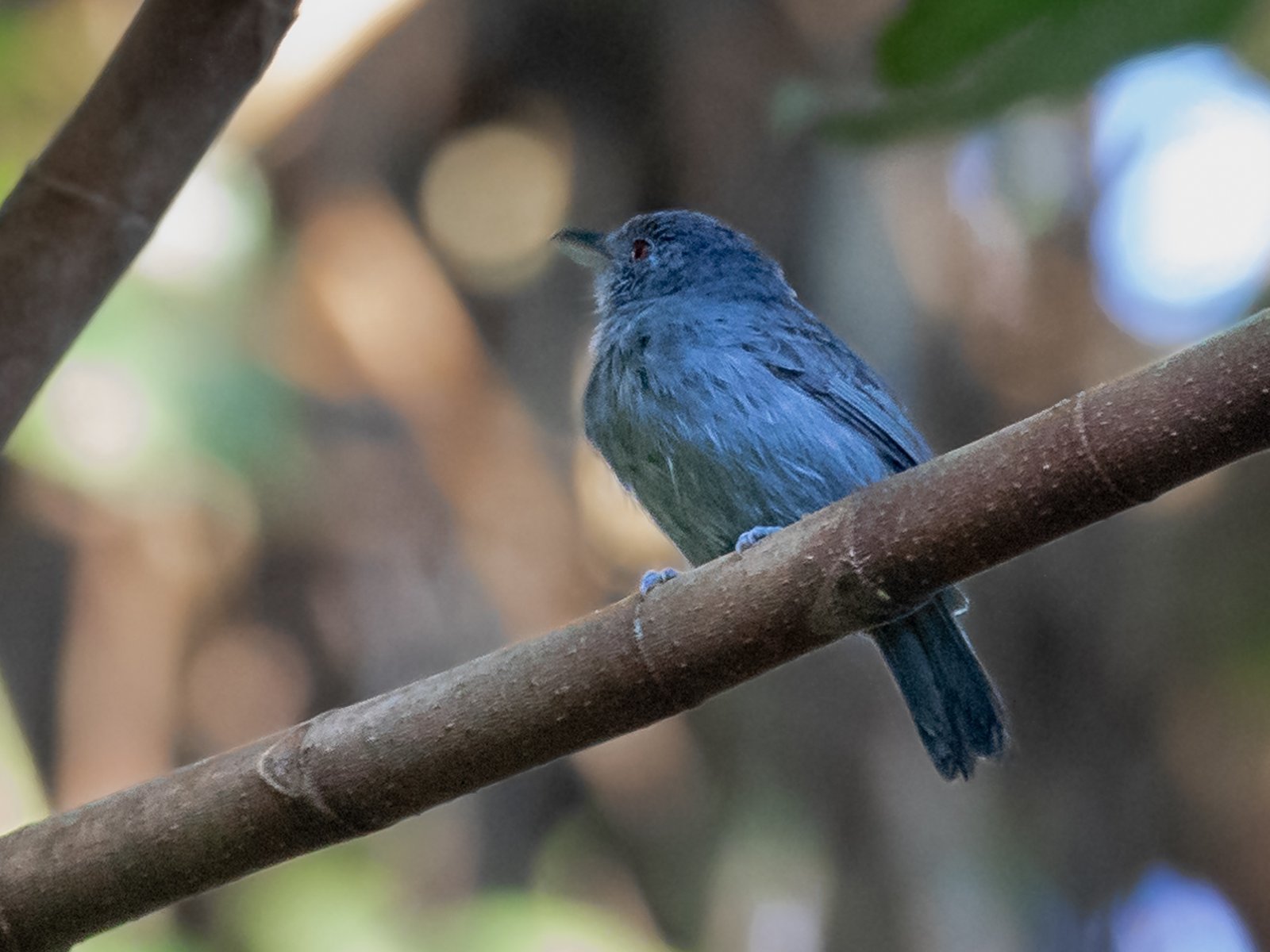
The Plain-winged Antshrike is one of the most widespread Thamnophilus species of the Amazonian lowlands in the guide area. It lives in the mid-storey of terra firme forest and often joins mixed flocks. Both sexes have a red eye and wings without white spots.
Voice
A series of nasal notes that accelerates into a short rattle and ends in an emphatic final note, roughly kuh-kuh-kuh-kukukuku-kwánk. Also single, nasal calls.
Recording: Juan Freile — CC BY-NC-SA 4.0 · xeno-canto
Identification
14 cm, with a heavy, hooked bill and a red eye. The male is plain slate-grey, in most of the guide area with a black crown; the wings lack white tips. The female has a rufous crown, an olive-brown back and wings, and olive-grey to buffy underparts.
Confusion species
Mouse-colored Antshrike Thamnophilus murinus is browner grey, with small white (male) or buff (female) tips to the wing coverts and a brownish-grey eye; it lives mainly in forest on white sand. Northern Slaty Antshrike Thamnophilus punctatus and Natterer's Slaty Antshrike Thamnophilus stictocephalus have obvious white wing spots. Dusky-throated Antshrike Thamnomanes ardesiacus and Cinereous Antshrike Thamnomanes caesius perch upright and have a dark eye.
Habitat
Mid-storey and lower canopy of humid terra firme lowland forest, less in várzea and at forest edges, up to about 1000 m in the foothills. It forages in pairs, often with mixed flocks, deliberately searching leaves and twigs for arthropods. The nest is an open cup hung in a branch fork.
Where the bird is most at home, classified by the vegetation units of the Andes and the west coast.


Range and movements
Colombia: in the Amazonian lowlands of the south-east. Ecuador: throughout the eastern lowlands. Peru: throughout the Amazonian lowlands. Bolivia: in the north and centre (Pando, Beni, La Paz, Cochabamba and Santa Cruz). Absent from the Galápagos. Outside the guide area in western and southern Amazonian Brazil.
- Resident
- dark = core range, pale = thinly spread
How and when to look
In terra firme forest listen for the nasal song in mixed flocks; at Yasuní (Ecuador) and at Tambopata and Manu (Peru) it is in many mid-storey flocks.
Conservation status
Least Concern. Common in undisturbed lowland forest; deforestation is the main threat.
Scientific name
Thamnophilus schistaceus | d'Orbigny, ACVMD, 1838
D'Orbigny, ACVMD described the species in 1838 and placed it straight away in the genus where it still stands. The genus Thamnophilus was introduced in 1816 by Vieillot. The genus name comes from Greek thamnos, 'bush', and philos, 'loving': bush-lover. The species name comes from New Latin schistaceus, 'slate-coloured'. The specimen the first description was based on came from Yuracaré country near Cochabamba, Bolivia.