All species › Passerines › Antbirds › Black-crowned Antshrike
Black-crowned Antshrike | Thamnophilus atrinucha
Westelijke gevlekte mierklauwier | Batará pizarroso occidental | Choca-de-coroa-preta
The Black-crowned Antshrike is the grey Thamnophilus antshrike of the humid forests west of the Andes. It nearly always joins mixed flocks in the understorey and mid-storey and sometimes attends army ants. In the guide area it occurs from northern and western Colombia to western Ecuador and the far north-west of Peru.
Voice
A series of short, nasal notes that accelerates and ends in a single higher note, roughly uh-uh-uh-uh-uhuhuh-ánk. Both sexes sing, mainly in the morning. Also short, cawing calls and a barking rattle.
Recording: Juan Freile — CC BY-NC-SA 4.0 · xeno-canto
Identification
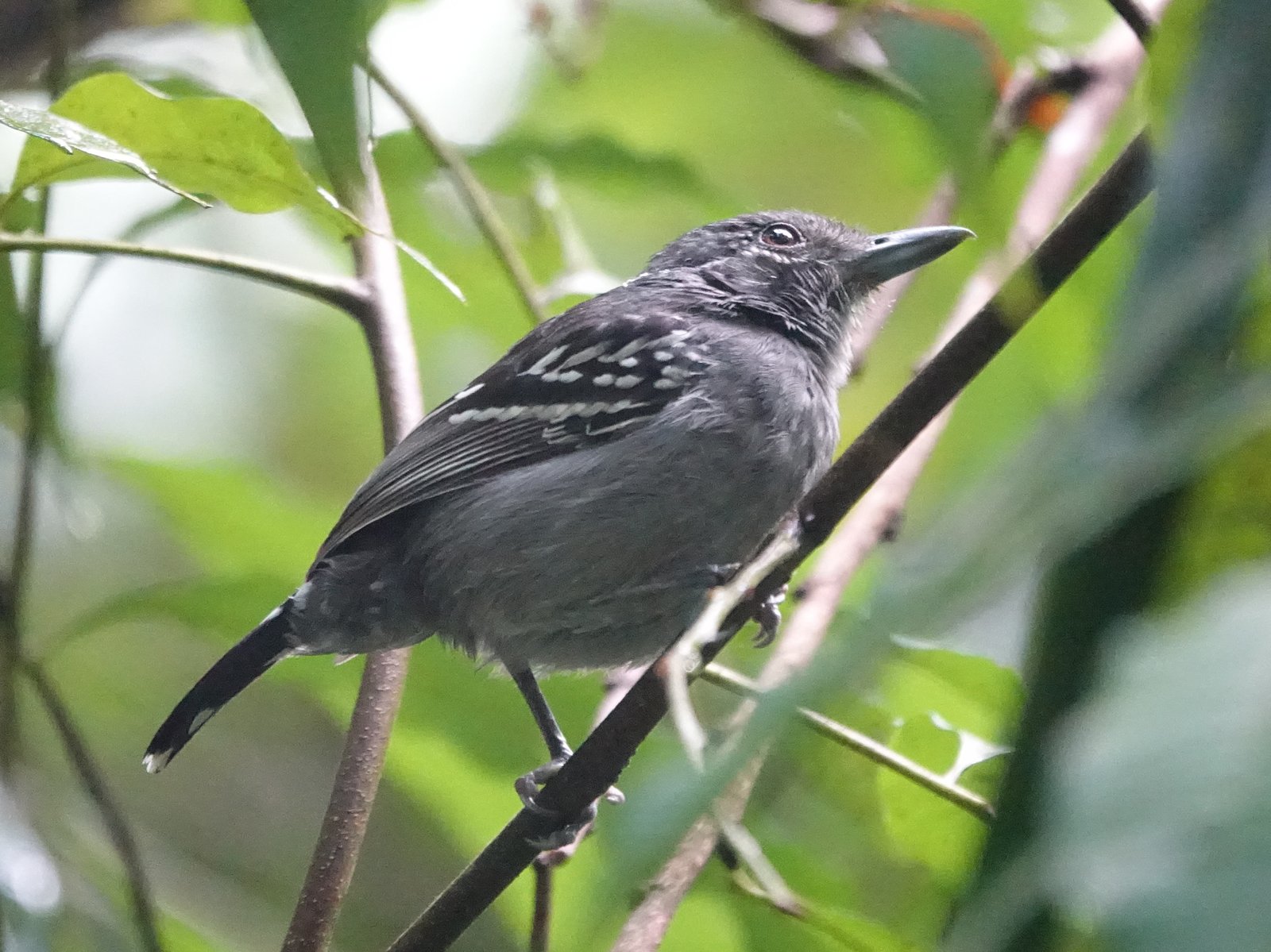
14–15 cm, with a heavy, hooked bill and a reddish-brown to chocolate-brown eye. The male is slate-grey, with a black crown and nape, black wings with white covert tips forming wing bars, and a black tail with white tips; a concealed white patch lies between the shoulders. The female is brown to buffy brown above, with dark, brown-edged wings, and buffy brown to greyish brown below. On Gorgona (subspecies gorgonae) the females are darker and more rufous.
Confusion species
Northern Slaty Antshrike Thamnophilus punctatus is very similar but does not occur on the Pacific side of the Andes. Plain-winged Antshrike Thamnophilus schistaceus and Mouse-colored Antshrike Thamnophilus murinus live east of the Andes and have no or only small white wing spots. Plain Antvireo Dysithamnus mentalis is smaller, with a shorter tail and a dark ear patch. Collared Antshrike Thamnophilus bernardi has a crest and a pale collar and lives in dry forest.
Habitat
Understorey and mid-storey of humid evergreen and semi-deciduous forest, both primary and secondary, also at forest edges. In Colombia up to about 1500 m, in Ecuador mostly below 1100 m, in Peru between 400 and 800 m. It forages alone or in pairs, almost always with mixed flocks; it gleans insects and other arthropods from leaves and branches, catches them in short sallies and sometimes takes small lizards. The nest is a cup of fungal fibres and moss hung in a branch fork, usually within 2 m of the ground; both parents incubate.
Where the bird is most at home, classified by the vegetation units of the Andes and the west coast.


Range and movements
Colombia: in the north, including the Caribbean lowlands and the Magdalena valley, and along the whole Pacific slope, also on Gorgona Island. Ecuador: in the western lowlands and on the lower slopes. Peru: only in the far north-west, in Tumbes. Absent from Bolivia and the Galápagos. Outside the guide area in north-western Venezuela and in Central America north to Belize and Guatemala.
- Resident
- dark = core range, pale = thinly spread
How and when to look
In humid lowland forest of the Chocó and western Ecuador it is often one of the first species of an understorey mixed flock. Listen for the nasal song, which can be heard at any time of day.
Conservation status
Least Concern. Common in a large range; the species tolerates secondary forest.
Scientific name
Thamnophilus atrinucha | Salvin & Godman, 1892
Salvin & Godman described the species in 1892 and placed it straight away in the genus where it still stands. The genus Thamnophilus was introduced in 1816 by Vieillot. The genus name comes from Greek thamnos, 'bush', and philos, 'loving': bush-lover. The species name comes from Latin ater, 'black', and Medieval Latin nucha, 'nape'. The specimen the first description was based on came from Panama.