All species › Passerines › Antbirds › Collared Antshrike
Collared Antshrike | Thamnophilus bernardi
Withalsmierklauwier | Batará collarejo | Choca-de-coleira
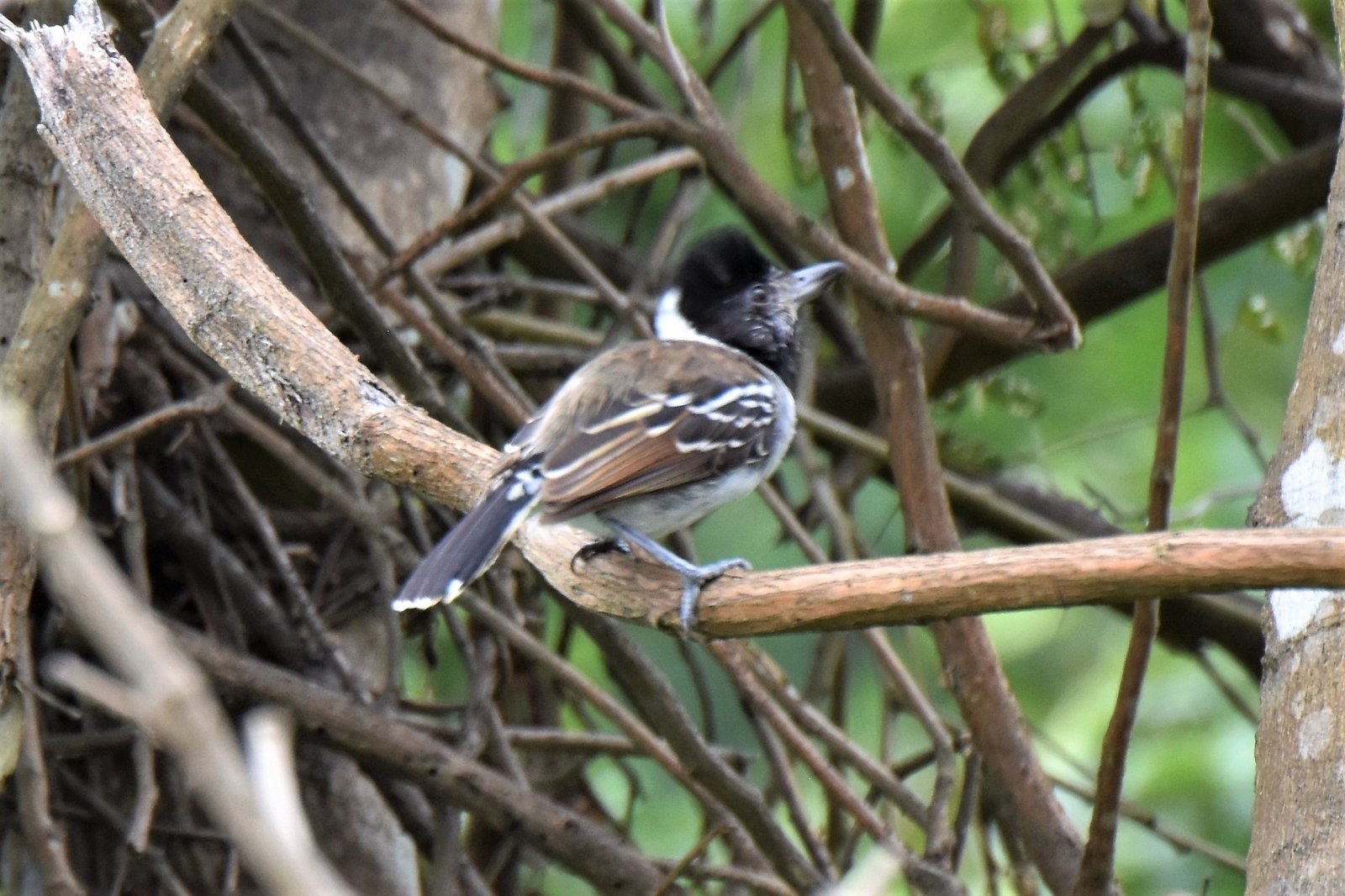
The Collared Antshrike is a crested antshrike of the dry north-west of the guide area, from western Ecuador to north-western Peru and the Marañón valley. Both sexes have a pale collar. The species was formerly placed in the genus Sakesphorus.
Voice
A slow, accelerating series of deep, barking notes; in the Marañón valley much faster, with distinct introductory and closing notes. Also a two-part call with a rolling second part and complaining, mewing calls.
Recording: Leonardo Ordóñez-Delgado — CC BY-NC-SA 4.0 · xeno-canto
Identification
17 cm, with a distinct crest, a heavy, hooked bill and a chestnut eye. The male has a black crown and crest with white spots on the forehead, a black face, a white collar joining the white underparts, and a black, white-scaled throat extending as a point onto the breast; the upperparts are dull rufous-brown and the tail is black with white tips. The female has a rufous crest, a grey face with fine white streaks, a buff collar, a dark reddish-brown back and buff underparts. In the Marañón valley (subspecies shumbae) the male is greyer-brown above with less black on the throat, and the female is paler.
Confusion species
Chapman's Antshrike Thamnophilus zarumae is smaller, has barred underparts and no collar, and lives mainly higher on the slopes. Black-crowned Antshrike Thamnophilus atrinucha lacks a crest and collar; the male is slate-grey with white wing spots, and the species lives in humid forest. The female of Black-crested Antshrike Sakesphorus canadensis resembles that of Collared Antshrike, but that species does not occur in the dry north-west.
Habitat
Deciduous dry forest, thorn scrub and shrubby secondary forest, mostly up to 1500 m, locally higher (in Ecuador to over 1800 m, in the Marañón valley to almost 2000 m). It forages in pairs, sometimes with mixed flocks, mostly on or near the ground, gleaning insects from twigs, trunks and leaf litter. The nest is a deep, loosely woven cup of dead grass and stems, hung in a branch fork up to 2 m above the ground; breeding takes place in the rainy season (roughly February–May). Nests are sometimes parasitised by Shiny Cowbird.
Where the bird is most at home, classified by the vegetation units of the Andes and the west coast.


Range and movements
Ecuador: in the west, from Manabí and Guayas south to El Oro and Loja. Peru: in the dry north-west, from Tumbes south to northern Ancash, and (subspecies shumbae) in the dry valleys of the Marañón and Chinchipe in Cajamarca and Amazonas. Absent from Colombia, Bolivia and the Galápagos. Does not occur outside the guide area.
- Resident
- dark = core range, pale = thinly spread
How and when to look
Search the dry forest of south-western Ecuador and of Tumbes and Piura; in the Marañón valley, shrubby dry forest around Jaén and Balsas. Birds sing a lot in the wet season.
Conservation status
Least Concern; fairly common to common. The Marañón population has a small range and is sometimes treated as a separate species, which is then considered Vulnerable; degradation of dry forest is the main threat there.
Scientific name
Thamnophilus bernardi | Lesson, 1844
Lesson described the species in 1844 and placed it straight away in the genus where it still stands. The genus Thamnophilus was introduced in 1816 by Vieillot. The genus name comes from Greek thamnos, 'bush', and philos, 'loving': bush-lover. The species name honours Captain Bernard, a French mariner and collector from Bordeaux. The specimen the first description was based on came from Guayaquil, Ecuador.