All species › Passerines › Antbirds › Chestnut-backed Antshrike
Chestnut-backed Antshrike | Thamnophilus palliatus
Gestreepte mierklauwier | Batará dorsicastaño | Choca-listrada
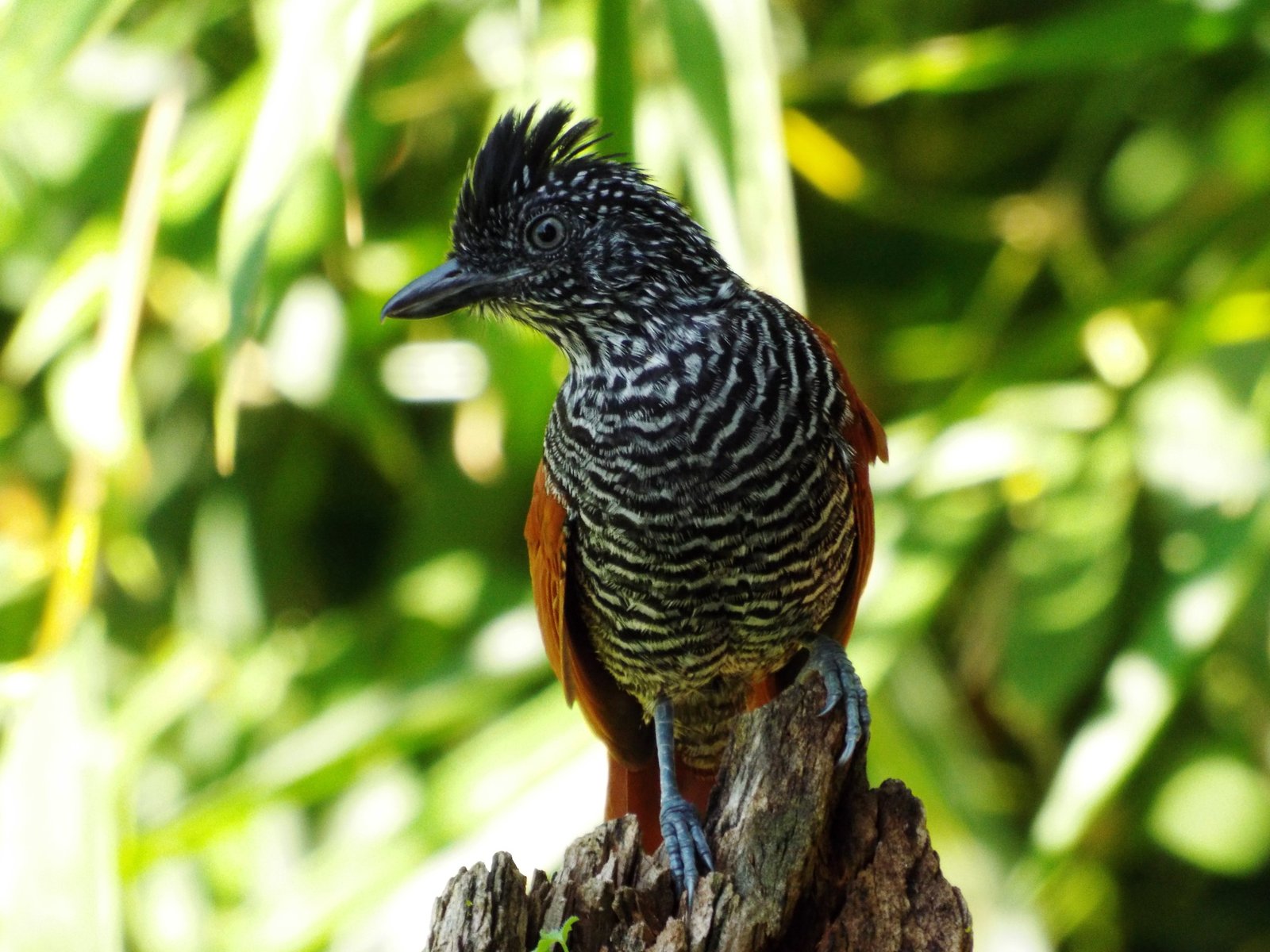
The Chestnut-backed Antshrike is a black-and-white barred antshrike with a plain chestnut back, wings and tail. In the guide area it lives in dense growth along forest edges, in bamboo and in riverside scrub in central and southern Peru and in Bolivia. Farther north it is replaced by Lined Antshrike.
Voice
An accelerating series of nasal notes that falls slightly towards the end and finishes with an emphatic final note, similar to the song of other Thamnophilus species. Also nasal, growling calls.
Recording: Tulio Dornas — CC BY-NC-SA 4.0 · xeno-canto
Identification
16 cm, with a small crest, a heavy, hooked bill and a yellow eye. The male has a black crown, a black-and-white streaked head and black-and-white barred underparts; the back, wings and tail are chestnut. The female resembles the male but has a rufous crown; her underparts are also barred black and white.
Confusion species
Lined Antshrike Thamnophilus tenuepunctatus lives farther north; the male is barred black and white on the back too. Barred Antshrike Thamnophilus doliatus has barred upperparts in the male; the female is cinnamon with plain underparts. Fasciated Antshrike Cymbilaimus lineatus and Bamboo Antshrike Cymbilaimus sanctaemariae are barred on the back too and have a red eye.
Habitat
Dense undergrowth at forest edges, secondary forest, bamboo, riverside scrub and overgrown clearings, from the lowlands up to about 1700 m in the foothills and lower Yungas. It forages in pairs in dense vegetation, mostly low, gleaning insects and other arthropods from leaves and branches. The nest is an open cup hung in a branch fork.
Where the bird is most at home, classified by the vegetation units of the Andes and the west coast.


Range and movements
Peru: on the eastern slope and in the adjacent lowlands of the central and southern parts, roughly from Huánuco south to Madre de Dios, Cusco and Puno. Bolivia: in the north and centre (Pando, La Paz, Beni, Cochabamba and Santa Cruz). Absent from Colombia, Ecuador and the Galápagos. Outside the guide area in southern Amazonian Brazil and in eastern Brazil.
- Resident
- dark = core range, pale = thinly spread
How and when to look
Search forest edges and bamboo in the foothills of Cusco and Madre de Dios, for example along the road to Manu, and in thickets around lodges. Pairs often answer each other's song.
Conservation status
Least Concern. Common; the species tolerates secondary growth well.
Scientific name
Thamnophilus palliatus | (Lichtenstein, 1823)
Lichtenstein described the species in 1823 as Lanius palliatus; because it was later moved to another genus, the author and year stand in brackets. The genus Thamnophilus was introduced in 1816 by Vieillot. The genus name comes from Greek thamnos, 'bush', and philos, 'loving': bush-lover. The species name comes from Latin palliatus, 'cloaked', for the contrasting mantle. The specimen the first description was based on came from Bahia, Brazil.