All species › Passerines › Antbirds › Lined Antshrike
Lined Antshrike | Thamnophilus tenuepunctatus
Fijnstreepmierklauwier | Batará listado | Choca-de-listras-finas
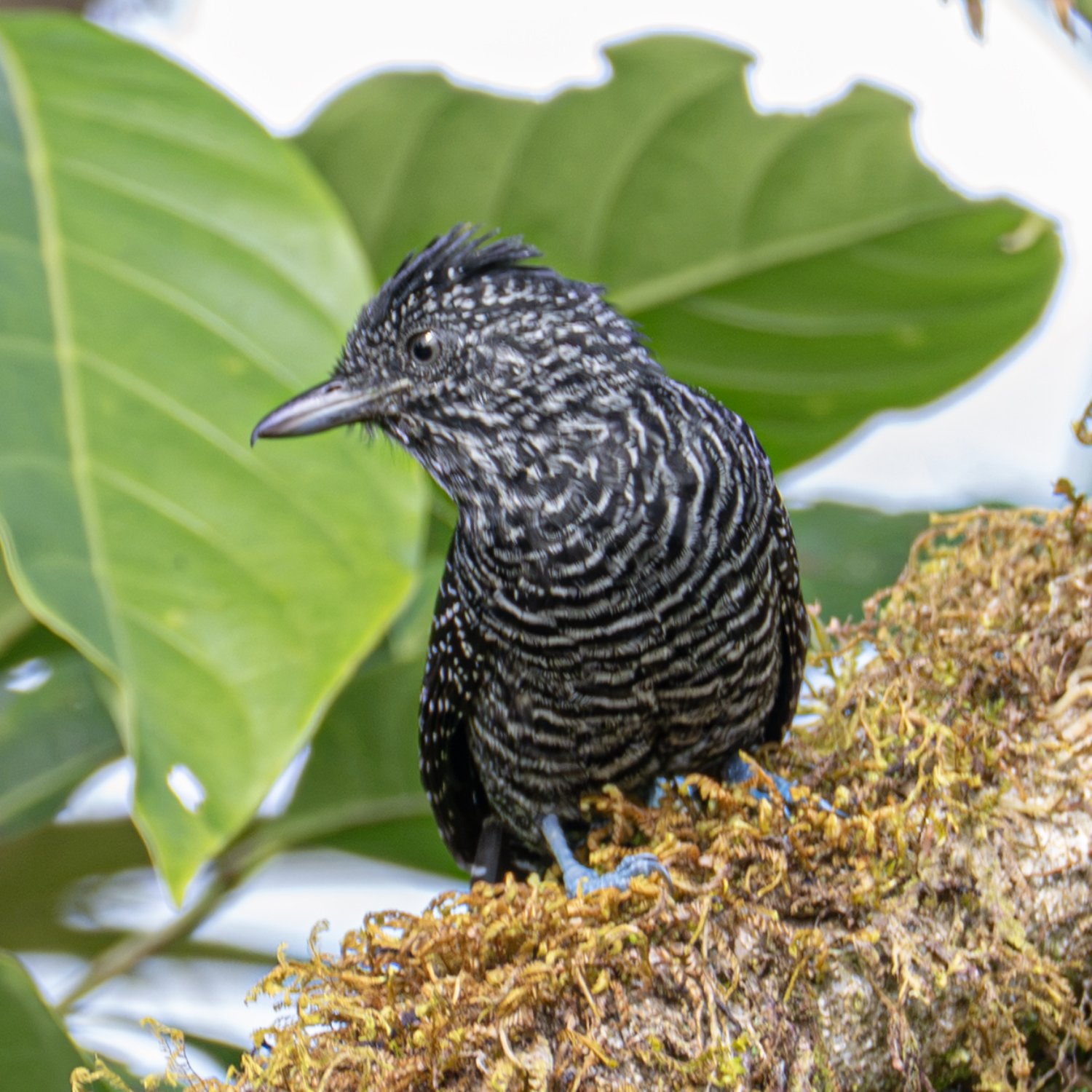
The Lined Antshrike is a black-and-white barred antshrike of the eastern slope of the Andes in Colombia, Ecuador and northern Peru. The male is finely barred black and white all over; the female is rufous above and barred below. It lives in dense growth along forest edges and in thickets in clearings.
Voice
An accelerating series of short, nasal notes that first rises and then falls, ending in a harsh, drawn-out, downslurred note, roughly ah-ah-ah-ahahahaha-kaaah. Also short nasal calls.
Recording: Juan Freile — CC BY-NC-SA 4.0 · xeno-canto
Identification
15–16 cm, with a crest, a heavy, hook-tipped bill and a pale, yellowish to brownish eye. The male is barred almost throughout with narrow white and broader black bars; the crown and crest are black and the throat is streaked black and white. The female has a rufous crown, crest, back, wings and tail, a narrow black-and-white nuchal band, a black-and-white streaked head and throat, and black-and-white barred underparts with a rufous tinge on the rear flanks. Young males are tinged buffy brown.
Confusion species
Barred Antshrike Thamnophilus doliatus has broader white bars in the male, and the female has plain cinnamon underparts; it lives mainly in drier, open lowland country. Chestnut-backed Antshrike Thamnophilus palliatus has a plain chestnut back and wings in both sexes and replaces it farther south in Peru. Fasciated Antshrike Cymbilaimus lineatus has a red eye and a heavier bill and lives higher in lowland forest.
Habitat
Edges of humid evergreen and secondary forest, especially with dense shrubbery, and thickets in clearings and along roads. In Colombia roughly between 400 and 1500 m, in Ecuador mostly between 400 and 1400 m, in Peru between 700 and 1700 m, locally lower. It forages alone or in pairs, rarely with mixed flocks, gleaning insects and other arthropods from leaves and branches up to about 10 m. The nest is an open cup of rootlets and fungal fibres, with moss on the outside, hung in a fork of a shrub 1–2 m up.
Where the bird is most at home, classified by the vegetation units of the Andes and the west coast.


Range and movements
Colombia: on the eastern slope of the Eastern Andes in Cundinamarca and Meta, with a separate population in Norte de Santander, and in the south from Putumayo. Ecuador: along the whole eastern slope of the Andes, south to Zamora-Chinchipe. Peru: in the north, in Amazonas, Cajamarca and San Martín. Absent from Bolivia and the Galápagos. The range lies almost entirely within the guide area.
- Resident
- dark = core range, pale = thinly spread
How and when to look
Search forest edges, overgrown clearings and roadsides in the foothills of the eastern slope, for example along roads descending from the Andes to the lowlands. The loud, accelerating song usually comes from dense cover.
Conservation status
Least Concern. Fairly common; the species tolerates secondary growth, and deforestation is a potential local threat.
Scientific name
Thamnophilus tenuepunctatus | de Lafresnaye, 1853
De Lafresnaye described the species in 1853 and placed it straight away in the genus where it still stands. The genus Thamnophilus was introduced in 1816 by Vieillot. The genus name comes from Greek thamnos, 'bush', and philos, 'loving': bush-lover. The species name comes from Latin tenuis, 'fine, thin', and punctatus, 'spotted'. The specimen the first description was based on came from Anolaima, Colombia.