All species › Swifts › Hummingbirds › Planalto Hermit
Planalto Hermit | Phaethornis pretrei
Brilheremietkolibrie | Ermitaño del Planalto | Rabo-branco-acanelado
The Planalto Hermit is a large hermit of the open, dry interior of Brazil, which in the guide area occurs only in eastern Bolivia. It lives less in closed forest than most hermits and also visits gardens and parks. The nest is often placed in a sheltered spot, such as under an overhanging rock or on a building.
Voice
The song is a high, repeated, squeaky phrase. The call is a sharp tseep, often in flight.
Recording: JAYRSON ARAUJO DE OLIVEIRA — CC BY-NC-SA 4.0 · xeno-canto
Identification
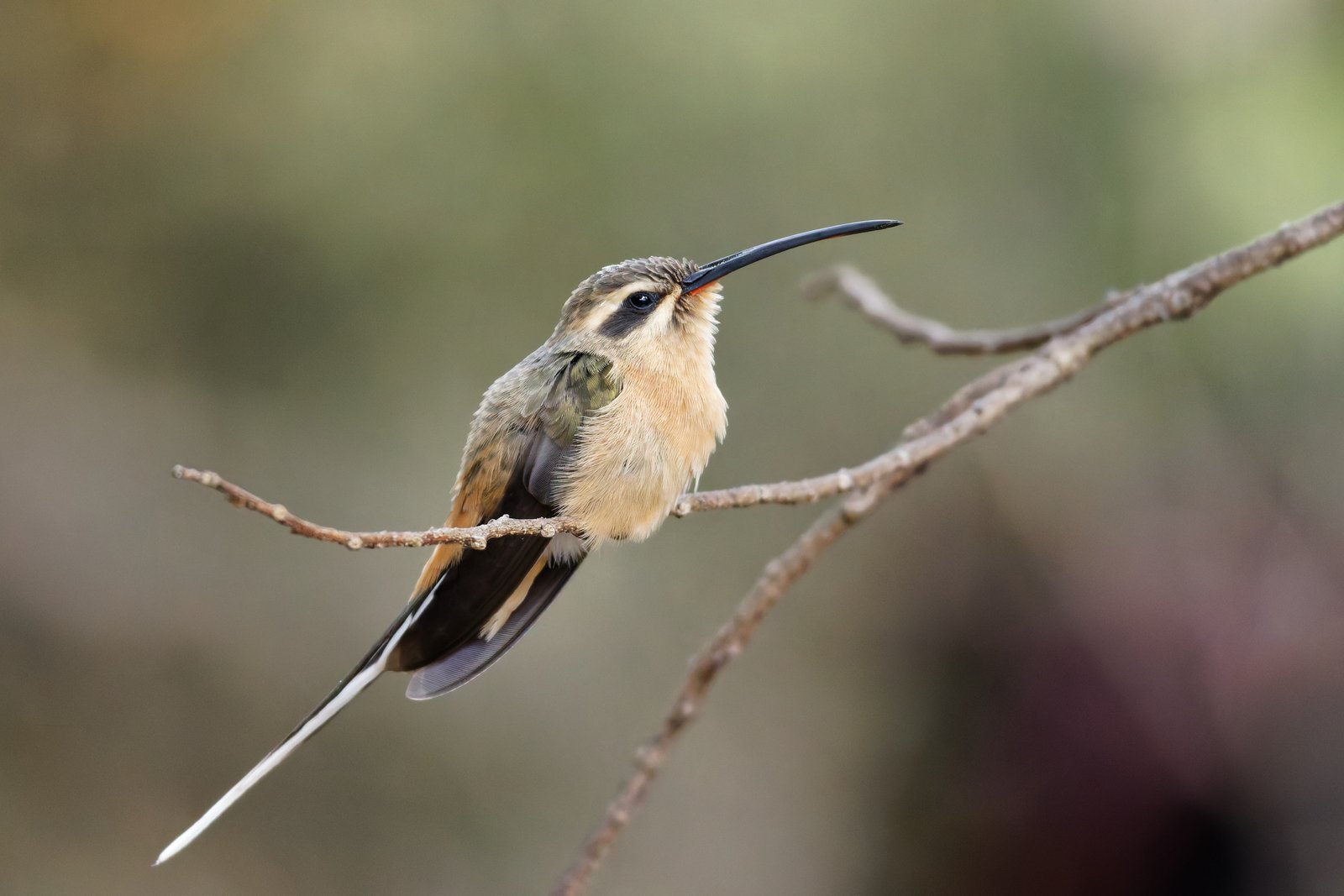
15–16 cm, with a long, decurved bill and long, white-tipped central tail feathers. The upperparts are bronzy green, the rump bright rufous. The head has a dark mask with a pale supercilium and malar stripe. The underparts are cinnamon to buffy brown. The outer tail feathers are dark with white tips. The sexes are nearly alike.
Confusion species
Buff-bellied Hermit Phaethornis subochraceus is smaller, with a less rufous rump and paler, ochre-buff underparts, and lives mainly in forest. Cinnamon-throated Hermit Phaethornis nattereri is much smaller, with a shorter tail and a cinnamon throat.
Habitat
Dry and semi-humid forest, gallery forest, forest edges, cerrado, rocky slopes and gardens, in Bolivia mainly in the lowlands and hills. It visits flowers of shrubs and herbs, including garden plants, and catches small arthropods. The cone-shaped nest hangs in a sheltered spot, under an overhanging rock, in a cave or under a roof or bridge.
Where the bird is most at home, classified by the vegetation units of the Andes and the west coast.


Range and movements
In Bolivia in the east, mainly in Santa Cruz. Absent from Colombia, Ecuador, Peru and the Galápagos. Outside the guide area in eastern and central Brazil and in Paraguay.
- Resident
- dark = core range, pale = thinly spread
How and when to look
Check flowering shrubs in gardens, along forest edges and on rocky slopes in eastern Santa Cruz, such as in the Chiquitano region.
Conservation status
Least Concern. It tolerates a semi-open, human-shaped landscape and sometimes nests on buildings.
Scientific name
Phaethornis pretrei | (Lesson & Delattre, 1839)
Lesson & Delattre described the species in 1839 as Trochilus Pretrei; because it was later moved to another genus, the author and year stand in brackets. The genus Phaethornis was introduced in 1827 by Swainson. The genus name combines Ancient Greek phaethōn, 'sun', with ornis, 'bird'. The species name honours Jean-Gabriel Prêtre (1768–1849), a Swiss-French natural history painter who worked for, among others, the natural history museum in Paris. The specimen the first description was based on came from Minas Gerais, Brazil.