All species › Swifts › Hummingbirds › Green-fronted Lancebill
Green-fronted Lancebill | Doryfera ludovicae
Groenvoorhoofdlancetkolibrie | Picolanza frentiverde | Bico-de-lança-de-testa-verde
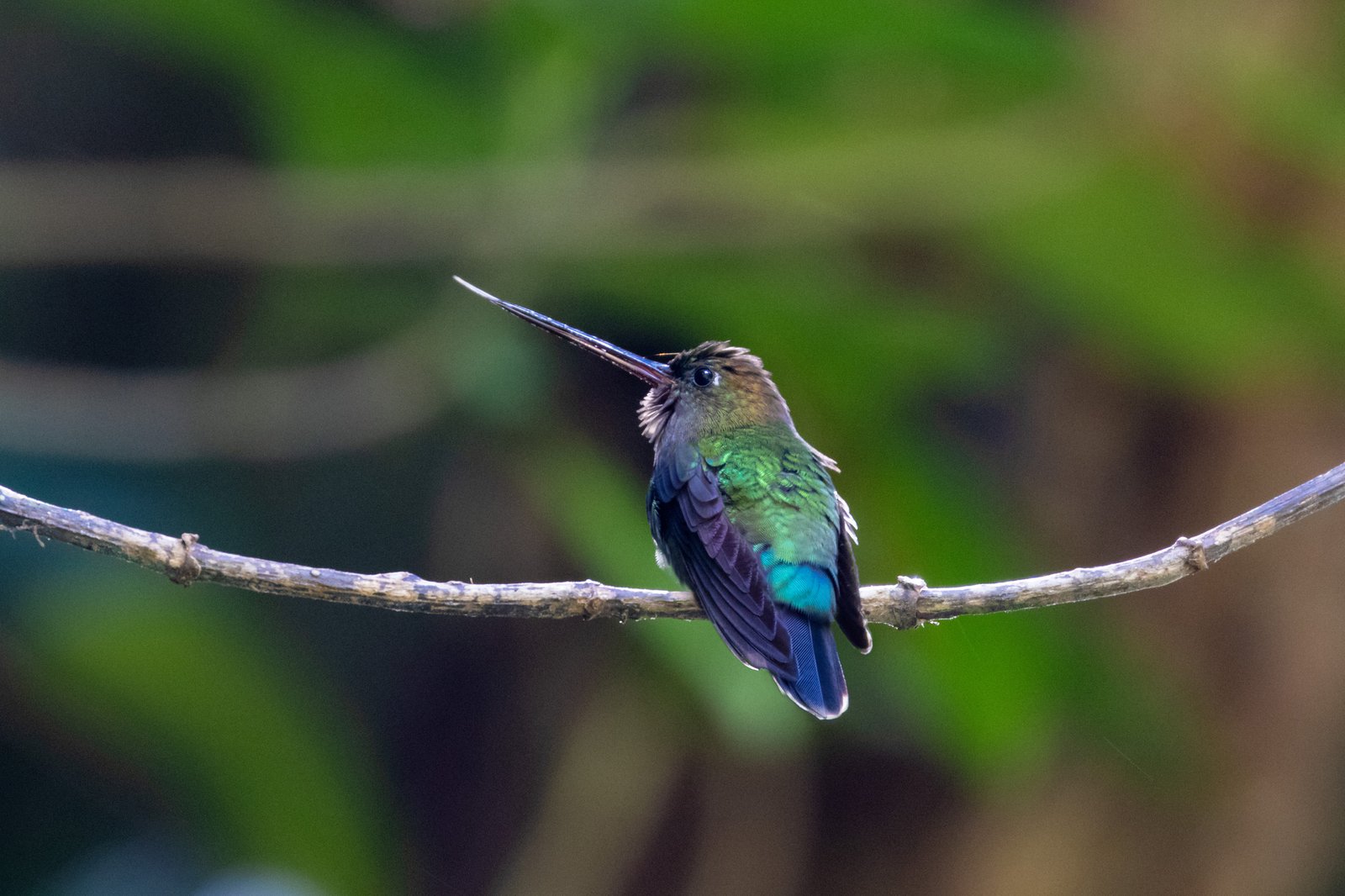
The Green-fronted Lancebill is a dark hummingbird of humid montane forest, with a long, straight, lance-shaped bill. It lives along streams and in ravines and follows fixed routes between scattered flowers. Of the two lancebills in the guide area it is the species of the higher slopes.
Voice
Usually silent. While foraging it gives thin, dry chipping notes, such as tsit.
Recording: John V. Moore — CC BY-NC-SA 4.0 · xeno-canto
Identification
10–11 cm, with a long, straight and fairly thick bill of about 3.5 cm, which appears slightly upturned towards the tip. The male is dark bronzy green above, with a glittering green patch on the forehead and a coppery crown and nape. The underparts are dark greyish green. The tail is blue-black with grey tips. The female resembles the male, but the green frontal patch is smaller and duller and the underparts are greyer. Young birds lack the green patch.
Confusion species
Blue-fronted Lancebill Doryfera johannae is smaller, with a shorter bill; the male has a violet-blue forehead and almost black underparts. It usually lives lower, in foothill forest. Bronzy Inca Coeligena coeligena also has a long, straight bill, but is larger, with a pale, scaled throat. Tooth-billed Hummingbird Androdon aequatorialis has a straight bill with a white hooked tip and streaked pale underparts; it lives only on the western side of the Andes.
Habitat
Humid montane forest and cloud forest, especially along streams, in ravines and at forest edges with hanging epiphytes, mostly between about 1000 and 2700 m. It visits scattered long-tubed flowers, such as those of heaths, epiphytes and vines, along a fixed route. The nest is a cup of moss and plant fibres hanging from dangling roots or under an overhanging rock above a stream.
Where the bird is most at home, classified by the vegetation units of the Andes and the west coast.


Range and movements
In Colombia in all three cordilleras. In Ecuador on both slopes of the Andes, more locally on the western slope. In Peru along the eastern slope of the Andes for the full length of the country. In Bolivia on the eastern slope of the Andes. Absent from the Galápagos. Outside the guide area in the mountains of Costa Rica and Panama and in the Andes of Venezuela.
- Resident
- dark = core range, pale = thinly spread
How and when to look
Walk along streams and through ravines in montane forest and look for a dark hummingbird with a long, straight bill flying low among hanging flowers and moss. A bird often returns to the same flowers at regular intervals.
Conservation status
Least Concern. Clearance of montane forest affects its habitat locally; the species depends on forest with streams and ravines.
Scientific name
Doryfera ludovicae | (Bourcier & Mulsant, 1847)
Bourcier & Mulsant described the species in 1847 as Trochilus ludovicae; because it was later moved to another genus, the author and year stand in brackets. The genus Doryfera was introduced in 1847 by Gould. The genus name combines Greek doru, 'spear', with -phoros, 'bearing': 'spear-bearer', after the long bill. The species name honours Louise Geoffroy Saint-Hilaire, née Blacque-Belair (1810–1855), wife of the French zoologist Isidore Geoffroy Saint-Hilaire. Ludovica is the Latin form of Louise. The specimen the first description was based on came from Buena Vista, Villavicencio, Colombia.