All species › Swifts › Hummingbirds › Blue-fronted Lancebill
Blue-fronted Lancebill | Doryfera johannae
Blauwvoorhoofdlancetkolibrie | Picolanza frentiazul | Bico-de-lança
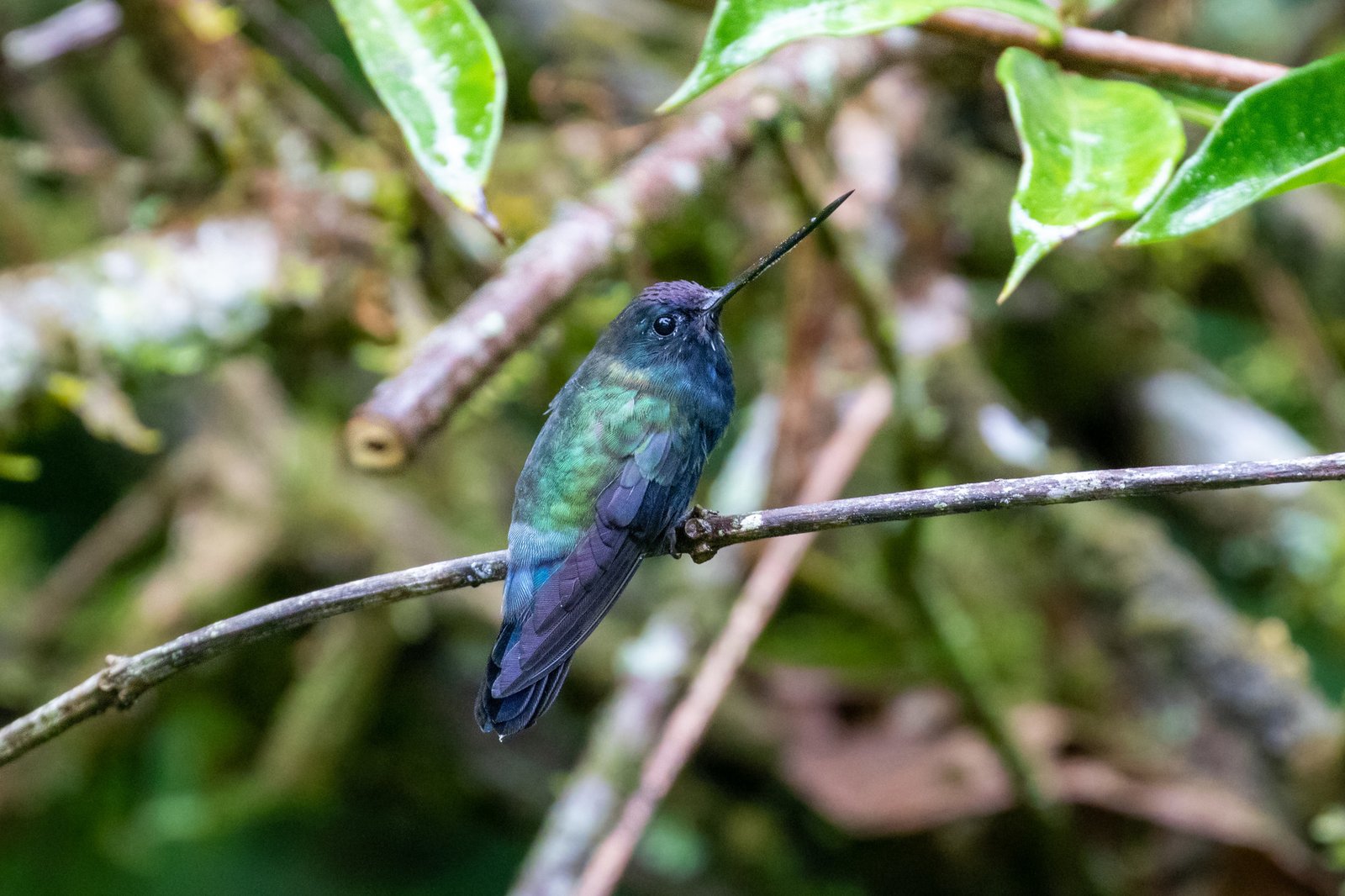
The Blue-fronted Lancebill is a small, dark hummingbird with a long, straight bill, living in the humid forest of the lower eastern Andean slopes. It is tied to ravines, streams and rock faces in the forest. Little is known about its breeding biology and song.
Voice
Poorly known. While foraging it gives thin, dry, chittering notes, such as chuert.
Recording: Ottavio Janni — CC BY-NC-SA 4.0 · xeno-canto
Identification
9–10 cm, with a long, straight, pointed bill of about 2.5–3 cm. The male has a glittering violet-blue forehead, a bronze nape and dark bronzy green upperparts. The underparts are blue-black, with a bluish green gloss on the throat and breast. The short tail is blue-black. The female has a greenish blue forehead and dull greyish bronze-green underparts.
Confusion species
Green-fronted Lancebill Doryfera ludovicae is larger, with a longer bill, a green forehead and greyish green underparts, and usually lives higher. Females of both species are very similar; then note bill length and elevation. Hermits such as Green Hermit Phaethornis guy have a decurved bill, a striped face and a long tail with elongated central feathers.
Habitat
Humid foothill forest and lower montane forest, especially in ravines, along streams and near rock faces and overhangs, mostly between about 500 and 1700 m. It forages in the middle and lower levels of the forest and in the shrub layer at forest edges, along a fixed route of flowers. The only nest described was a structure of moss and spider silk hanging under a rock overhang in a shallow cave.
Where the bird is most at home, classified by the vegetation units of the Andes and the west coast.


Range and movements
In Colombia on the eastern slope of the Eastern Cordillera. In Ecuador on the eastern slope of the Andes. In Peru along the eastern slope of the Andes, mainly in the north and centre of the country. Not known with certainty from Bolivia. Absent from the Galápagos. Outside the guide area in the tepui region of southern Venezuela, Guyana and the far north of Brazil.
- Resident
- dark = core range, pale = thinly spread
How and when to look
Search along forest streams and in ravines in the foothill forest of the eastern slope, for example along roads descending the eastern slope of Ecuador or northern Peru. Wait at flowering epiphytes or shrubs in a ravine; the bird passes low and fast.
Conservation status
Least Concern. Little is known about its numbers, but the species occurs scattered over a large area of humid forest. Clearance of foothill forest affects its habitat locally.
Scientific name
Doryfera johannae | (Bourcier, 1847)
Bourcier described the species in 1847 as Trochilus Johannae; because it was later moved to another genus, the author and year stand in brackets. The genus Doryfera was introduced in 1847 by Gould. The genus name combines Greek doru, 'spear', with -phoros, 'bearing': 'spear-bearer', after the long bill. The species name honours Jane Cooke, née Loddiges (1812–1843), botanical artist and daughter of the hummingbird specialist George Loddiges. The specimen the first description was based on came from (volgens de beschrijving).