All species › Swifts › Hummingbirds › White-throated Daggerbill
White-throated Daggerbill | Schistes albogularis
Witvlekwigsnavel | Colibrí picocuña occidental | Bico-de-cunha-de-garganta-branca
The White-throated Daggerbill is a small, compact hummingbird with a short, straight, sharply pointed bill, found in humid montane forest on the western side of the Andes. It was long treated as one species with Geoffroy's Daggerbill, but differs in plumage and song. With its pointed bill it often pierces the base of flower corollas to reach the nectar.
Voice
High, thin chipping notes. The male's song is a fairly slow, somewhat lilting and varied series of high notes, slower and more varied than that of Geoffroy's Daggerbill.
Recording: rudy gelis — CC BY-NC-SA 4.0 · xeno-canto
Identification
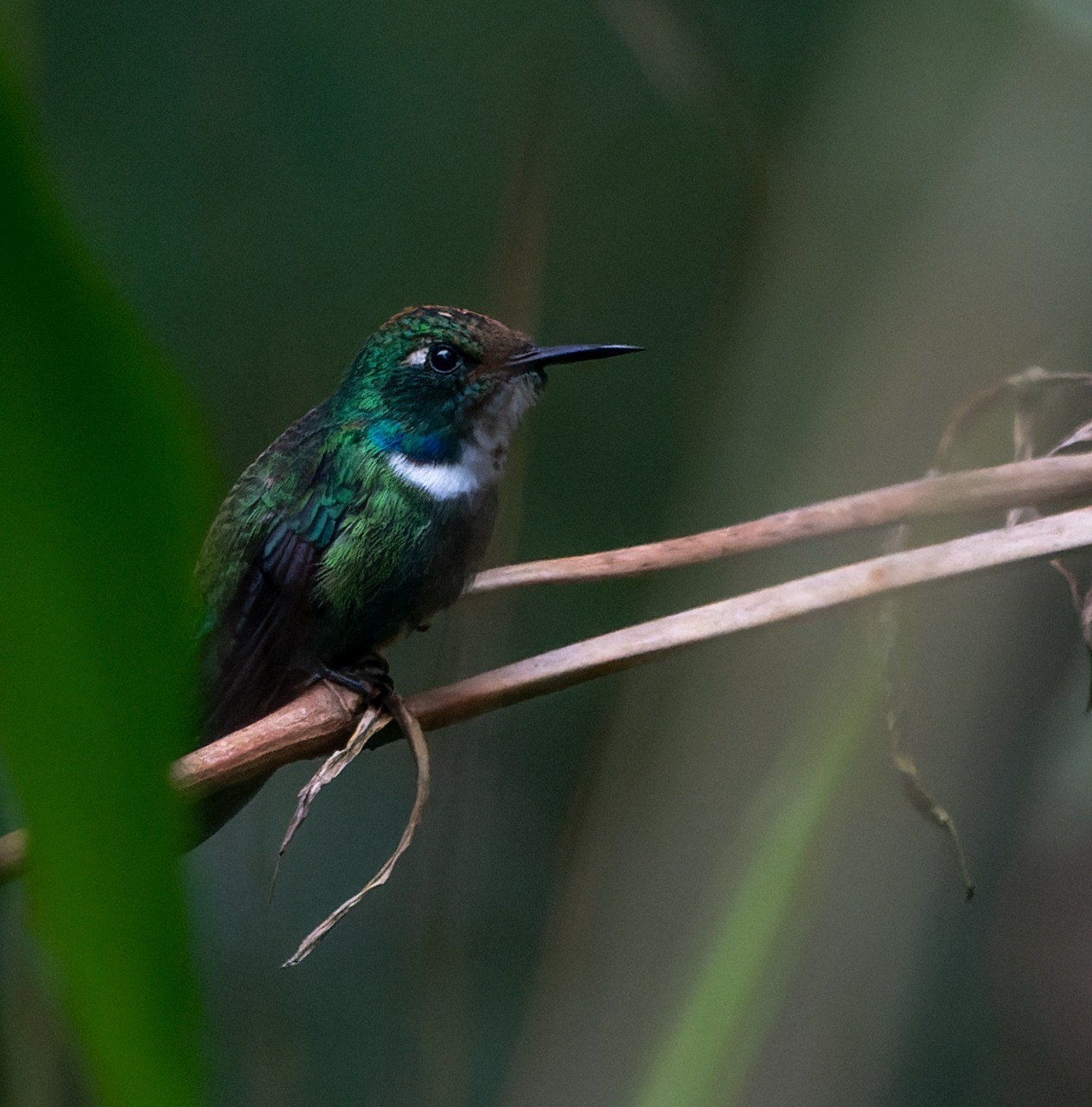
8–9 cm, with a short, straight, wedge-shaped bill of about 1.5 cm. Both sexes have a white stripe behind the eye and a violet patch on the side of the neck, which passes into dark blue at the rear. The male is dark green, with a bright green forecrown and a glittering green throat with much white at the sides; below it runs a continuous white breast band shaped like a chevron. The female has an entirely white throat that merges with the white breast band; the rest of the underparts is green. The tail is green with a dark band and white tips.
Confusion species
Geoffroy's Daggerbill Schistes geoffroyi lives on the eastern side of the Andes and in the Central and Eastern Cordilleras of Colombia. The male has a larger, purple neck patch and a white breast band interrupted by green in the middle; the female has a pale green throat scaled with white. Speckled Hummingbird Adelomyia melanogenys also has a short bill, but is brownish, with a dark ear patch and spotted pale underparts without a violet neck patch.
Habitat
Humid montane forest and cloud forest, forest edges and older secondary forest, mostly between about 800 and 2400 m. It forages in the lower and middle levels of the forest. It visits small flowers and pierces the base of longer corollas to rob nectar; it also catches small insects. The nest is a small cup of moss and plant fibres, usually low in the vegetation.
Where the bird is most at home, classified by the vegetation units of the Andes and the west coast.


Range and movements
In Colombia in the Western Cordillera, locally on both slopes. In Ecuador on the western slope of the Andes, south to the south-west. Not known with certainty from Peru; records in the far north-west are possible. Absent from Bolivia and the Galápagos. Outside the guide area in eastern Panama.
- Resident
- dark = core range, pale = thinly spread
How and when to look
Search forest edges and trails in the cloud forest of the western slope, such as around Mindo and in the Western Cordillera of Colombia. The bird forages low and fast among small flowers and sometimes visits verbena-like shrubs in lodge gardens.
Conservation status
Least Concern. Its habitat on the western slope has been heavily cleared in places, but the species also uses forest edges and secondary forest.
Scientific name
Schistes albogularis | Gould, 1852
Gould described the species in 1852 and placed it straight away in the genus where it still stands. The genus Schistes was introduced in 1851 by Gould. The genus name comes from Greek skhistos, 'split, cleft'. The specific name comes from Latin albus, 'white', and gula, 'throat'. The specimen the first description was based on came from Pichincha, Ecuador.