All species › Swifts › Hummingbirds › Geoffroy's Daggerbill
Geoffroy's Daggerbill | Schistes geoffroyi
Witstreepwigsnavel | Colibrí picocuña oriental | Bico-de-cunha-de-geoffroy
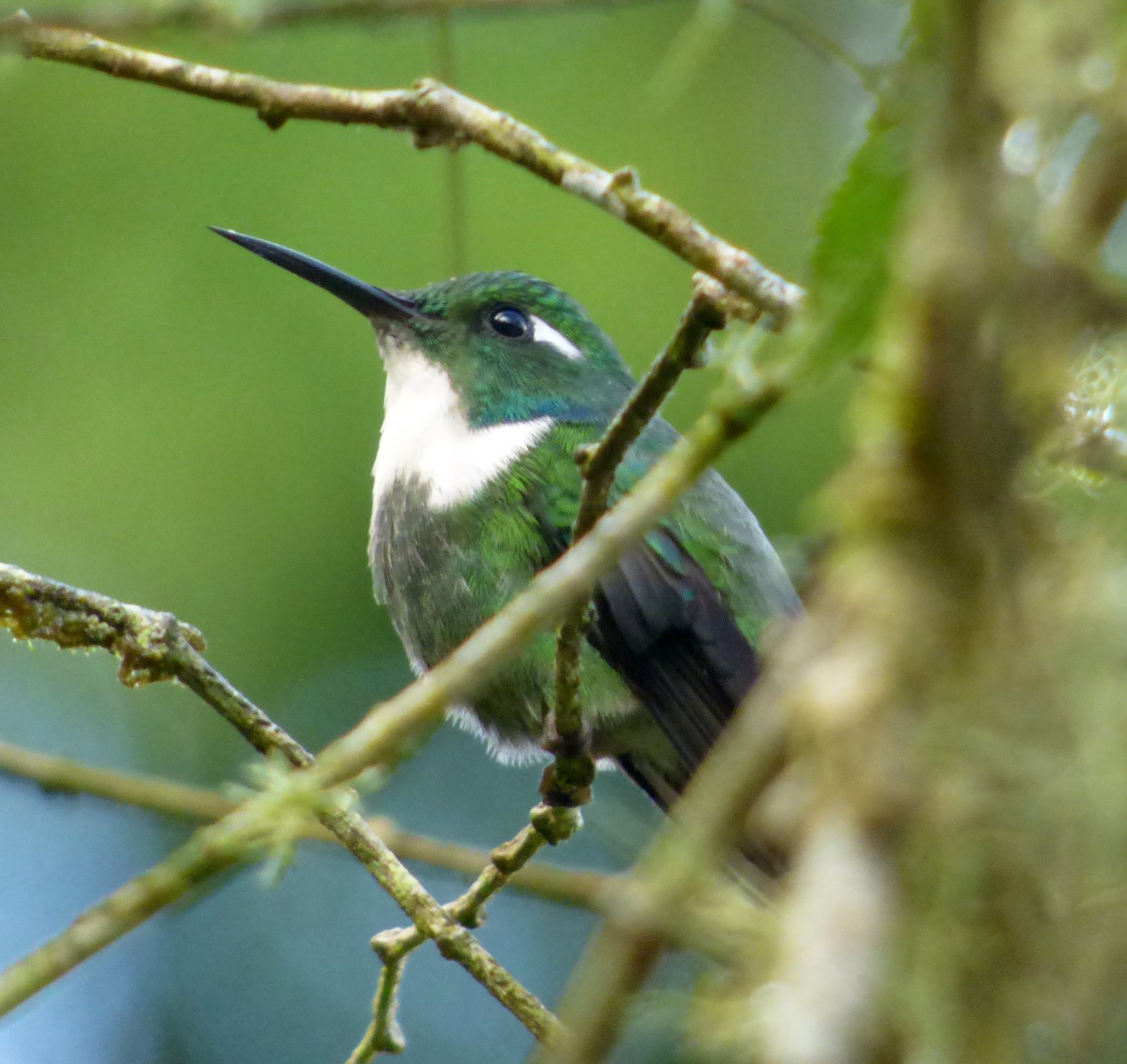
Geoffroy's Daggerbill is a small hummingbird with a short, straight, dagger-shaped bill, living in humid montane forest of the eastern Andes, from Venezuela to Bolivia. It forages low in the forest and often robs nectar by piercing the base of flower corollas. Geoffroy's and White-throated Daggerbills were long treated as one species.
Voice
High, thin chipping notes. The male's song is a rapid, little-varied series of high notes, faster and more monotonous than that of White-throated Daggerbill.
Recording: Jacob Wijpkema — CC BY-NC-SA 4.0 · xeno-canto
Identification
8–9 cm, with a short, straight, pointed bill of about 1.5 cm. Both sexes have a white stripe behind the eye and a purple patch on the side of the neck, which passes into blue at the rear. The male is green, with a glittering green throat and a broad, diagonal white band on the side of the breast that is interrupted by green in the middle; the breast is pale green. The female has a pale green throat with broad greyish white fringes and greyish white scaled underparts. The tail is bronzy green with a dark band and white tips. In southern Peru and Bolivia the white breast band is narrower or absent.
Confusion species
White-throated Daggerbill Schistes albogularis lives on the western side of the Andes and in the Western Cordillera of Colombia; the male has a continuous, chevron-shaped white breast band and a smaller violet neck patch, and the female an entirely white throat. Speckled Hummingbird Adelomyia melanogenys also has a short bill, but is brownish, with a dark ear patch and spotted pale underparts without a purple neck patch.
Habitat
Humid montane forest and cloud forest, forest edges and older secondary forest, mostly between about 900 and 2400 m. It forages in the lower and middle levels. It visits small flowers and pierces the base of longer corollas to rob nectar; it also catches small insects. The nest is a small cup of moss and plant fibres, usually low in the vegetation.
Where the bird is most at home, classified by the vegetation units of the Andes and the west coast.


Range and movements
In Colombia in the Central and Eastern Cordilleras. In Ecuador on the eastern slope of the Andes. In Peru along the eastern slope of the Andes for the full length of the country. In Bolivia on the eastern slope of the Andes. Absent from the Galápagos. Outside the guide area in the Andes and coastal mountains of Venezuela.
- Resident
- dark = core range, pale = thinly spread
How and when to look
Search forest edges and roads through cloud forest on the eastern slope, for example in northern and central Peru and on the eastern slope of Ecuador. Look for a small hummingbird foraging low among small flowers and showing the white stripe behind the eye.
Conservation status
Least Concern. Clearance of montane forest affects its habitat locally, but the species also uses forest edges and secondary forest.
Scientific name
Schistes geoffroyi | (Bourcier, 1843)
Bourcier described the species in 1843 as Trochilus Geoffroyi; because it was later moved to another genus, the author and year stand in brackets. The genus Schistes was introduced in 1851 by Gould. The genus name comes from Greek skhistos, 'split, cleft'. The specific name honours the French zoologist Isidore Geoffroy Saint-Hilaire (1805–1861), son of Étienne Geoffroy Saint-Hilaire. The specimen the first description was based on came from El Roble, Fusagasugá, Colombia.