All species › Swifts › Hummingbirds › White-vented Violetear
White-vented Violetear | Colibri serrirostris
Witbuikvioletoorkolibrie | Colibrí orejimorado | Beija-flor-de-orelha-violeta
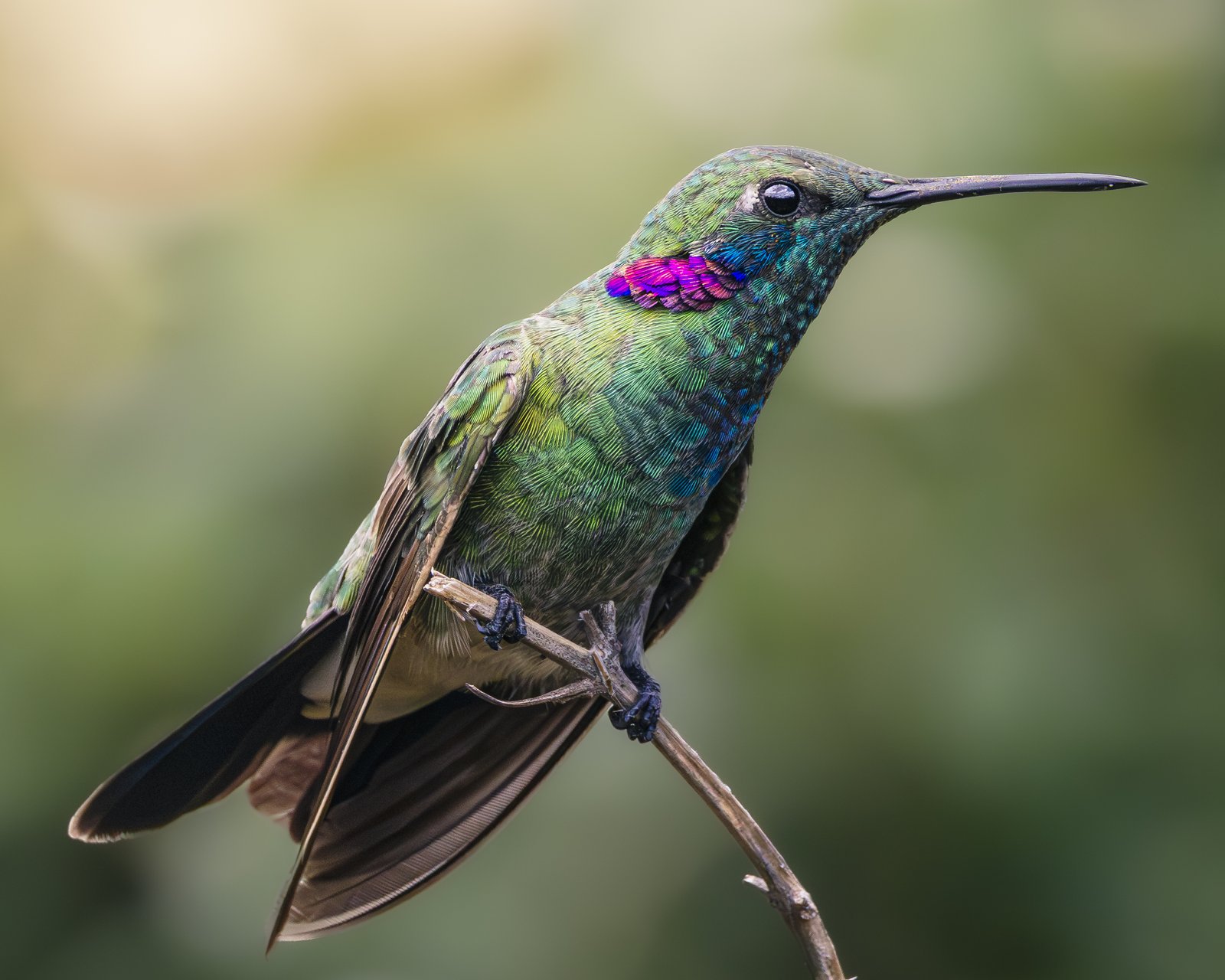
The White-vented Violetear is a medium-sized green hummingbird with violet ear patches and white undertail coverts, found in open and semi-open country in interior South America. In the guide area it lives only in Bolivia, on the eastern side of the Andes. The male sings for long periods from a fixed perch.
Voice
The song is a repeated series of dry, metallic chipping notes, given for long periods from an open perch. The call is a dry tchik.
Recording: JAYRSON ARAUJO DE OLIVEIRA — CC BY-NC-SA 4.0 · xeno-canto
Identification
12–13 cm, with a straight black bill. Glittering green, with a violet patch running back from below the eye that in the male also reaches the chin and the side of the throat. The undertail coverts are white. The tail is bluish green with a broad dark subterminal band. The female is duller, with a smaller violet patch. Young birds have rufous fringes on the head and back.
Confusion species
Sparkling Violetear Colibri coruscans is larger, with a blue-violet patch in the centre of the belly and green or dark undertail coverts; it lives mainly higher in the Andes. Lesser Violetear Colibri cyanotus is smaller, with no violet on the chin and no white undertail coverts. Brown Violetear Colibri delphinae is greyish brown, not green.
Habitat
Dry, open and semi-open landscapes: scrub and thickets in the dry valleys on the eastern side of the Andes, cerrado, the edges of dry forest and Chaco, riparian woodland, gardens and parks, from about 500 to 2800 m, locally higher. It visits flowering trees and shrubs and catches insects in flight. The nest is a small cup on a horizontal branch.
Where the bird is most at home, classified by the vegetation units of the Andes and the west coast.


Range and movements
In Bolivia in the dry valleys and on the slopes on the eastern side of the Andes and in the adjacent lowlands of the east and south-east, including Santa Cruz, Cochabamba, Chuquisaca and Tarija. In Peru at most rare in the far south-east. Absent from Colombia, Ecuador and the Galápagos. Outside the guide area in central and south-eastern Brazil, Paraguay and northern Argentina; in the south part of the population leaves in winter.
- Resident
- dark = core range, pale = thinly spread
How and when to look
In gardens, parks and dry scrub in the valleys of Cochabamba, Santa Cruz and Chuquisaca. Listen for the repeated chipping notes of a male singing from a bare branch.
Conservation status
Least Concern. The species tolerates human-modified landscapes well and also occurs in towns.
Scientific name
Colibri serrirostris | (Vieillot, 1816)
Vieillot described the species in 1816 as Trochilus serrirostris; because it was later moved to another genus, the author and year stand in brackets. The genus Colibri was introduced in 1824 by Spix. The genus name is the French word colibri, 'hummingbird'; the further origin of that word is uncertain, possibly from a Caribbean language. The species name combines Latin serra, 'saw', with rostrum, 'bill': 'saw-billed', after the finely serrated bill tip. The specimen the first description was based on came from Brazil.