All species › Passerines › Antbirds › Plumbeous Antbird
Plumbeous Antbird | Myrmelastes hyperythrus
Loodgrijze miervogel | Hormiguero plomizo | Formigueiro-chumbo
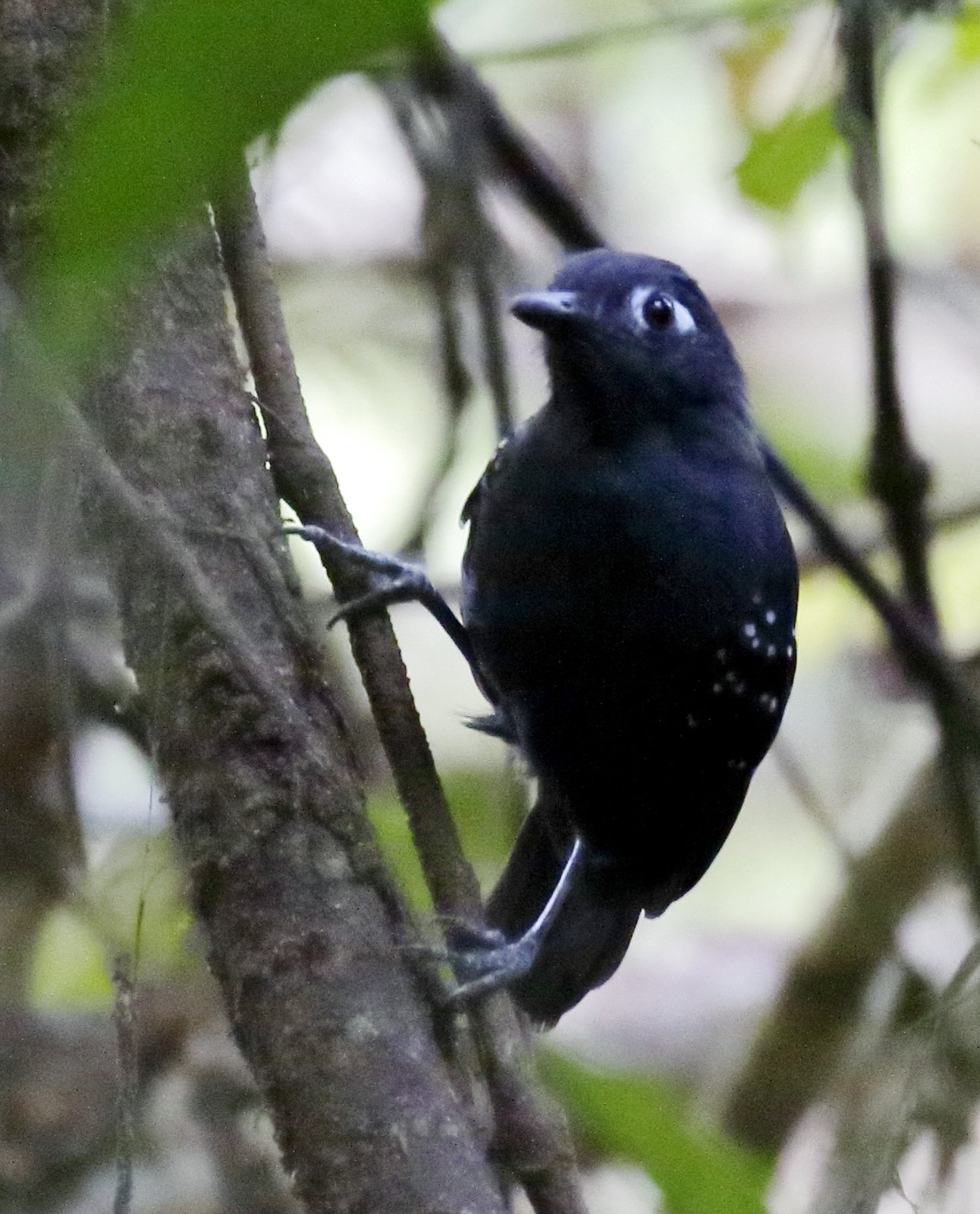
The Plumbeous Antbird is the largest member of its genus and an antbird of flooded forest in western Amazonia. The male is dark plumbeous grey, with a large, pale blue bare patch around the eye; the female is bright rufous below. Pairs keep low and often on the ground, in openings created by fallen trees.
Voice
The song is a long, accelerating, rattling trill that first swells and then fades. Calls are a two-note wo-poor or klo-koo and a rapid chatter.
Recording: JAYRSON ARAUJO DE OLIVEIRA — CC BY-NC-SA 4.0 · xeno-canto
Identification
17–18 cm, with a stout, black bill and a fairly long tail. Around the eye a very large, pale blue bare patch. The male is dark slate-grey, with blackish-grey wings and tail and white spots at the tips of the wing coverts. The female has the same slate-grey upperparts, wings and tail, with white wing spots, but bright rufous underparts, browner on the flanks and undertail coverts.
Confusion species
Slate-colored Antbird Myrmelastes schistaceus and Spot-winged Antbird Myrmelastes leucostigma are smaller, without blue skin around the eye, and live mainly in terra firme; their females have a brown back. Goeldi's Antbird Akletos goeldii has a red iris; the male is blackish and the female brown above and grey below, and it lives in bamboo. The male White-shouldered Antbird Akletos melanoceps is black with a white shoulder patch; the female has a black head and a rufous body.
Habitat
Floor and understorey of evergreen lowland forest, especially in the interior of várzea, where fallen trees create openings; also in transitional forest and along forest streams. Up to about 500 m in Colombia, 300 m in Ecuador and mostly below 500 m in Peru, locally to 800 m. It forages alone, in pairs or in family groups, mostly within 3 m of the ground; it hops over the ground and low branches and picks prey from the litter. It sometimes follows army ants. Little is known about the nest.
Where the bird is most at home, classified by the vegetation units of the Andes and the west coast.


Range and movements
Colombia: in the south-east, in the Amazonian lowlands. Ecuador: in the eastern lowlands. Peru: in the eastern lowlands, from north to south. Bolivia: in the north-west (Pando, Beni and La Paz). Absent from the Galápagos. Outside the guide area in western Amazonian Brazil, east to the Purus basin.
- Resident
- dark = core range, pale = thinly spread
How and when to look
In várzea along tributaries of the Amazon, the Napo or the Madre de Dios, look for places where fallen trees open gaps; the rattling song often comes from the ground.
Conservation status
Least Concern. Fairly common in suitable flooded forest.
Scientific name
Myrmelastes hyperythrus | (Sclater, 1855) (GBIF: Myrmeciza hyperythra)
Sclater described the species in 1855 as Thamnophilus hyperythrus; because it was later moved to another genus, the author and year stand in brackets. The genus Myrmelastes was introduced in 1858 by Sclater. The genus name combines Greek murmēx, 'ant', and lēistēs, 'robber'. The species name comes from Greek hupo, 'below', and eruthros, 'red', after the rufous underparts of the female. The specimen the first description was based on came from Chamicuros, Loreto, Peru.