All species › Passerines › Antbirds › Slate-colored Antbird
Slate-colored Antbird | Myrmelastes schistaceus
Leikleurige miervogel | Hormiguero pizarroso | Formigueiro-ardósia
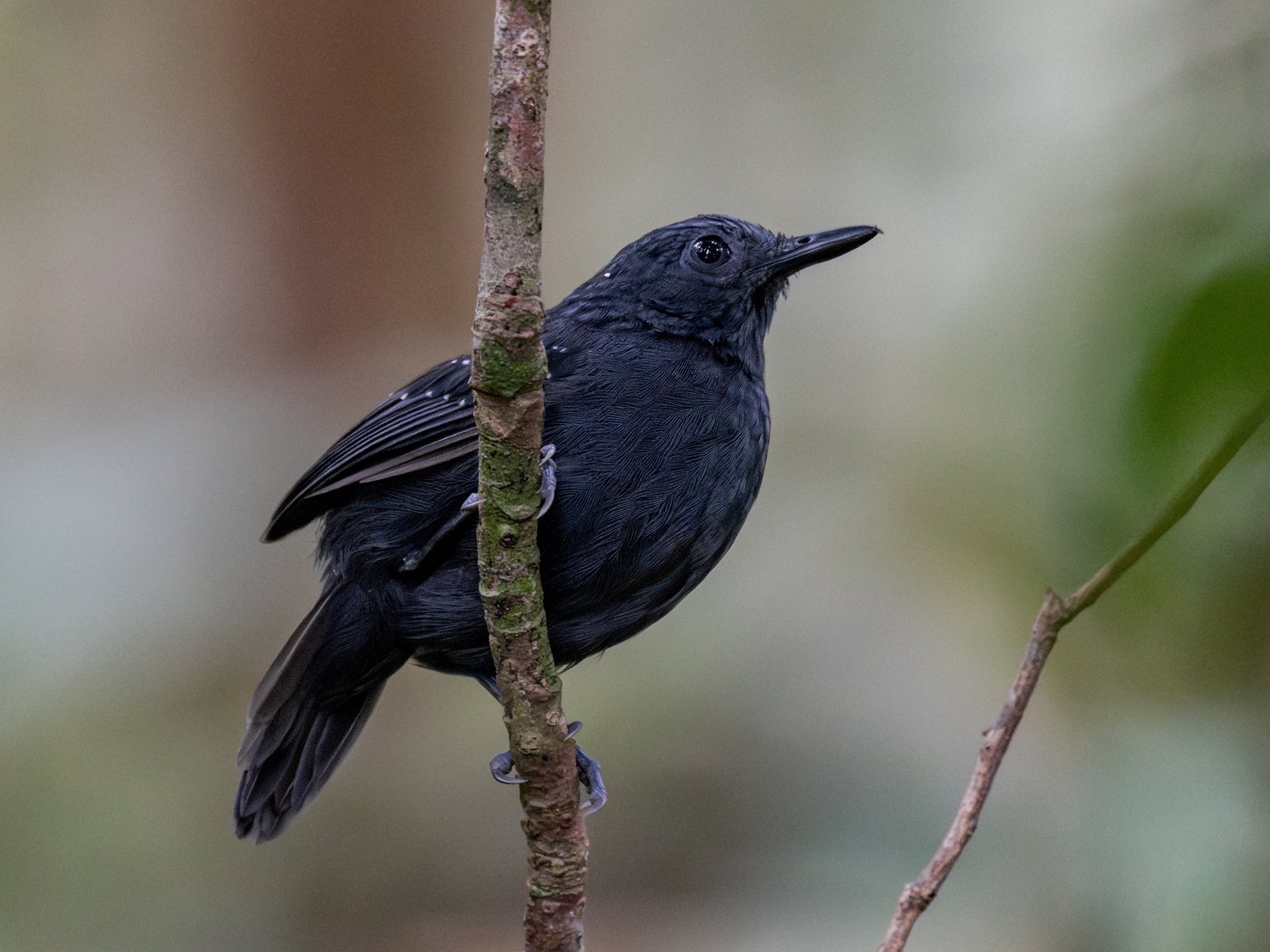
The Slate-colored Antbird is an antbird of the understorey of terra firme forest in western Amazonia. The male is almost plain slate-grey, the female has a chestnut crown and orange-rufous underparts. The species lives in pairs close to the ground and is detected mainly by a series of clear whistles.
Voice
The song is a simple, accelerating and rising series of clear, penetrating whistles, sometimes ending in a buzzy note.
Recording: JAYRSON ARAUJO DE OLIVEIRA — CC BY-NC-SA 4.0 · xeno-canto
Identification
14.5–15.5 cm, with a black, straight bill, a grey iris and leaden to bluish-grey legs. The male is dark bluish grey to slate-grey, with blackish wings and tail and small white tips to the wing coverts. The female has a dark chestnut crown with fine rufous streaks, olive-brown back and wings with broad buff tips to the coverts, a slate-grey tail and orange-rufous to rufous throat and underparts.
Confusion species
Spot-winged Antbird Myrmelastes leucostigma lives mainly along streams and on poorly drained ground; the male usually has larger white wing spots and the female a grey or dark crown; the song differs. Plumbeous Antbird Myrmelastes hyperythrus is larger, with blue bare skin around the eye, and lives mainly in várzea. The female Bluish-slate Antshrike Thamnomanes schistogynus is also rufous below, but has a grey head and a thicker, hooked bill, perches upright and lives in mixed flocks.
Habitat
Understorey of humid terra firme lowland forest, up to about 250 m in Ecuador and 400 m in Colombia, locally higher in Peru. It forages in pairs low in the vegetation and on the ground, searching for insects and other arthropods on leaves and in the litter; it rarely joins mixed flocks. Little is known about its breeding.
Where the bird is most at home, classified by the vegetation units of the Andes and the west coast.


Range and movements
Colombia: in the south, in the Amazonian lowlands (Caquetá, Putumayo, Amazonas). Ecuador: only in the far north-east. Peru: in the north-east to east-central part of the country, mainly north of the Amazon and along the Ucayali. Absent from Bolivia and the Galápagos. Outside the guide area in western Amazonian Brazil, east to central Amazonas.
- Resident
- dark = core range, pale = thinly spread
How and when to look
Listen in terra firme forest near Iquitos and along the Napo for the rising series of whistles and look low in the understorey; pairs respond to each other's song.
Conservation status
Least Concern. Fairly common in undisturbed terra firme forest, but disappears with logging and fragmentation.
Scientific name
Myrmelastes schistaceus | (Sclater, 1858) (GBIF: Schistocichla schistacea)
Sclater described the species in 1858 as Hypocnemis schistacea; because it was later moved to another genus, the author and year stand in brackets. The genus Myrmelastes was introduced in 1858 by Sclater. The genus name combines Greek murmēx, 'ant', and lēistēs, 'robber'. The species name comes from New Latin schistaceus, 'slate-coloured'. The specimen the first description was based on came from Río Yavarí, Peru.