All species › Passerines › Antbirds › Russet Antshrike
Russet Antshrike | Thamnistes anabatinus
Rosse mierklauwier | Batará café | Choca-parda
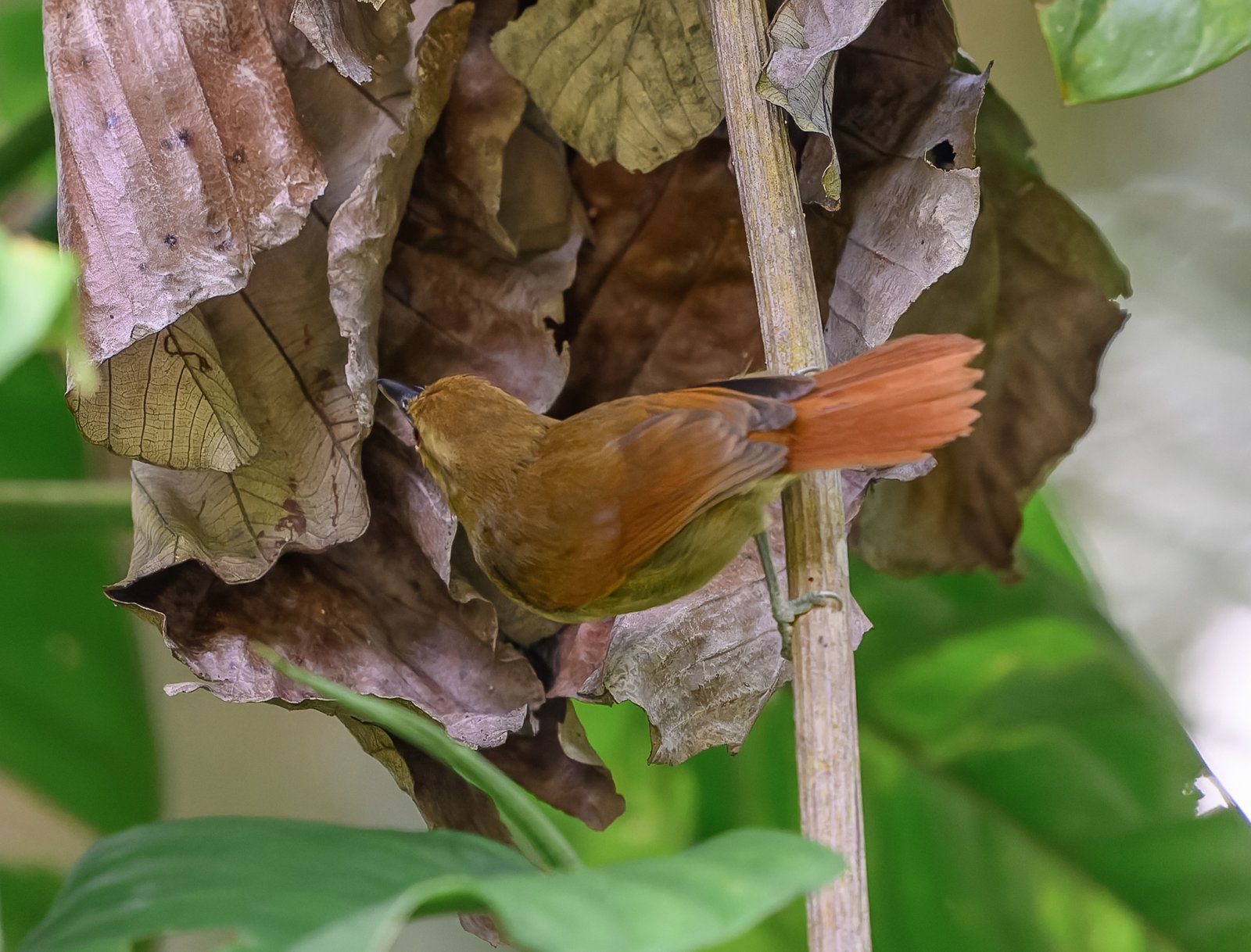
The Russet Antshrike is a stocky, olive-brown antshrike with rufous wings and tail and a heavy, hooked bill. It lives high in the forest and almost always travels with mixed flocks. In the guide area it occurs in Colombia and Ecuador; south of the Marañón it is replaced by Rufescent Antshrike.
Voice
The slow song is a short, countable series of falling, thin whistles, preceded by a softer, lower note; eastern birds also have a loud, penetrating rapid song. Calls are high and sibilant, such as tssip-i-tssip.
Recording: Juan Freile — CC BY-NC-SA 4.0 · xeno-canto
Identification
14–15 cm, stocky, with a heavy, hook-tipped bill. The upperparts are olive-brown, the wings cinnamon-rufous and the tail rufous; a pale ochraceous supercilium. The underparts are pale yellowish-olive to ochraceous. The male has an orange-rufous patch between the shoulders that is rarely visible in the field; the female lacks it. Otherwise the sexes are alike.
Confusion species
Rufescent Antshrike Thamnistes rufescens lives south of the Marañón and has a different song. Foliage-gleaners such as Buff-fronted Foliage-Gleaner Dendroma rufa and Scaly-throated Foliage-Gleaner Anabacerthia variegaticeps have a slimmer bill without a hook and a bolder face pattern. Rufous Mourner Rhytipterna holerythra is uniformly rufous-brown, without a supercilium, and perches quietly on a branch.
Habitat
Canopy and upper mid-storey of humid lowland and foothill forest, lower montane forest and adjacent secondary forest, from sea level to about 1500 m; in Ecuador mainly between 400 and 1300 m. It searches leaves, dead leaves, vines and moss for arthropods and sometimes fruit, usually with mixed flocks; it occasionally attends army ants. The nest is a deep pouch of leaves high in a tree; both parents build, incubate and feed.
Where the bird is most at home, classified by the vegetation units of the Andes and the west coast.


Range and movements
Colombia: in the Pacific lowlands, the north and on the Andean slopes, and on the eastern slope in the south. Ecuador: in the west, from Esmeraldas to El Oro, and on the eastern slope of the Andes. Peru: possibly in the far north, north of the Marañón. Absent from Bolivia and the Galápagos. Outside the guide area from Mexico through Central America to Panama and in Venezuela.
- Resident
- dark = core range, pale = thinly spread
How and when to look
Search canopy mixed flocks in foothill forest in western Ecuador or the Chocó, for example along roads with views into the treetops. Watch for a rusty-brown bird picking through dead leaves.
Conservation status
Not Evaluated in this species concept; the western and eastern forms are each listed as Least Concern. Fairly common in Colombia; numbers are thought to be declining through deforestation.
Scientific name
Thamnistes anabatinus | Sclater & Salvin, 1860
Sclater & Salvin described the species in 1860 and placed it straight away in the genus where it still stands. He introduced the genus Thamnistes in that same work. The genus name comes from Greek thamnos, 'bush', and hizō, 'to sit': a bird that sits in bushes. The species name comes from Greek anabatēs, 'climber'. The specimen the first description was based on came from Verapaz, Guatemala.