All species › Passerines › Antbirds › Rufescent Antshrike
Rufescent Antshrike | Thamnistes rufescens
Roestmierklauwier | Batará andino | Choca-ferrugínea
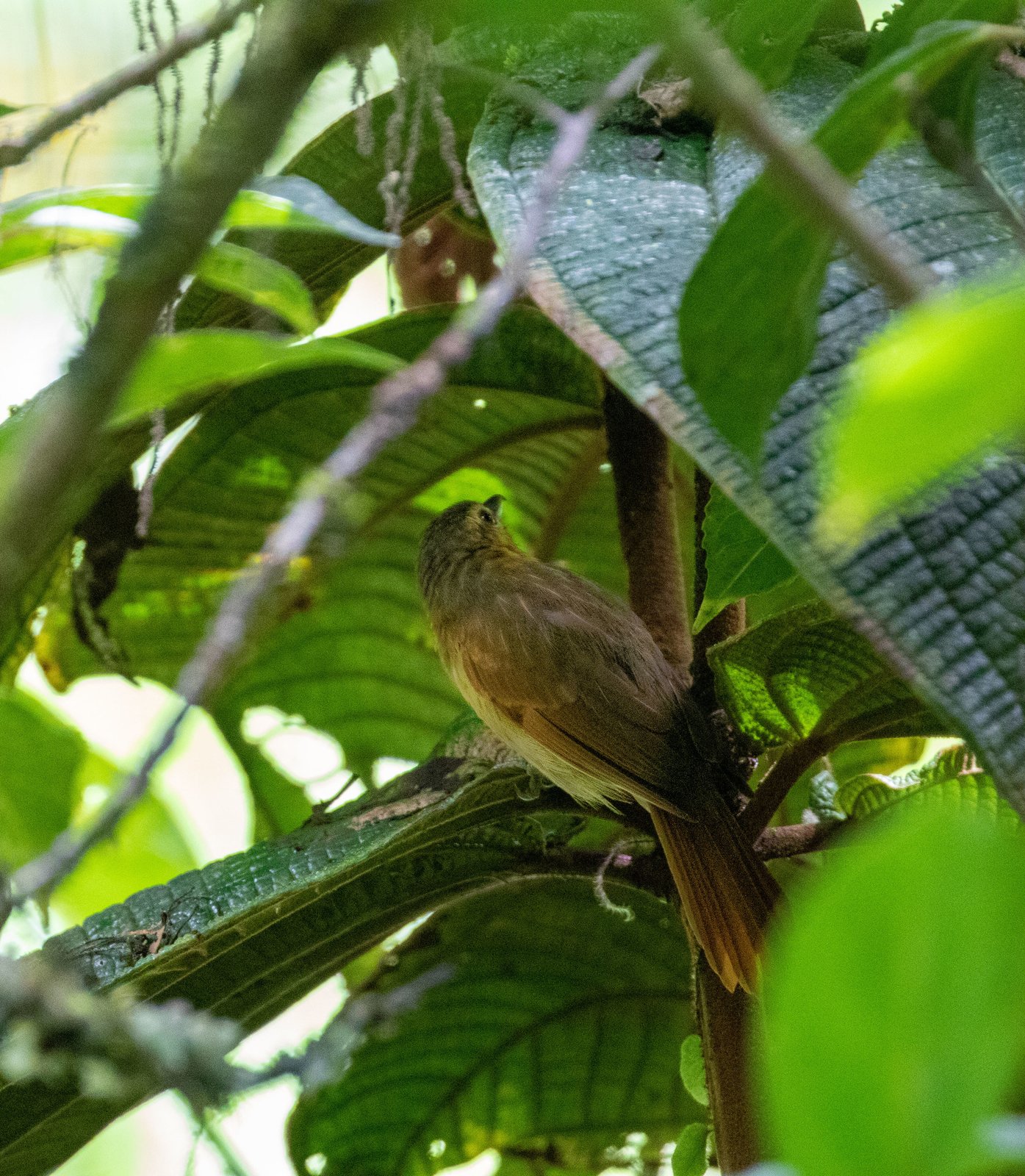
The Rufescent Antshrike is a stocky, rusty-brown antshrike with a heavy, hooked bill from the eastern slope of the Andes in Peru and Bolivia. It forages high in the canopy with mixed flocks and behaves more like a foliage-gleaner than other antshrikes. It has recently been treated as a separate species from the Russet Antshrike.
Voice
The slow song is a high, slightly accelerating and rising series of thin, downslurred whistles; there is also a faster song. Calls are a high swee-tip or swee, and in southeastern Peru also a short, descending tsew.
Recording: GABRIEL LEITE — CC BY-NC-SA 4.0 · xeno-canto
Identification
15–16 cm, stocky, with a heavy, hook-tipped bill. The face is ochraceous with a pale supercilium, the upperparts olive-brown, the wings cinnamon-rufous and the tail rufous. The throat is dull olive-yellow, breast and belly ochraceous with an olive-grey tinge. The male has a bright orange-rufous patch between the shoulders, usually concealed; the female lacks it. Otherwise the sexes are alike.
Confusion species
Russet Antshrike Thamnistes anabatinus is very similar, but lives north of the Marañón and has a different song. Foliage-gleaners such as Buff-fronted Foliage-Gleaner Dendroma rufa and Rufous-tailed Foliage-Gleaner Anabacerthia ruficaudata have a slimmer, unhooked bill, a bolder face pattern and clamber along branches.
Habitat
Canopy and upper mid-storey of humid foothill and lower montane forest and adjacent secondary forest, roughly between 600 and 1600 m. It searches leaves, dead leaves, vines and moss for arthropods, almost always with mixed flocks. Nothing is known about its breeding biology.
Where the bird is most at home, classified by the vegetation units of the Andes and the west coast.


Range and movements
Peru: on the eastern slope of the Andes south of the Marañón. Bolivia: in the Yungas, at least in La Paz and Cochabamba. Absent from Colombia, Ecuador and the Galápagos, where Russet Antshrike occurs. Not known outside the guide area.
- Resident
- dark = core range, pale = thinly spread
How and when to look
Search canopy mixed flocks along mountain roads through foothill forest, such as in the Manu buffer zone. Watch for a rusty-brown bird with a heavy bill probing dead leaves in the crown.
Conservation status
Not Evaluated as a separate species; as part of Russet Antshrike it is listed as Least Concern. Locally fairly common; the foothill and montane forest it inhabits is being cleared for timber and agriculture.
Scientific name
Thamnistes rufescens | Cabanis, 1873
Cabanis described the species in 1873 and placed it straight away in the genus where it still stands. The genus Thamnistes was introduced in 1860 by Sclater & Salvin. The genus name comes from Greek thamnos, 'bush', and hizō, 'to sit': a bird that sits in bushes. The species name comes from Latin rufescens, 'reddish'. The specimen the first description was based on came from Monterico, Peru.