All species › Passerines › Tyrant flycatchers and allies › Plumbeous-crowned Tyrannulet
Plumbeous-crowned Tyrannulet | Phyllomyias plumbeiceps
Loodkruinvliegenpikker | Tiranolete coroniplomizo | Piolhinho-de-coroa-plúmbea
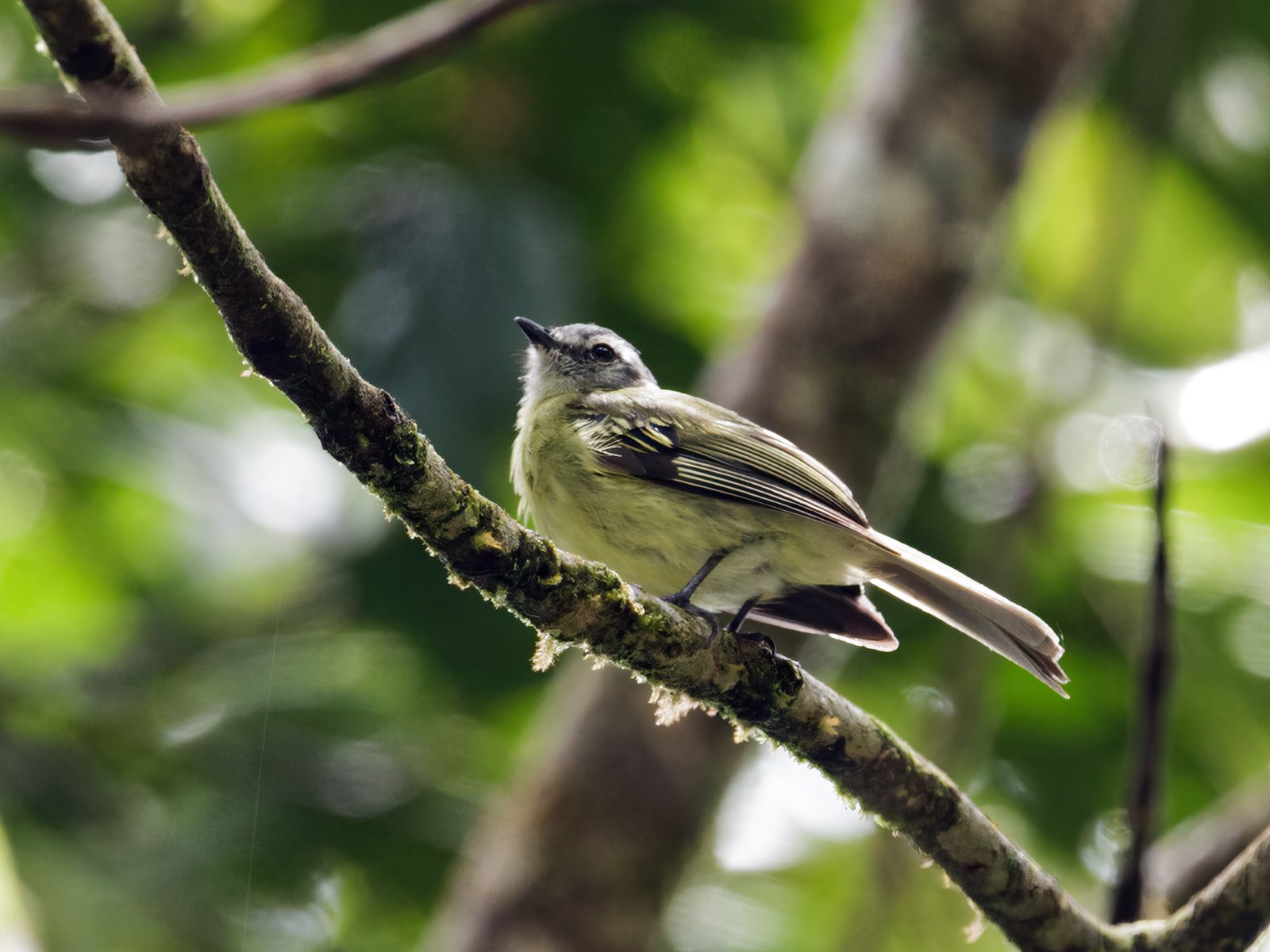
The Plumbeous-crowned Tyrannulet is a small, olive-green tyrant flycatcher of montane forest at middle elevations in the northern and central Andes. It lives in the middle and upper levels of the forest and often travels with mixed flocks. The lead-grey crown and the dark patch on the ear coverts are the best features.
Voice
Short, fast series of high, sharp notes and single thin calls.
Recording: Juan Freile — CC BY-NC-SA 4.0 · xeno-canto
Identification
11.5 cm, with a short, dark bill. The crown is lead-grey, with a whitish eyebrow, speckled pale cheeks and a dark crescent on the ear coverts. The back is olive-green. The wings are dark, with two yellowish wing bars. The throat is greyish, the breast olive-yellow and the belly yellow. The sexes are alike.
Confusion species
Marble-faced Bristle Tyrant Pogonotriccus ophthalmicus has a more strongly marbled face, perches upright and often lifts one wing. Variegated Bristle Tyrant Pogonotriccus poecilotis has ochre-buff wing bars. Ashy-headed Tyrannulet Tyranniscus cinereiceps has a blue-grey head without a distinct eyebrow and a pale iris. Sooty-headed Tyrannulet Phyllomyias griseiceps lives lower, in the lowlands and foothills, and lacks wing bars.
Habitat
Humid montane forest and cloud forest, mainly edges, clearings and tall secondary growth, roughly between 1200 and 2200 m. It gleans small insects from leaves in the middle and upper levels, usually with mixed flocks. Little is known about the nest.
Where the bird is most at home, classified by the vegetation units of the Andes and the west coast.


Range and movements
Colombia: locally on the slopes of the Andes, mainly in the Central and Eastern Andes. Ecuador: on the eastern slope of the Andes. Peru: on the eastern slope of the Andes from Amazonas and San Martín south to Cusco. Absent from Bolivia and the Galápagos. Hardly occurs outside the guide area.
- Resident
- dark = core range, pale = thinly spread
How and when to look
Search mixed flocks in montane forest on the eastern slope, for example along the road to Abra Patricia in San Martín or the Manu road in Cusco. Look for the grey head with a dark ear patch on birds foraging in the middle storey.
Conservation status
Least Concern. The species is local, but also occurs at forest edges and in secondary forest.
Scientific name
Phyllomyias plumbeiceps | (Lawrence, 1869)
Lawrence described the species in 1869 as Pogonotriccus plumbeiceps; because it was later moved to another genus, the author and year stand in brackets. The genus Phyllomyias was introduced in 1860 by Cabanis & Heine. The genus name combines Greek phullon, 'leaf', with Modern Latin myias, 'flycatcher'. The species name comes from Latin plumbeus, 'leaden', and -ceps, 'headed', referring to the lead-grey crown. The specimen the first description was based on came from Bogotá, Colombia.