All species › Passerines › Tyrant flycatchers and allies › Spot-billed Ground Tyrant
Spot-billed Ground Tyrant | Muscisaxicola maculirostris
Leeuwerikgrondtiran | Dormilona piquipinta | Gaúcha-de-bico-pintado
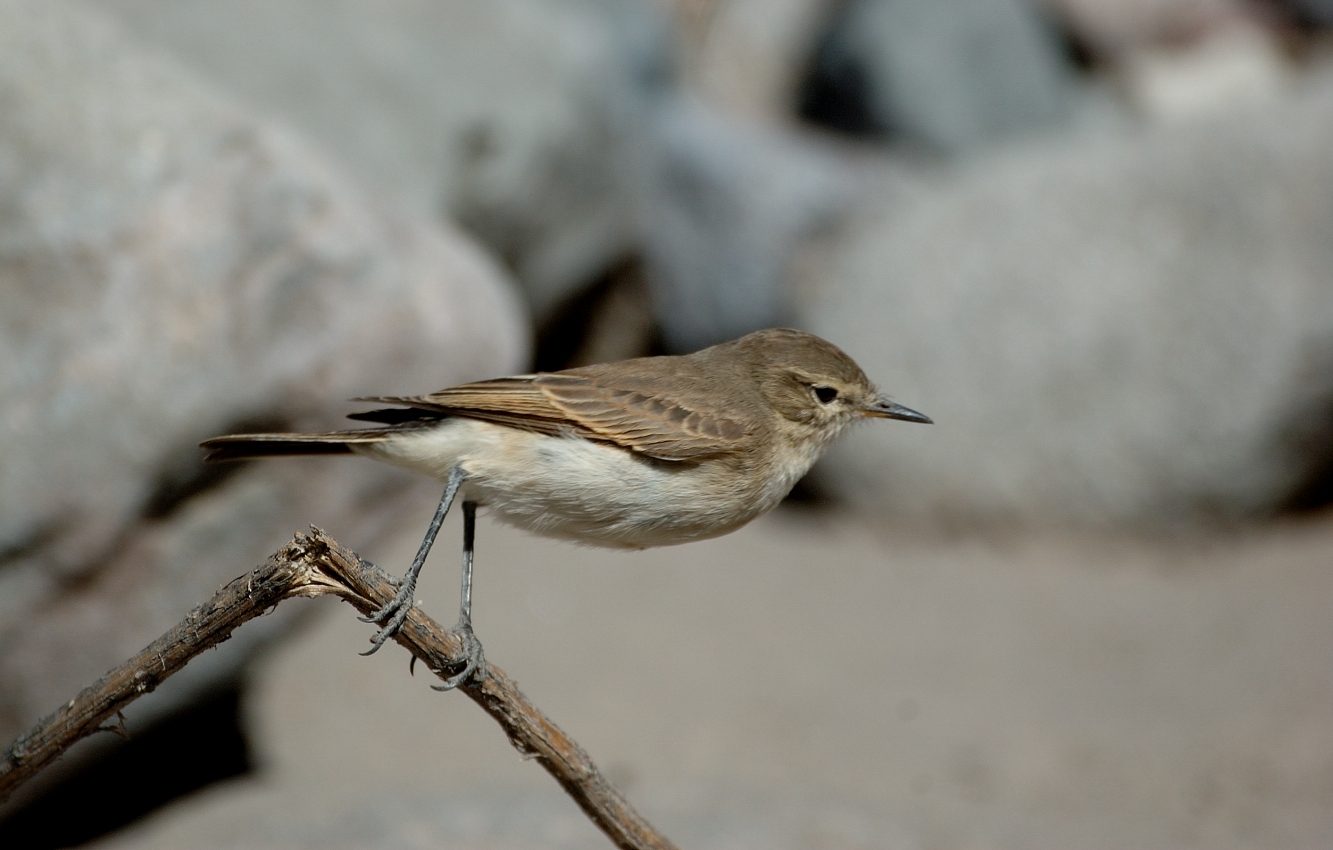
The Spot-billed Ground Tyrant is a small, brownish ground tyrant of dry, rocky slopes and farmland in the Andes. It occurs lower than most other ground tyrants and is the most vocal species in the genus: the male sings in a display flight, comparable to that of a pipit. The name refers to the pale spot at the base of the bill.
Voice
The most vocal ground tyrant. The male sings in a display flight: a series of pit notes that accelerates into a higher flourish and ends with two clear whistles. The calls are a short pit, pip or pew.
Recording: Cristian Pinto Fernandez — CC BY-NC-SA 4.0 · xeno-canto
Identification
14–15 cm, slender and upright. The crown and back are olive-brown, with a whitish-buff supercilium and a dark eye-stripe. The wings are dark with buff edges, the tail blackish with white outer edges. The underparts are whitish, with olive mottling or dusky streaks on the breast. The bill is black, with a yellow to orange base to the lower mandible. In Colombia the birds are paler brown with pinkish-buff underparts, in Ecuador mainly cinnamon to pale rufous. The sexes are alike; juveniles are duller with rustier wing edges.
Confusion species
Puna Ground Tyrant Muscisaxicola juninensis and Cinereous Ground Tyrant Muscisaxicola cinereus are greyer, with plain underparts and a dark bill, and live higher in the puna. Paramo Ground Tyrant Muscisaxicola alpinus in Colombia and Ecuador is larger and greyer, with a brown crown, and lives higher in the páramo. Common Miner Geositta cunicularia has a longer, slightly curved bill and much rufous in the wing.
Habitat
Dry, sparsely vegetated and often rocky slopes with grass and shrubs, and farmland; in Peru and Bolivia from about 2000 to 4500 m, in Colombia between 2000 and 3400 m, in Ecuador mostly between 2400 and 3500 m. It walks on the ground and catches insects with short dashes and flights. The nest is a cup in a cavity between stones or in a bank.
Where the bird is most at home, classified by the vegetation units of the Andes and the west coast.


Range and movements
Colombia: very local in the Eastern Andes, from southern Boyacá to Cundinamarca and the Bogotá area; one record from the far south. Ecuador: in the Andes from Imbabura to Chimborazo, possibly further south. Peru: fairly common in the Andes from Amazonas and Cajamarca south through the whole country, reaching the coast in the south. Bolivia: in the west and centre. Absent from the Galápagos. Outside the guide area in Chile and Argentina.
- Resident
- dark = core range, pale = thinly spread
How and when to look
Search dry, rocky slopes and field edges in the Peruvian and Bolivian Andes for a small brown ground tyrant that runs over the ground and perches upright on a stone. In the breeding season the song flight gives it away.
Conservation status
Least Concern. The species is fairly common in Peru and Bolivia; the Colombian subspecies is very local.
Scientific name
Muscisaxicola maculirostris | d'Orbigny, ACVMD & de Lafresnaye, 1837
D'Orbigny, ACVMD & de Lafresnaye described the species in 1837 and placed it straight away in the genus where it still stands. He introduced the genus Muscisaxicola in that same work. The genus name is a blend of the genera Muscicapa (flycatchers) and Saxicola (stonechats and whinchats). The species name comes from Latin macula, 'spot', and rostrum, 'bill'. The specimen the first description was based on came from La Paz, Bolivia.