All species › Passerines › Tanagers and allies › Purple Honeycreeper
Purple Honeycreeper | Cyanerpes caeruleus
Purpersuikervogel | Mielero cerúleo | Saí-de-perna-amarela
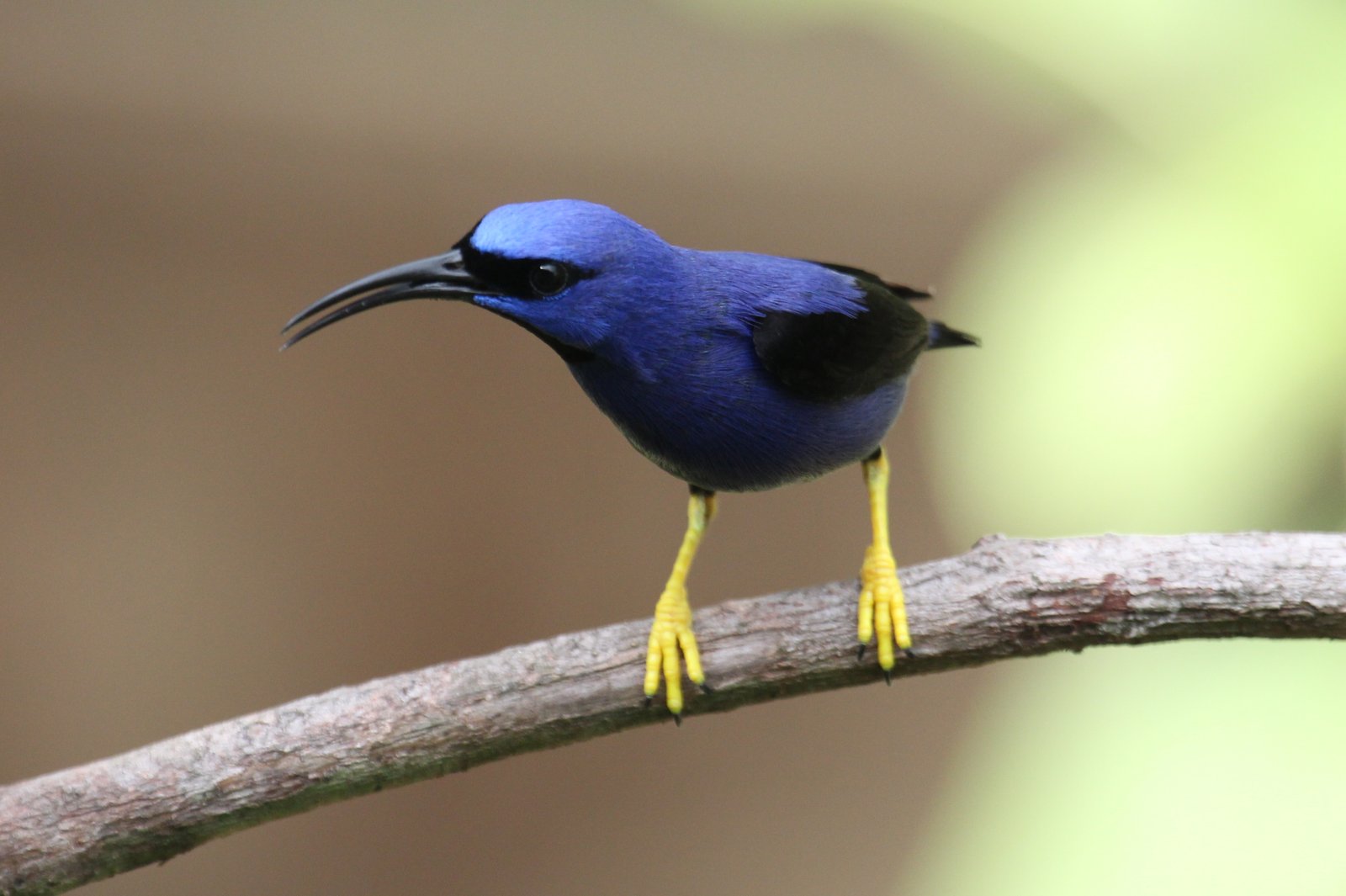
The Purple Honeycreeper is the most widespread honeycreeper of the humid lowlands on both sides of the Andes. The male is deep purplish blue with a black throat and bright yellow legs; the female is green with an ochre head. Both have a long, curved bill with which they take nectar from flowers.
Voice
Gives thin, high tseet notes; the song is a rapid series of high, thin chip notes.
Recording: JAYRSON ARAUJO DE OLIVEIRA — CC BY-NC-SA 4.0 · xeno-canto
Identification
10–11 cm, short-tailed, with a long, clearly curved black bill. The male is deep purplish blue, with black lores, a black throat patch and black wings and tail; the legs are bright yellow. The female is green above, with an ochre face and throat, a blue malar stripe and green and yellowish streaked underparts; her legs are dull yellow to greyish green. Juveniles resemble the female.
Confusion species
Short-billed Honeycreeper Cyanerpes nitidus has a short, almost straight bill, a larger black bib and pinkish-red legs. Red-legged Honeycreeper Cyanerpes cyaneus has a turquoise crown, a black back and red legs; the female is a duller green without an ochre head. Shining Honeycreeper Cyanerpes lucidus, found only near the Panama border, is a brighter azure-blue in the male; the female has a blue-streaked breast.
Habitat
Canopy and edges of humid lowland and foothill forest, also secondary forest, forest edges, cacao plantations and gardens with flowering trees, mostly below 1200 m. It eats nectar, small fruits and insects; it often visits flowering trees and fruiting shrubs and travels with mixed flocks. The nest is a small cup in a tree.
Where the bird is most at home, classified by the vegetation units of the Andes and the west coast.


Range and movements
In Colombia widespread in humid lowlands and foothills, both in the Chocó and east of the Andes. In Ecuador on both sides of the Andes, in the west mainly in the humid north and centre. In Peru in the lowlands and foothills east of the Andes. In Bolivia in the north and along the base of the Andes. Does not occur on the Galápagos. Outside the guide area in Panama, Venezuela, Trinidad, the Guianas and Amazonian Brazil.
- Resident
- dark = core range, pale = thinly spread
How and when to look
At flowering trees and feeders at lodges in the lowlands and foothills, where it often comes for nectar with other honeycreepers and dacnises; in the male, look for the yellow legs.
Conservation status
Least Concern. Widespread and fairly common; tolerates secondary forest and forest edges.
Scientific name
Cyanerpes caeruleus | (Linnaeus, 1758)
Linnaeus described the species in 1758 as Certhia caerulea; because it was later moved to another genus, the author and year stand in brackets. The genus Cyanerpes was introduced in 1899 by Oberholser. The genus name combines Greek kuanos, 'dark blue', and herpēs, 'creeper'. The species name is Latin caeruleus, 'blue'. The specimen the first description was based on came from Suriname.