All species › Jacamars and puffbirds › Jacamars › Purplish Jacamar
Purplish Jacamar | Galbula chalcothorax
Purperglansvogel | Jacamará violáceo | Ariramba-violácea
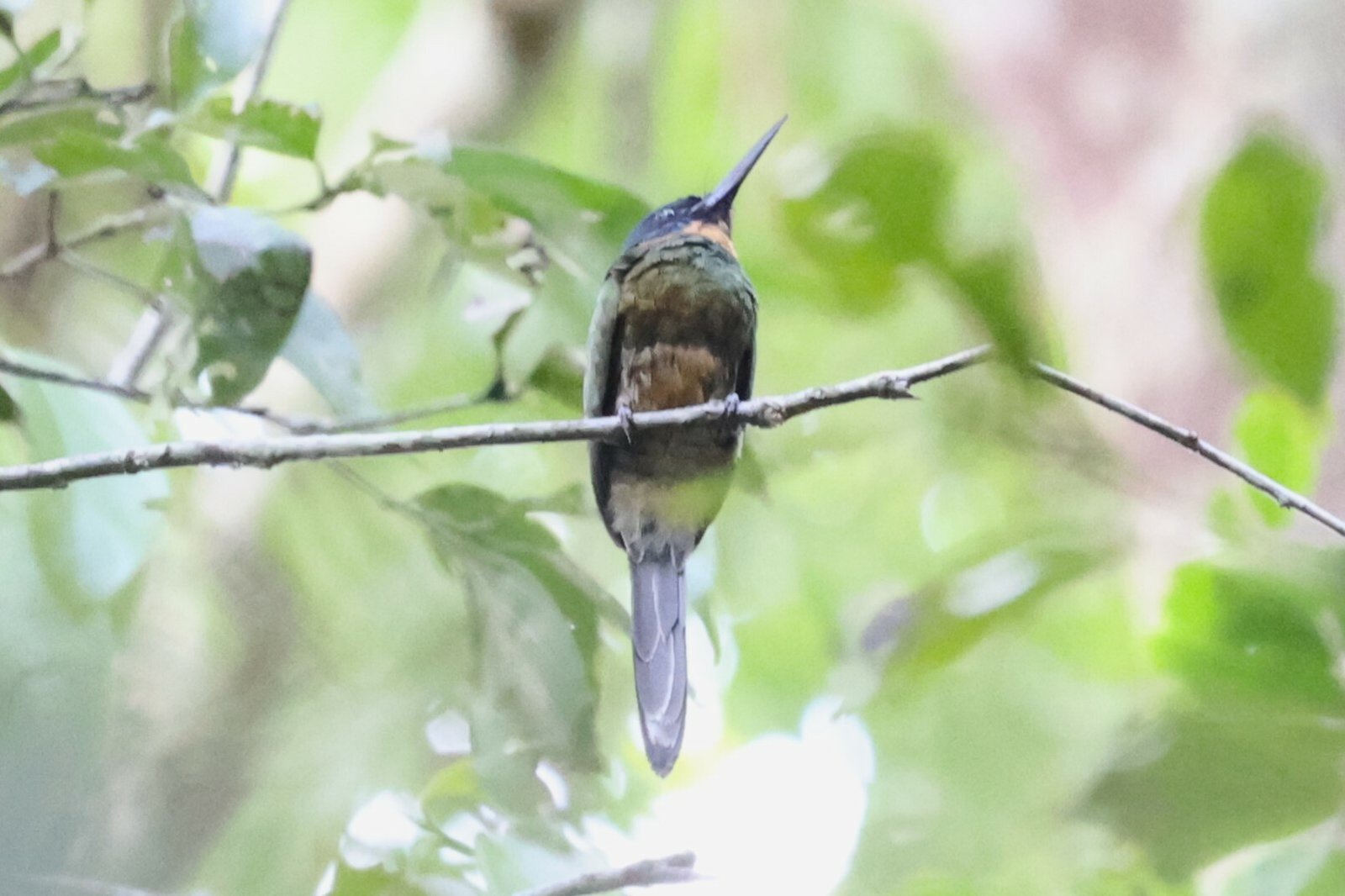
The Purplish Jacamar is a dark jacamar of western Amazonia, with a coppery purple gloss on the upperparts and breast. It often perches high on a bare branch at the edge of the canopy and sallies from there for insects. It is closely related to Bronzy Jacamar, which lives further east.
Voice
A series of high, thin whistles, pee-pee-pee, often rising and accelerating; also single sharp peek calls.
Recording: Daan van der Hoeven — CC BY-NC-SA 4.0 · xeno-canto
Identification
21–23 cm, with a long, straight, black bill. The upperparts and breast are dark, with a coppery purple to bronze-green gloss depending on the light; the crown is dark blue-green. The male has a white throat patch, the female a buff one. The belly is dark, with white in the centre and at the vent. The tail is dark and rather short for a jacamar.
Confusion species
Bronzy Jacamar Galbula leucogastra is smaller, more bronze-green than purple, with a whiter belly, and lives mainly in white-sand forest in eastern Colombia. Paradise Jacamar Galbula dea has a much longer, pointed tail and a pale, grey-brown crown. White-chinned Jacamar Galbula tombacea is green with a rufous belly.
Habitat
Humid terra firme forest and forest along rivers and streams, especially at forest edges, treefall gaps and along watercourses, from the lowlands up to about 900 m. It perches at middle to high levels on open branches and catches flying insects such as butterflies, bees and wasps. It nests in a self-dug tunnel in an earth bank or riverbank.
Where the bird is most at home, classified by the vegetation units of the Andes and the west coast.


Range and movements
In Colombia only locally in the far south-east, in Putumayo and Amazonas. In Ecuador in the eastern lowlands and the lowest Andean foothills. In Peru locally in the Amazonian lowlands, mainly in the north. Only a few records are known from Bolivia. Absent from the Galápagos. Outside the guide area in western Amazonian Brazil.
- Resident
- dark = core range, pale = thinly spread
How and when to look
Along rivers and clearings in the lowlands of eastern Ecuador, for example along the Napo, where the bird sallies from a bare branch above the river or forest edge. Also look from canopy towers.
Conservation status
Least Concern. The species has a fairly large range in largely undisturbed lowland forest.
Scientific name
Galbula chalcothorax | Sclater, 1855
Sclater described the species in 1855 and placed it straight away in the genus where it still stands. The genus Galbula was introduced in 1760 by Brisson. The genus name comes from Latin galbula, the name for a small yellow bird. The species name comes from Greek khalkos, 'copper' or 'bronze', and thōrax, 'breast': 'copper-breasted'. The specimen the first description was based on came from Quijos, Ecuador.