All species › Gamebirds › Guans, curassows and chachalacas › Razor-billed Curassow
Razor-billed Curassow | Mitu tuberosum
Mesbekpauwies | Paujil común | Mutum-cavalo
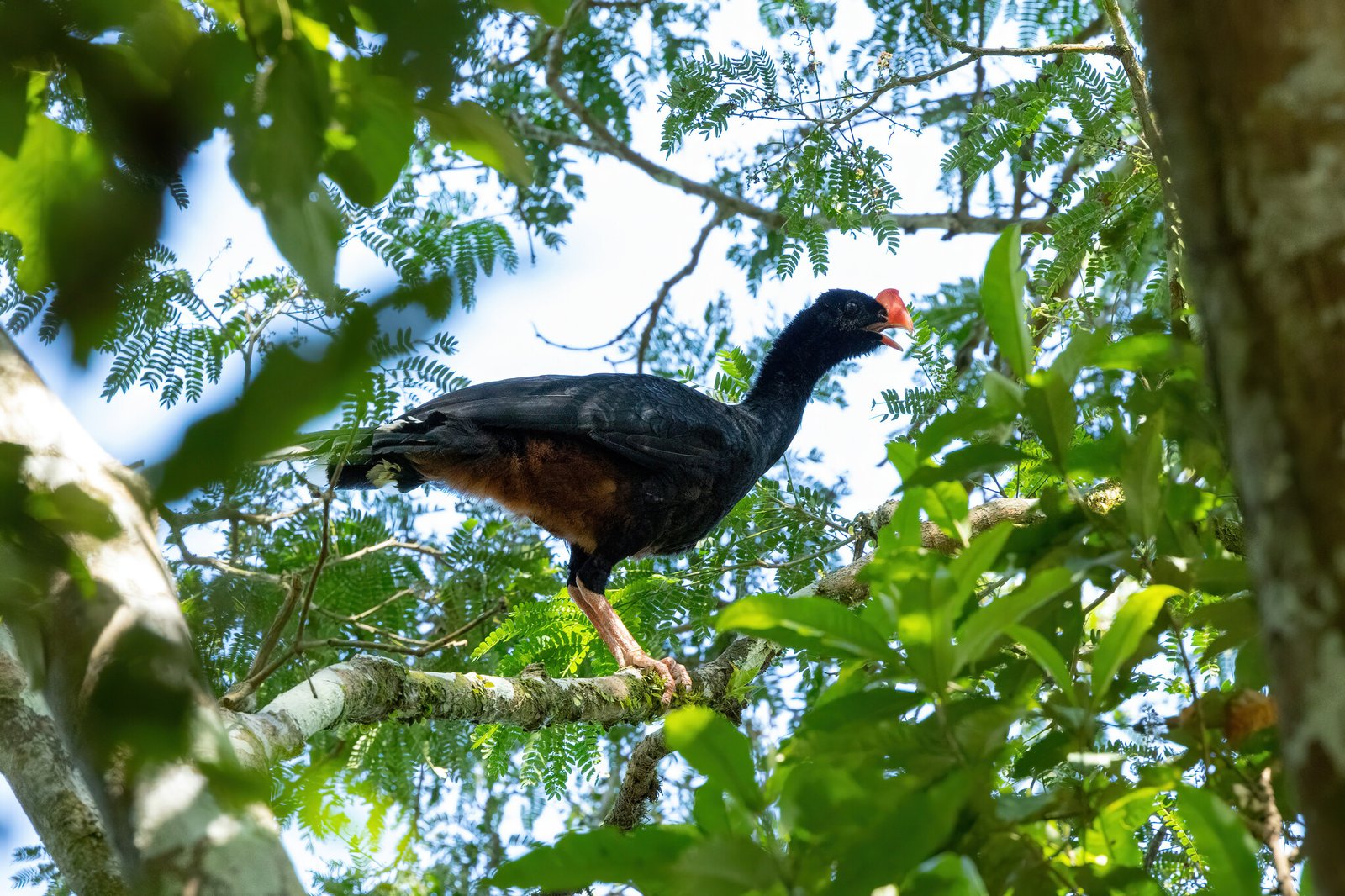
The Razor-billed Curassow is the curassow of southern Amazonia, recognisable by its tall, swollen red bill shaped like a blade. In the guide area it lives in the Amazonian lowlands of Peru and Bolivia, south of the Amazon and the Marañón, where it still walks regularly along trails in little-hunted forest.
Voice
A very deep, humming mmm-mmm… mm, given from a branch mainly at dusk and in the breeding season; also high, thin whistles as an alarm.
Recording: JAYRSON ARAUJO DE OLIVEIRA — CC BY-NC-SA 4.0 · xeno-canto
Identification
83–89 cm. Glossy blue-black, with a chestnut belly and chestnut undertail coverts, and a narrow white terminal band on the tail. The crown feathers are short and velvety. The bill is bright red, with a tall, laterally compressed and swollen ridge that extends onto the forehead; the legs are red. The sexes are alike.
Confusion species
Salvin's Curassow Mitu salvini lives north of the Amazon and the Marañón and has a white belly and a broad white tail tip. Wattled Curassow Crax globulosa and Bare-faced Curassow Crax fasciolata have a crest of curled feathers; the male Bare-faced has a yellow bill base, and the female is barred. Nocturnal Curassow Nothocrax urumutum is much smaller and rufous-brown.
Habitat
Tall humid lowland forest on terra firme and in seasonally flooded forest, also bamboo forest and foothill forest on the eastern slope of the Andes; mostly below about 1000 m. It walks alone or in pairs on the forest floor and eats fallen fruit, seeds and leaves. It nests in a tree, usually with two eggs.
Where the bird is most at home, classified by the vegetation units of the Andes and the west coast.


Range and movements
In Colombia only a few records from the far south. Absent from Ecuador. In Peru in the Amazonian lowlands south of the Amazon and the Marañón, east of the Andes to Madre de Dios. In Bolivia in the northern and central lowlands. Outside the guide area in Brazilian Amazonia south of the Amazon.
- Resident
- dark = core range, pale = thinly spread
How and when to look
Walk quietly early in the morning along trails in large, protected forest, such as Manu and Tambopata in Peru and Madidi in Bolivia. Birds often walk ahead of the observer along the trail and sometimes come to clay licks or riverbanks.
Conservation status
Near Threatened. Numbers are declining through hunting, to which large curassows are especially vulnerable, and through clearance of lowland forest, particularly along the edge of Amazonia in Brazil; in large protected areas still fairly common.
Scientific name
Mitu tuberosum | (Spix, 1825)
Spix described the species in 1825 as Crax tuberosa; because it was later moved to another genus, the author and year stand in brackets. The genus Mitu was introduced in 1831 by Lesson. The genus name comes from the Tupi name Mitú or Mutúm for the curassows, roughly 'black bird'; Marcgrave recorded it in 1648 as 'Mitu' or 'Mutu', and Lesson made it a genus name in 1831. The species name comes from Latin tuber, 'swelling': 'swollen', for the tall, swollen bill. The specimen the first description was based on came from (per the description).