All species › Gannets and cormorants › Boobies and gannets › Red-footed Booby
Red-footed Booby | Sula sula
Roodpootgent | Piquero patirrojo | Atobá-de-pé-vermelho
The Red-footed Booby is the smallest booby and the only one that nests in trees and shrubs. It forages far out at sea and often hunts flying fish and squid at dusk. On Galápagos, Genovesa holds one of the largest colonies in the world.
Voice
In the colony a hoarse, rattling karr-karr and cackling calls; silent at sea.
Recording: Oscar Campbell — CC BY-NC-SA 4.0 · xeno-canto
Identification
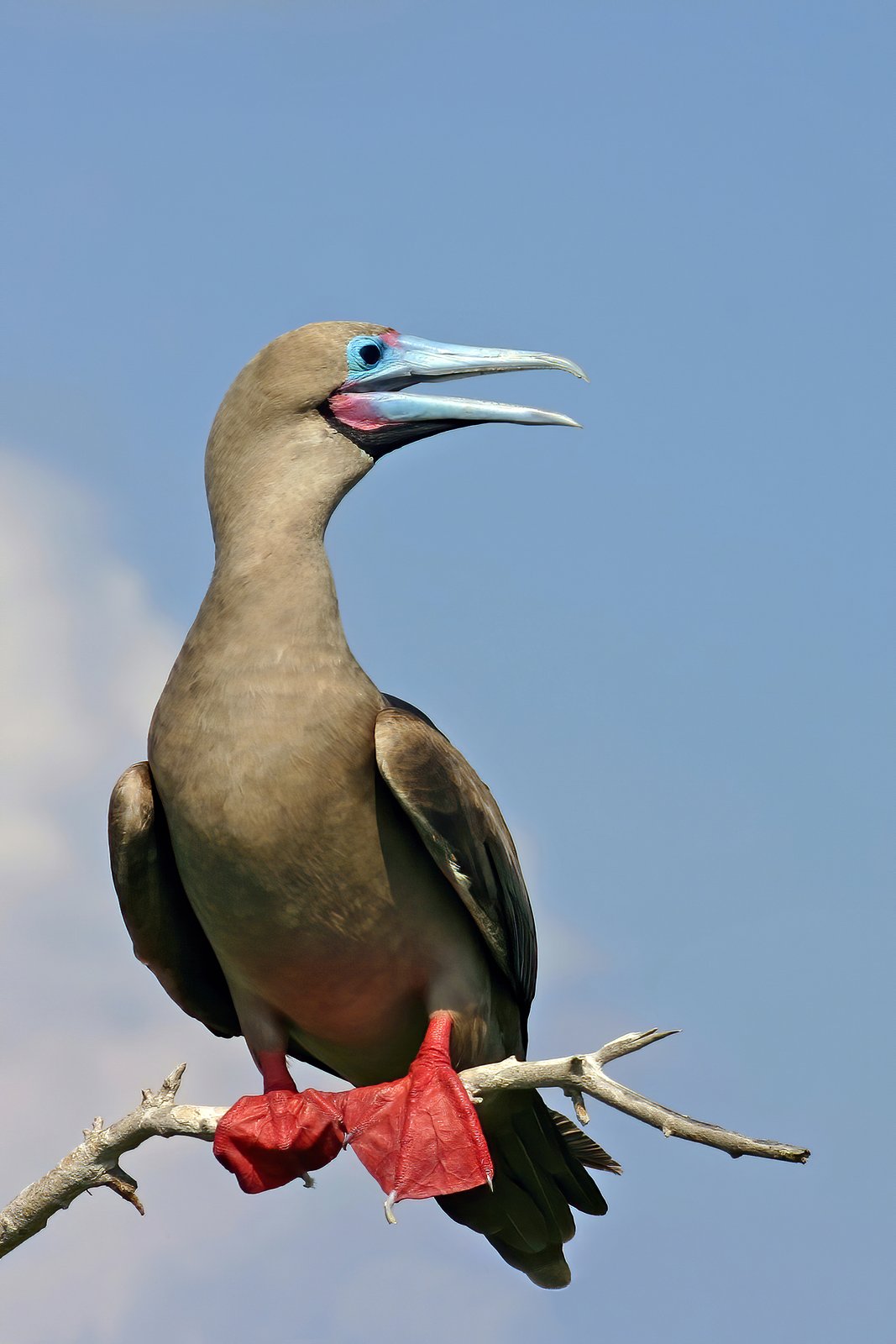
66–77 cm, the smallest booby, with a long, pointed tail, narrow wings and bright red feet in adults. The bill is pale blue with a pink base, the face bluish. There are several colour morphs: a brown morph, all greyish brown, sometimes with a white tail and rump; a white morph, white with black flight feathers and often a yellowish wash on the head and nape; and intermediates. On Galápagos the brown morph predominates. The sexes are alike. Juveniles are greyish brown with a dark bill and grey to pinkish feet.
Confusion species
Nazca Booby Sula granti is larger, white with black flight feathers, black tail and a black mask, and has an orange bill and dark feet; the white morph of Red-footed Booby has a white tail. Masked Booby Sula dactylatra closely resembles Nazca Booby but has a yellow bill. Brown Booby Sula leucogaster has a dark brown head and breast sharply demarcated from the white belly, and yellow feet. Blue-footed Booby Sula nebouxii has blue feet and nests on the ground.
Habitat
Open warm ocean, often far from the coast; comes ashore only at the breeding islands. It plunges into the sea from a height or catches flying fish in the air; it feeds mainly on flying fish and squid. It breeds in colonies in shrubs, low trees and mangroves, on a nest of twigs.
Where the bird is most at home, classified by the vegetation units of the Andes and the west coast.


Range and movements
On Galápagos a common breeding bird, with large colonies on Genovesa and smaller ones at Punta Pitt on San Cristóbal, among others. Along the mainland coast of Ecuador, Colombia and northern Peru mainly offshore and scarce. In Colombia also in the Caribbean, around islands. Absent from Bolivia. Outside the guide area on tropical islands in the Atlantic, Pacific and Indian Oceans.
- Resident
- dark = core range, pale = thinly spread
How and when to look
On Genovesa, Red-footed Boobies sit on their nests in the bushes beside the trails at Darwin Bay and Prince Philip's Steps. On San Cristóbal they breed at Punta Pitt, where Blue-footed and Nazca Boobies also nest.
Conservation status
Least Concern. The world population is large. On many islands elsewhere colonies have disappeared because of hunting and introduced predators; on Galápagos the colonies are protected.
Scientific name
Sula sula | (Linnaeus, 1766)
Linnaeus described the species in 1766 as Pelecanus Sula; because it was later moved to another genus, the author and year stand in brackets. The genus Sula was introduced in 1760 by Brisson. The genus name comes from Old Norse súla, the name for the Northern Gannet. The species name repeats the genus name, from Old Norse súla, 'gannet'. The specimen the first description was based on came from Barbados.