All species › Gannets and cormorants › Boobies and gannets › Brown Booby
Brown Booby | Sula leucogaster
Bruine gent | Piquero pardo | Atobá-pardo
The Brown Booby is the most widespread booby of tropical coasts, and in the guide area mainly a bird of the Caribbean coast and islands of Colombia. It fishes closer inshore than most other boobies and often dives obliquely from a fairly low height. It frequently rests on buoys, rocks and ship rigging.
Voice
The male gives a thin, hissing whistle, the female a loud, hoarse honk or quack; mainly in the colony.
Recording: David Darrell-Lambert — CC BY-NC-SA 4.0 · xeno-canto
Identification
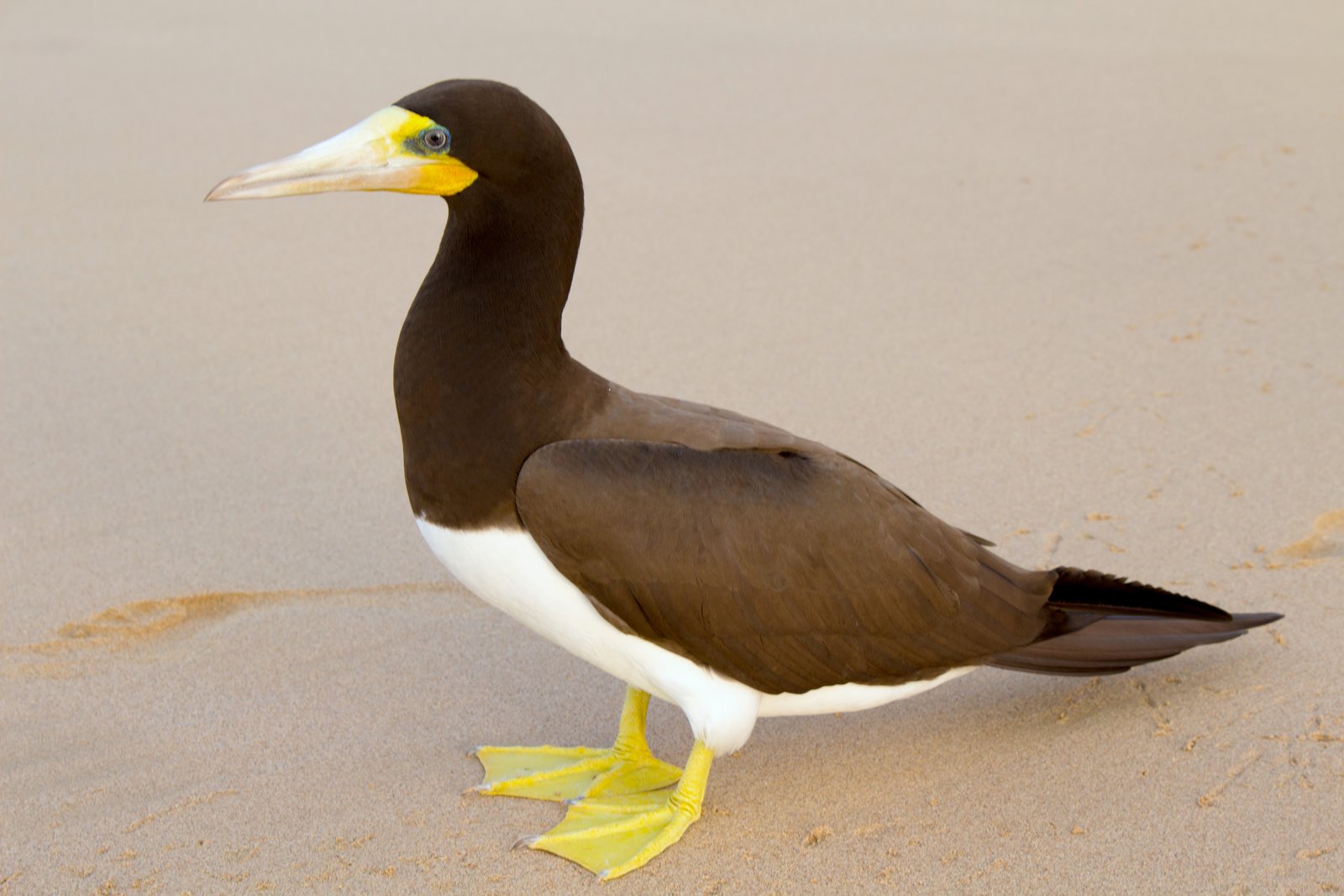
64–74 cm, with a pointed yellow to greyish-yellow bill, narrow wings and a pointed tail. The head, neck, breast and upperparts are uniform dark chocolate brown; the white belly is sharply demarcated from the brown breast. The underwing is white with a broad brown border. The feet are yellow. The female has a yellow bill and yellow face, the male a bluish-grey face. Males of the Pacific forms have a greyish-white head. Juveniles are brown with a dirty brown belly, on which the sharp breast border is faintly visible.
Confusion species
Juvenile Red-footed Boobies Sula sula and brown morphs of Red-footed Booby are uniformly brown without a sharply demarcated white belly. Juvenile Nazca Boobies Sula granti and Masked Boobies Sula dactylatra have a white neck collar and a white breast. Blue-footed Booby Sula nebouxii has a finely streaked pale head, a white rump patch and blue feet.
Habitat
Warm inshore waters, bays and the sea around islands and rocks, usually not far from the coast. It dives for shoals of small fish and squid, often obliquely and from a low height; it also follows fishing boats. It breeds in colonies on the ground, on rocky islands and cliffs, in a shallow scrape with some plant material.
Where the bird is most at home, classified by the vegetation units of the Andes and the west coast.


Range and movements
In Colombia common along the Caribbean coast and around the islands, and along the Pacific coast and around Gorgona and Malpelo. In Ecuador scarce along the mainland coast, rare on Galápagos. In Peru rare in the north. Absent from Bolivia. Outside the guide area widespread on tropical coasts and islands of the Atlantic, Pacific and Indian Oceans.
- Resident
- dark = core range, pale = thinly spread
How and when to look
Along the Caribbean coast of Colombia, for example near Santa Marta and the Islas del Rosario, Brown Boobies sit on rocks and buoys and fish just offshore. On the Pacific side they can be seen from boats to Gorgona.
Conservation status
Not Evaluated. Following a recent taxonomic revision, the species in its current circumscription has no Red List assessment of its own yet; in the former, broader sense it was considered Least Concern. Threats are disturbance of breeding islands, introduced predators and overfishing.
Scientific name
Sula leucogaster | (Boddaert, 1783)
Boddaert described the species in 1783 as Pelecanus Leucogaster; because it was later moved to another genus, the author and year stand in brackets. The genus Sula was introduced in 1760 by Brisson. The genus name comes from Old Norse súla, the name for the Northern Gannet. The species name comes from Greek leukos, 'white', and gastēr, 'belly', for the white belly. The specimen the first description was based on came from Cayenne, French Guiana.