All species › Gannets and cormorants › Boobies and gannets › Nazca Booby
Nazca Booby | Sula granti
Nazcagent | Bobo de Nazca | Atobá-de-nazca
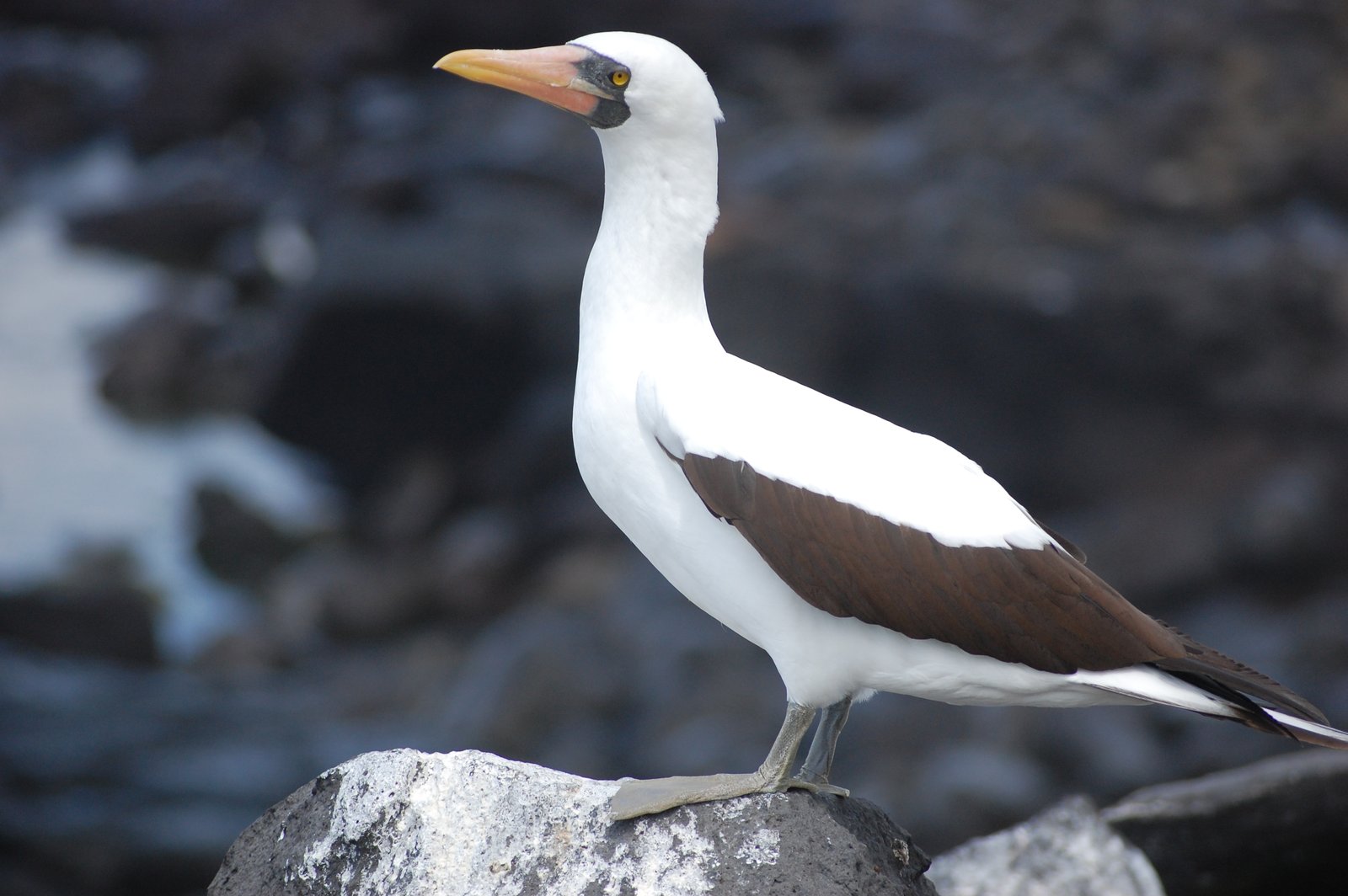
The Nazca Booby is a large white-and-black booby of the eastern Pacific that breeds on Galápagos and a few other islands. It was formerly included in Masked Booby, but is now treated as a separate species. Nazca Boobies fish further out at sea than Blue-footed Boobies and dive deeply for larger fish.
Voice
The male gives a thin, squeaky whistle, the female a loud, hoarse honk; mainly in the colony.
Recording: Eric DeFonso — CC BY-NC-SA 3.0 · xeno-canto
Identification
81–92 cm, a large, heavy booby with long, narrow wings and a pointed tail. Adults are bright white, with black flight feathers, a black tail and a black facial mask around the base of the bill. The bill is orange to pinkish orange, the eye yellow, the feet greyish olive. In flight the black trailing edge and wingtip contrast sharply with the white body and white forewing. Juveniles are brown on the head, neck and upperparts, with a white belly, a brown collar and a grey bill; they gradually become whiter.
Confusion species
Masked Booby Sula dactylatra is very similar but has a greenish-yellow rather than orange bill; in the guide area it is rare and mainly far offshore. Red-footed Booby Sula sula occurs in a white morph, with a white tail, red feet and a bluish-grey bill; on Galápagos most Red-footed Boobies are brown. Young Nazca Boobies resemble Brown Booby Sula leucogaster, but that species has a dark breast sharply demarcated from the white belly, without a pale collar.
Habitat
Open sea around islands, often further from the coast than other boobies. It nests on bare ground on cliffs, cliff edges and flat parts of islands, in loose colonies; two eggs are usually laid, but the older chick almost always pushes its younger sibling out of the nest. It dives vertically and deeply for fish, especially sardines and flying fish.
Where the bird is most at home, classified by the vegetation units of the Andes and the west coast.


Range and movements
In Ecuador on Galápagos and on Isla de la Plata. In Colombia on the island of Malpelo, with a large colony. In Peru mainly at sea off the north, outside the breeding season. Absent from Bolivia. Outside the guide area on islands in the eastern Pacific off Mexico and Central America, such as Clipperton.
- Resident
- dark = core range, pale = thinly spread
How and when to look
At Punta Suárez on Española and on Genovesa, Nazca Boobies nest on the cliff edges beside the trail. On Isla de la Plata they can also be seen from the trails, alongside Blue-footed Boobies.
Conservation status
Least Concern. The population is large and the main colonies lie in protected areas. In El Niño years many breeding attempts fail and adults also die.
Scientific name
Sula granti | Rothschild, 1902
Rothschild described the species in 1902 and placed it straight away in the genus where it still stands. The genus Sula was introduced in 1760 by Brisson. The genus name comes from Old Norse súla, the name for the Northern Gannet. The species name honours William Robert Ogilvie-Grant (1863–1924), English ornithologist at the British Museum (Natural History) from 1882 to 1918. The specimen the first description was based on came from Isla Darwin, Galápagos.