All species › Gannets and cormorants › Boobies and gannets › Masked Booby
Masked Booby | Sula dactylatra
Maskergent | Bobo enmascarado | Atobá-grande
The Masked Booby is the largest booby, a seabird of the open tropical oceans. In the guide area it is scarce: the black-and-white boobies of Galápagos and the coast of Ecuador are almost always Nazca Boobies, which used to be included in this species. True Masked Boobies appear mainly off the coast of Colombia and far out at sea.
Voice
The male gives a thin, whistled squeak, the female a loud, hoarse honk; usually silent at sea.
Recording: Eric S. J. Tan — CC BY-NC-SA 4.0 · xeno-canto
Identification
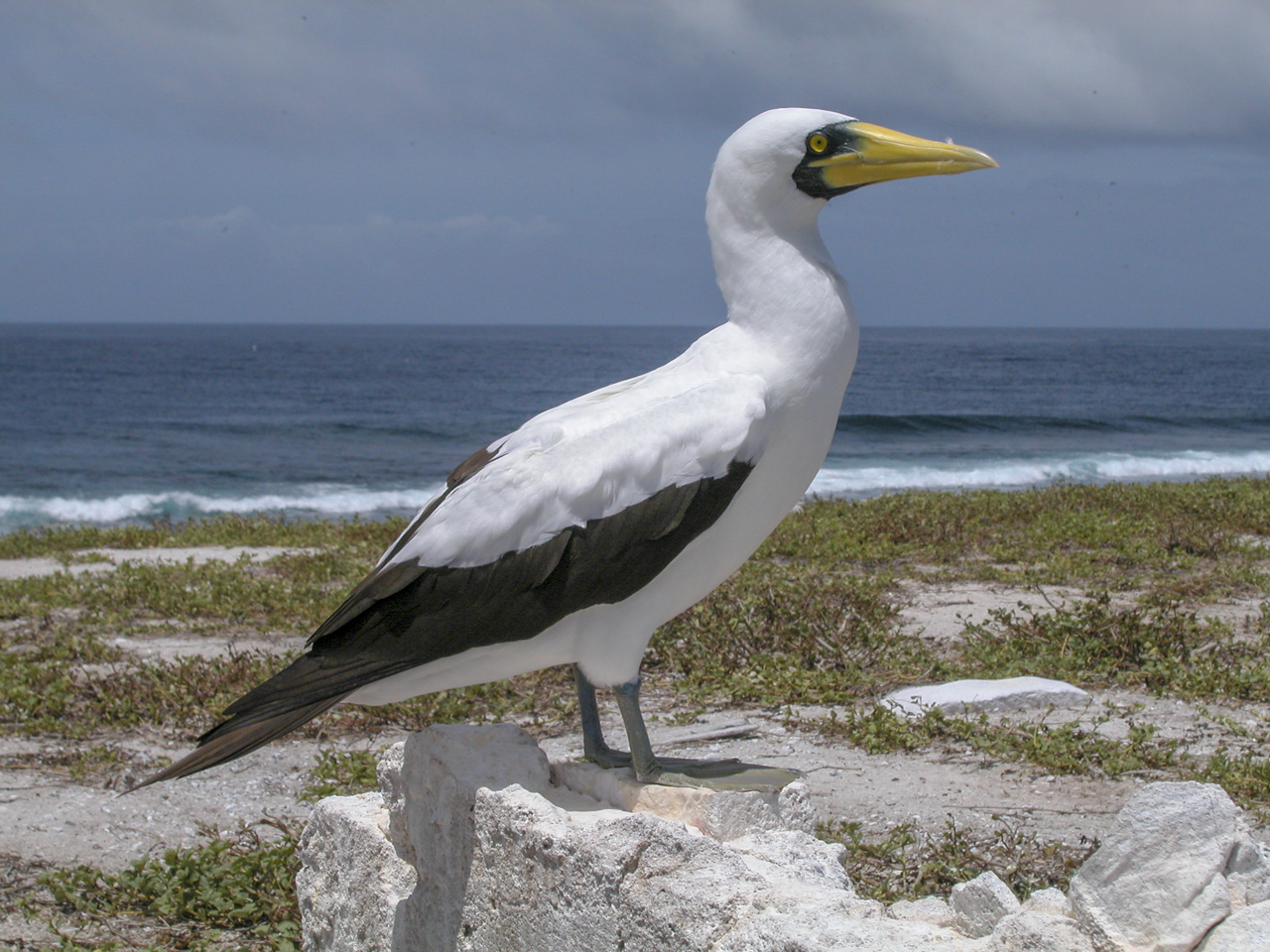
81–92 cm, the largest booby, with a powerful, pointed bill, long, narrow wings and a pointed tail. The plumage is white with black flight feathers, a black trailing edge to the wing and a black tail; the bare skin around the base of the bill is blackish grey and forms a mask. The bill is yellow to greenish yellow, the eye yellow, the feet grey to olive green. The sexes are alike; the female is slightly larger. Juveniles are brown on the head, neck and upperparts, with a white neck collar and a white belly.
Confusion species
Nazca Booby Sula granti has the same pattern but an orange to pinkish-orange bill and a slightly slimmer build; juveniles can hardly be separated. The white morph of Red-footed Booby Sula sula is smaller, with a white tail, a blue bill and red feet. Juvenile Brown Boobies Sula leucogaster lack the white neck collar.
Habitat
Open warm ocean, often far from the coast, over deep water. It plunges vertically from a great height for flying fish, mackerel and squid. It breeds in colonies on the ground on flat, bare islands, without a nest.
Where the bird is most at home, classified by the vegetation units of the Andes and the west coast.


Range and movements
In Colombia scarce at sea off the Caribbean and Pacific coasts; possibly breeds on a few remote islets of the San Andrés archipelago. In Ecuador and Peru rare far offshore; many older records refer to Nazca Booby. On Galápagos replaced by Nazca Booby. Absent from Bolivia. Outside the guide area on tropical islands in the Atlantic, Pacific and Indian Oceans, in the eastern Pacific for example on Clipperton and the Revillagigedo Islands.
- Resident
- Winter visitor (c. Oct–Mar)
- Passage (Mar–Apr, Oct–Nov)
- dark = core range, pale = thinly spread
How and when to look
The best chance of a Masked Booby is on a boat trip far off the coast of Colombia. With every black-and-white booby, check the bill colour: yellow in Masked, orange in Nazca.
Conservation status
Least Concern. The world population is large, but on many islands colonies have declined because of introduced predators, disturbance and egg collecting.
Scientific name
Sula dactylatra | Lesson, 1831
Lesson described the species in 1831 and placed it straight away in the genus where it still stands. The genus Sula was introduced in 1760 by Brisson. The genus name comes from Old Norse súla, the name for the Northern Gannet. The species name comes from Greek daktulos, 'finger', and Latin ater, 'black', referring to the black primaries. The specimen the first description was based on came from Ascension.