All species › Gannets and cormorants › Boobies and gannets › Peruvian Booby
Peruvian Booby | Sula variegata
Humboldtgent | Bobo peruano | Atobá-peruano
The Peruvian Booby is one of the three great guano birds of the Humboldt Current, together with Guanay Cormorant and Peruvian Pelican. In the cold, food-rich waters off the coast of Peru it lives on anchovies and dives in flocks of hundreds or thousands of birds. Its numbers fluctuate strongly with fish stocks and with El Niño.
Voice
The male gives a thin whistle, the female a low, hoarse grunt or honk; mainly in the colony.
Recording: Cristian Pinto Fernandez — CC BY-NC-SA 4.0 · xeno-canto
Identification
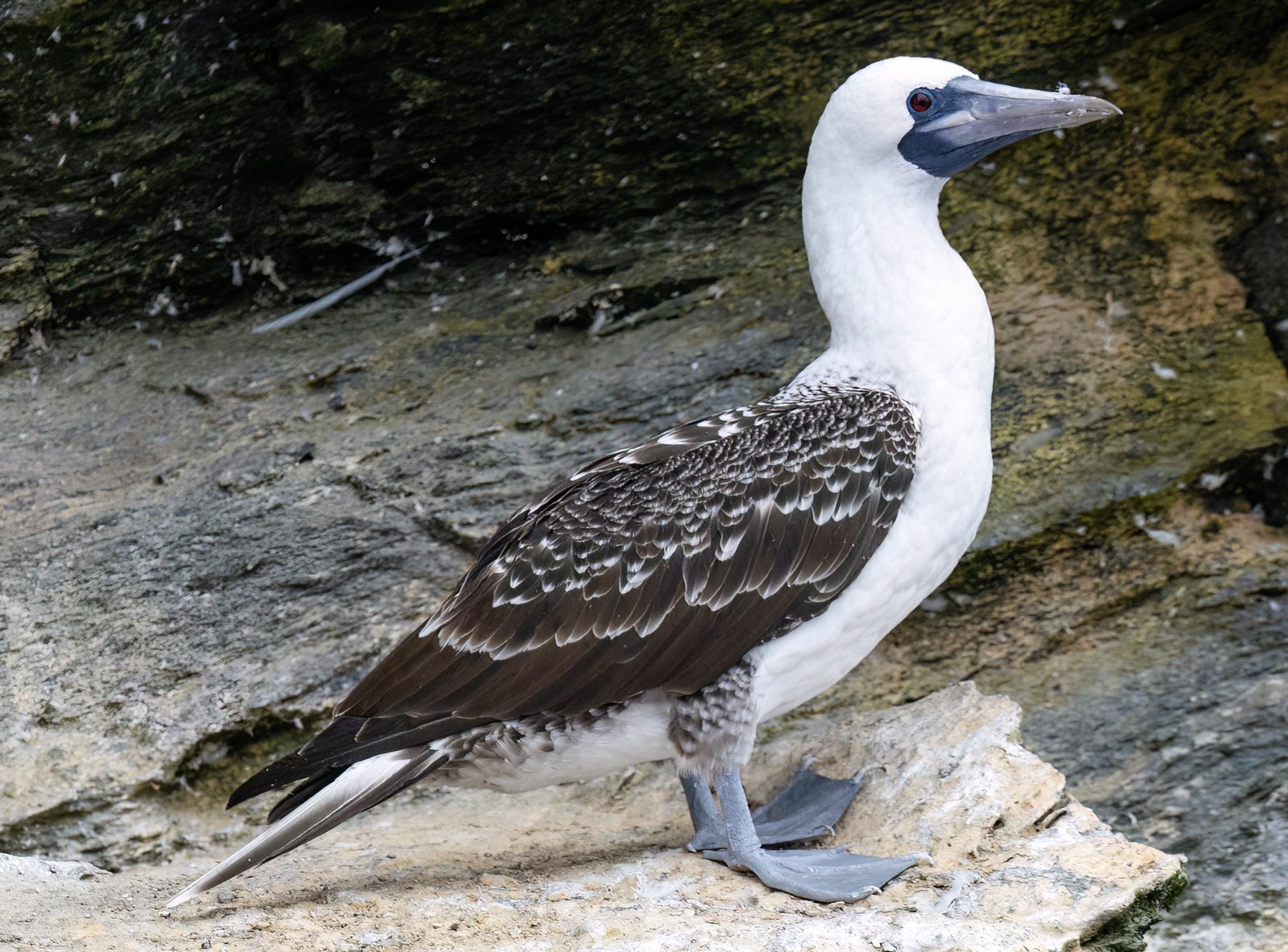
70–76 cm, a medium-sized booby with a pointed bluish-grey bill, a bluish-black face and bluish-grey feet. The head, neck and underparts are white. The back and wings are dark brown with white fringes, giving a scaly look. The rump is white with brown spots, the tail dark. The sexes are alike. Juveniles have a brownish-washed head and neck.
Confusion species
Blue-footed Booby Sula nebouxii has a brownish streaked rather than white head and neck and bright blue feet. Nazca Booby Sula granti has a white back and upperwing coverts, black flight feathers, a black mask and an orange bill. Brown Booby Sula leucogaster has a dark brown head and breast and yellow feet.
Habitat
Cold inshore waters of the Humboldt Current, mainly within a few tens of kilometres of the coast. It dives in flocks, obliquely or vertically, for anchovies and other small schooling fish. It breeds in large, dense colonies on guano islands, cliffs and rocky headlands along the coast, in a shallow scrape surrounded by guano.
Where the bird is most at home, classified by the vegetation units of the Andes and the west coast.


Range and movements
In Peru common along the whole coast, with large colonies on guano islands such as the Islas Ballestas, the Islas Chincha and the Islas Lobos. In Ecuador scarce in the southwest, in the Gulf of Guayaquil and along the coast of Santa Elena, more numerous during El Niño. In Colombia only a rare wanderer along the Pacific coast, mainly in El Niño years. Absent from Galápagos and Bolivia. Outside the guide area along the coast of northern and central Chile.
- Resident
- dark = core range, pale = thinly spread
How and when to look
On a boat trip from Paracas to the Islas Ballestas you see thousands of Peruvian Boobies on the rocks and diving into the sea, together with Guanay Cormorants, Peruvian Pelicans and Inca Terns. Along the whole coast of Peru diving flocks can also be watched from land.
Conservation status
Least Concern. Numbers fluctuate strongly: during El Niño many birds die or leave, and the population depends on the anchovy fishery. In the past guano harvesting disturbed the colonies; today most guano islands are protected.
Scientific name
Sula variegata | (Tschudi, 1843)
Tschudi described the species in 1843 as Dysporus variegatus; because it was later moved to another genus, the author and year stand in brackets. The genus Sula was introduced in 1760 by Brisson. The genus name comes from Old Norse súla, the name for the Northern Gannet. The species name comes from Latin variegatus, 'variegated'. The specimen the first description was based on came from islands off the coast of Peru.