All species › Gannets and cormorants › Boobies and gannets › Blue-footed Booby
Blue-footed Booby | Sula nebouxii
Blauwvoetgent | Bobo patas azules | Atobá-de-pés-azuis
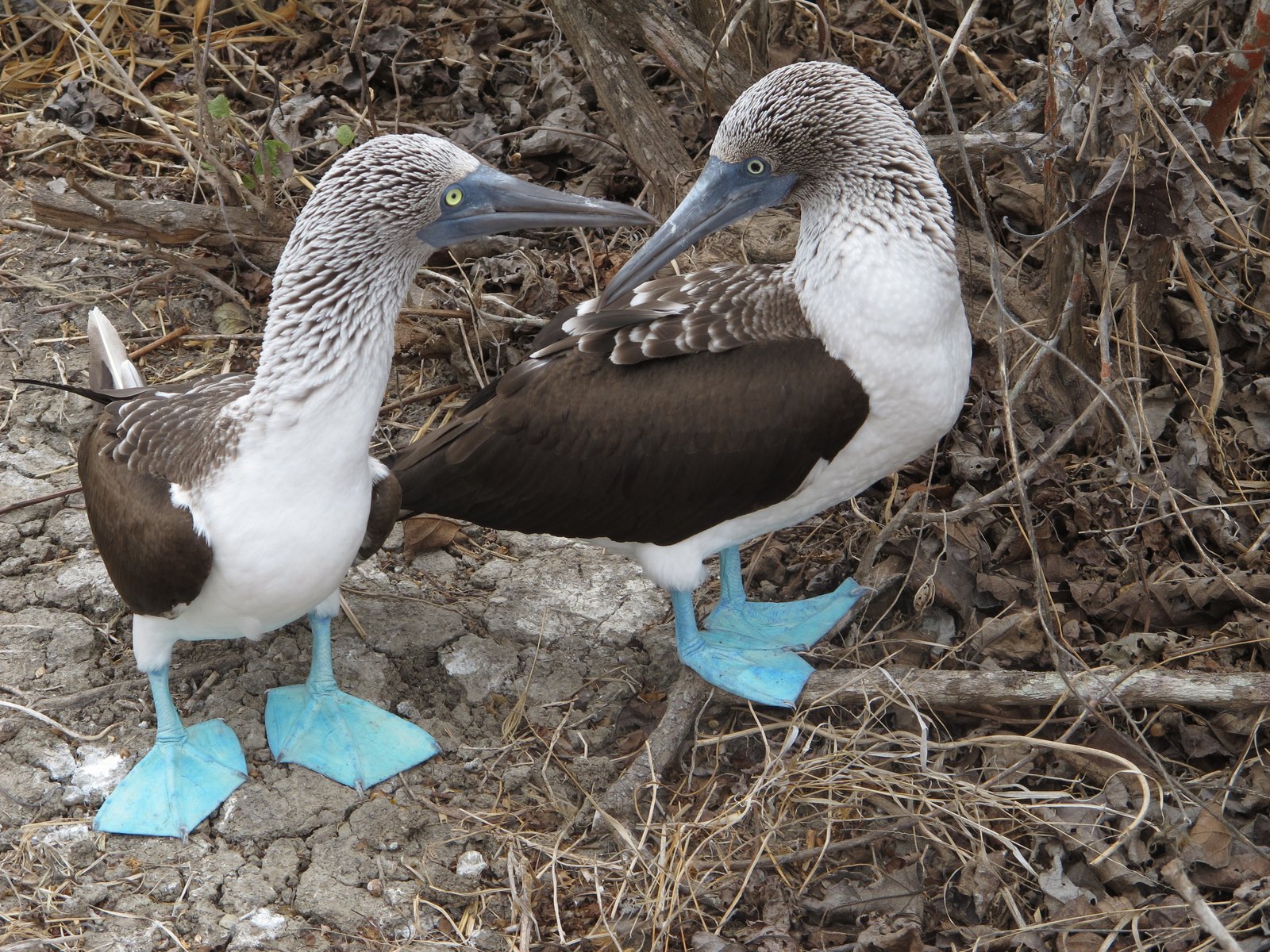
With its bright blue feet, the Blue-footed Booby is one of the best-known birds of Galápagos and the coast of Ecuador. It fishes in warm and temperate inshore waters, plunging into the water in groups from a great height. In courtship, males take turns lifting their blue feet and point their bill and wings skyward.
Voice
The male gives a thin, shrill whistle, the female a low, hoarse honk or quack; heard mainly in the colony.
Recording: Bobby Wilcox — CC BY-NC-SA 4.0 · xeno-canto
Identification
76–84 cm, with a long, pointed bill, long, narrow wings and a pointed tail. The head and neck are pale brown with fine white streaks, the back and wings dark brown with pale fringes. A white patch on the nape and back and a white patch on the rump stand out. The underparts are white. The feet are bright turquoise to sky blue, the bill greyish blue. The female is larger and appears to have a larger pupil because of a dark ring around it. Juveniles have a darker brown head, a brown breast band and dull greyish-blue feet.
Confusion species
Peruvian Booby Sula variegata, found mainly along the coast of Peru, has a plain white head and neck, more white on the back and grey feet. Nazca Booby Sula granti is white with black flight feathers and tail and has an orange bill. Brown Booby Sula leucogaster has a plain dark brown head and breast sharply demarcated from the white belly, and yellow feet.
Habitat
Inshore waters, bays and the sea around islands, mostly close to land. It nests on the ground on flat parts of islands and coasts, on bare ground between rocks or low scrub, without a nest; the ground around the nest turns white with droppings. It often dives in groups, obliquely or vertically, for shoals of small fish such as sardines and anchovies.
Where the bird is most at home, classified by the vegetation units of the Andes and the west coast.


Range and movements
In Ecuador common on Galápagos, with colonies on Española, North Seymour and Isabela, among others, and on Isla de la Plata and elsewhere along the mainland coast. In Peru mainly in the north, on islands such as the Islas Lobos, and scarcer further south along the coast. In Colombia mainly along the Pacific coast and around islands outside the breeding season. Absent from Bolivia. Outside the guide area along the Pacific coast of Mexico and Central America, with large colonies in the Gulf of California.
- Resident
- dark = core range, pale = thinly spread
How and when to look
On Española and North Seymour Blue-footed Boobies nest beside the trails and their courtship can be watched at close range. From Puerto López on the coast of Ecuador, boat trips go to Isla de la Plata, where the species breeds in large numbers.
Conservation status
Least Concern. On Galápagos the number of breeding birds has fallen sharply since the 1990s, probably because of a shortage of sardines. In El Niño years many breeding attempts fail.
Scientific name
Sula nebouxii | Milne-Edwards, 1882
Milne-Edwards described the species in 1882 and placed it straight away in the genus where it still stands. The genus Sula was introduced in 1760 by Brisson. The genus name comes from Old Norse súla, the name for the Northern Gannet. The species name honours Adolphe-Simon Neboux (1806–1844), French surgeon, naturalist and explorer. The specimen the first description was based on came from Pacific coast of America (probably Chile).