All species › Gannets and cormorants › Anhinga and darters › Anhinga
Anhinga | Anhinga anhinga
Amerikaanse slangenhalsvogel | Anhinga americana | Biguatinga
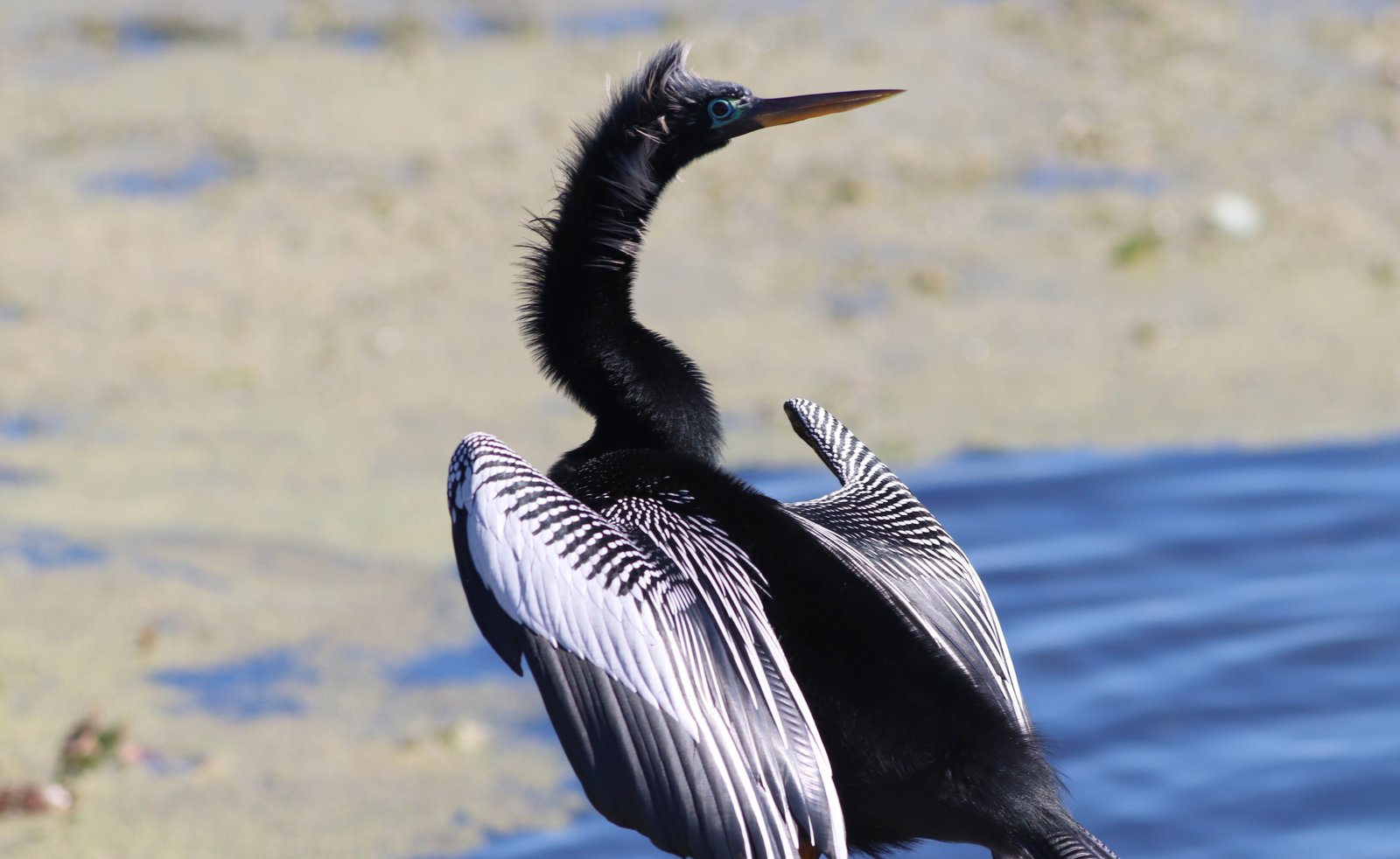
The Anhinga is a waterbird with a long, thin, S-shaped neck and a straight, pointed bill. It often swims with only its head and neck above the water, which earned it the name 'snakebird'. It spears fish underwater with its bill and afterwards dries its plumage on a branch with wings spread.
Voice
Usually silent. At the nest and in colonies a dry, clicking or rattling krrr-krrr-krrr and low grunting sounds.
Recording: Raul A. Spais — CC BY-NC-SA 4.0 · xeno-canto
Identification
81–91 cm, slender, with a small head, a long, thin neck, a straight, dagger-shaped yellow bill and a long, fan-shaped tail with a pale terminal band. The male is glossy black with silvery-white streaks and spots on the scapulars and upperwing. The female has the same wing pattern, but the head, neck and breast are pale brown. Juveniles resemble the female but are duller and browner. In flight it alternates flapping with gliding and often soars high on thermals, with the tail spread.
Confusion species
Neotropic Cormorant Nannopterum brasilianum has a shorter, thicker neck, a hook-tipped bill and a shorter tail, lacks the silvery-white wing pattern and swims with more of the body above water. In flight the cormorant holds its neck slightly kinked and flaps continuously, whereas the Anhinga shows a straight neck, a long tail and often a gliding flight.
Habitat
Calm fresh or brackish water with trees or shrubs along the shore: lakes, oxbows (cochas), marshes, slow rivers, flooded forest and mangrove, mainly in the lowlands up to about 500 m, locally higher. It swims underwater and spears fish, as well as amphibians and aquatic insects. It often nests in colonies with herons and cormorants; the stick nest is placed in a tree or shrub over water.
Where the bird is most at home, classified by the vegetation units of the Andes and the west coast.


Range and movements
In Colombia widespread in the lowlands of the Caribbean region, the Magdalena Valley, the llanos and Amazonia, scarcer along the Pacific coast. In Ecuador in the western lowlands, especially the Guayas basin, and in the Amazonian lowlands. In Peru mainly in the Amazonian lowlands, on the Pacific side only in the far north-west. In Bolivia in the lowlands of the north and east. Absent from Galápagos. Outside the guide area from the south-eastern United States to northern Argentina.
- Resident
- dark = core range, pale = thinly spread
How and when to look
Check branches and dead trees over oxbow lakes and marshes in the Amazonian lowlands or the llanos, where birds sit drying their wings. In the middle of the day they sometimes soar high over the water.
Conservation status
Least Concern (LC). The species has a large range; locally it suffers from the loss of wetlands, disturbance of breeding colonies and water pollution.
Scientific name
Anhinga anhinga | (Linnaeus, 1766)
Linnaeus described the species in 1766 as Plotus anhinga; because it was later moved to another genus, the author and year stand in brackets. The genus Anhinga was introduced in 1760 by Brisson. The genus name comes from anhinga, the Tupi name for this bird in Brazil. The species name repeats the genus name, the Tupi name anhinga for this bird. The specimen the first description was based on came from Rio Tapajós, Pará, Brazil.