All species › Gannets and cormorants › Cormorants and shags › Red-legged Cormorant
Red-legged Cormorant | Poikilocarbo gaimardi
Roodpootaalscholver | Cormorán chuita | Biguá-de-pernas-vermelhas
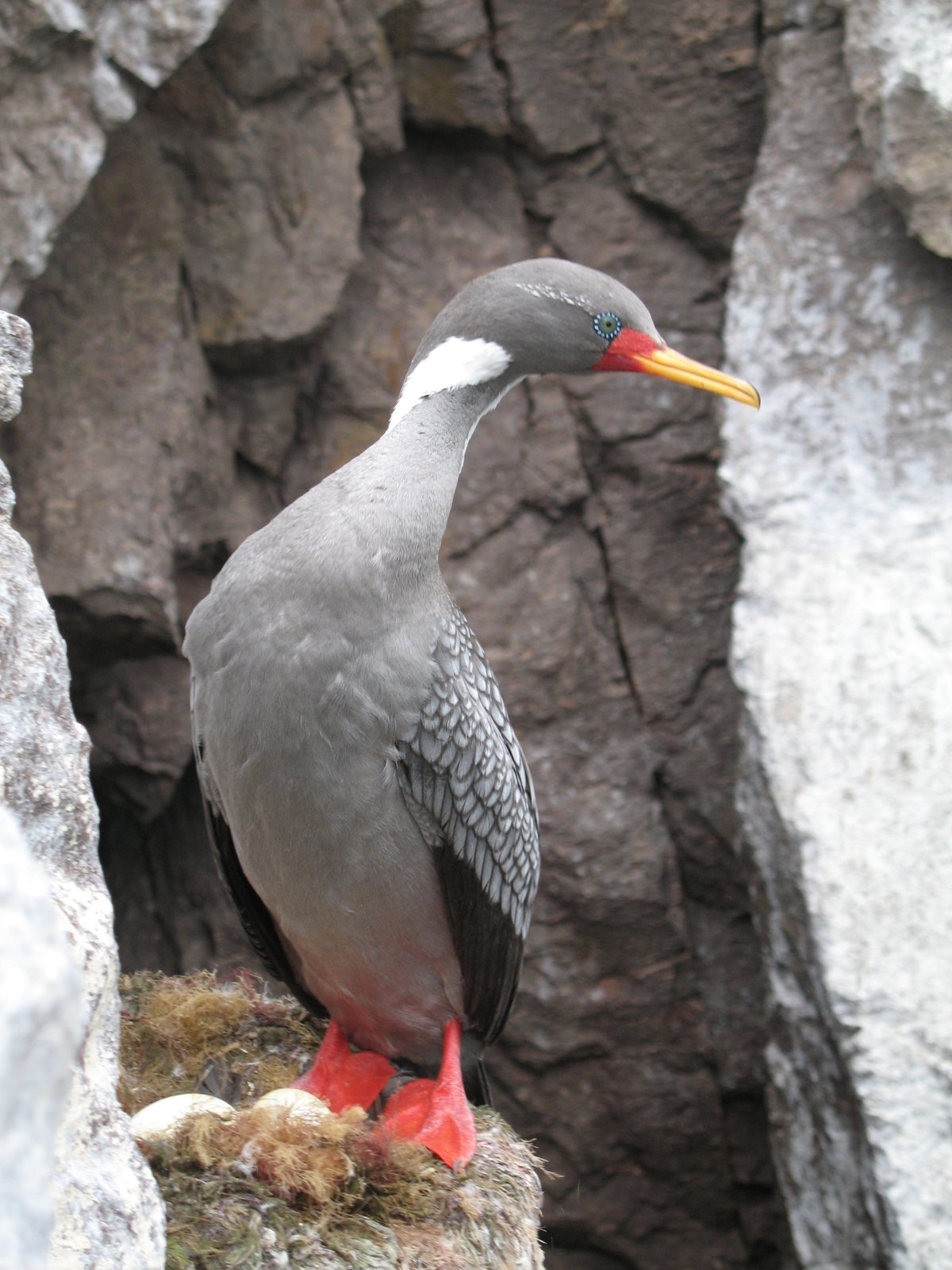
The Red-legged Cormorant is a grey cormorant of rocky coasts along the cold Humboldt Current. Unlike the Guanay Cormorant it does not nest in large colonies, but singly or in small groups on ledges of steep cliffs. Bright red legs, a yellow bill and a white patch on the side of the neck make it unambiguous in the guide area.
Voice
Largely silent. At the nest short, soft hissing and grunting sounds.
Recording: Heraldo V. Norambuena — CC BY-NC-SA 4.0 · xeno-canto
Identification
71–76 cm, medium-sized, with a fairly short tail. Adults are mostly dark slate-grey, with pale silvery-grey, black-edged feathers on the back and wing coverts, giving the upperparts a scaled look. There is an elongated white patch on the side of the neck. The bill is yellow, with orange-red bare skin at the base; the eye is green and the legs are bright red. In the breeding season fine white streaks appear on the head and neck. The sexes are alike. Juveniles are browner and paler below, with duller, brownish legs and a less distinct neck patch.
Confusion species
Guanay Cormorant Leucocarbo bougainvilliorum is larger, blue-black above and white below, with pink feet, and lives in large, dense colonies. Neotropic Cormorant Nannopterum brasilianum is all black as an adult, with a longer tail and dark legs, and juveniles are brown without red legs.
Habitat
Steep rocky coasts, cliffs, rocky islets and harbour piers along cool, food-rich inshore waters. It usually forages alone, close inshore, diving to the bottom for fish among rocks and kelp. It builds a nest of seaweed and feathers on a narrow ledge or in a hollow in a steep cliff, often above the surf.
Where the bird is most at home, classified by the vegetation units of the Andes and the west coast.


Range and movements
In Peru along almost the entire coast wherever there is rocky shore, from the north to the Chilean border. In Ecuador only as a rare vagrant along the south-western coast. Absent from Colombia, Bolivia and Galápagos. Outside the guide area along the coast of Chile and, in a separate population, along the Atlantic coast of southern Argentina.
- Resident
- dark = core range, pale = thinly spread
How and when to look
Check steep cliffs at Pucusana, Paracas and the Ballestas Islands or the piers of fishing harbours along the Peruvian coast; birds often rest on ledges just above the surf.
Conservation status
Near Threatened. The population is moderate in size and declining. Drowning in gillnets, disturbance of nest sites, overfishing and food shortage in El Niño years are the main threats.
Scientific name
Poikilocarbo gaimardi | (Garnot, 1828) (GBIF: Phalacrocorax gaimardi)
Garnot described the species in 1828 as Carbo Gaimardi; because it was later moved to another genus, the author and year stand in brackets. The genus Poikilocarbo was introduced in 1935 by Boetticher. The genus name comes from Greek poikilos, 'variegated, pied', and Latin carbo, 'charcoal', used in ornithology for cormorants. The species name honours Joseph Paul Gaimard (1796–1858), French naval surgeon and naturalist on round-the-world expeditions. The specimen the first description was based on came from Isla San Lorenzo, Lima, Peru.