All species › Gannets and cormorants › Cormorants and shags › Flightless Cormorant
Flightless Cormorant | Nannopterum harrisi
Galapagosaalscholver | Cormorán no volador | Biguá-de-galápagos
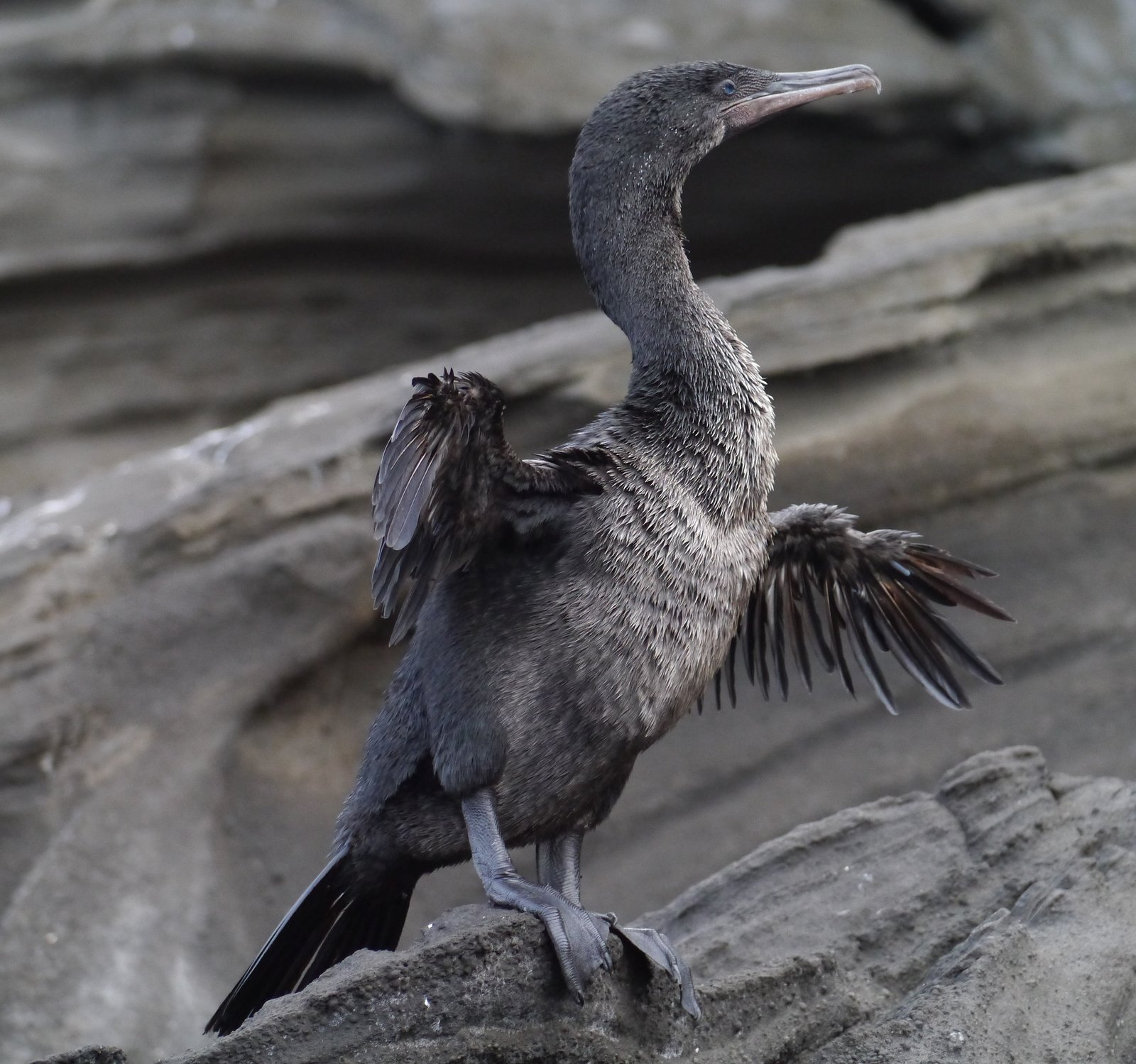
The Flightless Cormorant is the only cormorant in the world that cannot fly. On the cool western islands of Galápagos, without land predators and with food just offshore, it lost the power of flight and became a heavy, powerful diver. With its stubby wings it is one of the most conspicuous endemic birds of the archipelago.
Voice
Largely silent; at the nest it gives low growling and grunting sounds.
Recording: Charlie Vogt — CC BY-NC-SA 4.0 · xeno-canto
Identification
89–100 cm, the largest cormorant, heavily built, with a long neck, a long, heavy, hook-tipped bill and large webbed feet. The wings are greatly reduced and look ragged. Adults are blackish brown above and dark brown below, with a bright turquoise to blue eye. The male is clearly larger than the female. Juveniles are more uniformly black, with a dark eye.
Confusion species
No other cormorant occurs on Galápagos, and the reduced wings make it unmistakable. On the water it may at a distance resemble Galapagos Penguin Spheniscus mendiculus, but that species is much smaller, white below and has a short bill. Other cormorants occur on the mainland coast, such as Neotropic Cormorant Nannopterum brasilianum, but these can fly and are much smaller.
Habitat
Rocky lava coasts with cool, food-rich water. It dives close inshore to the bottom, searching among the rocks for fish, eel-like fish and octopus. After diving it stands on the rocks with its wing stubs spread to dry. It builds a nest of seaweed and other flotsam on rocks just above the waterline.
Where the bird is most at home, classified by the vegetation units of the Andes and the west coast.

Range and movements
Only on Galápagos, along the coast of Fernandina and the north and west coasts of Isabela. Absent from mainland Ecuador, Colombia, Peru and Bolivia.
- Resident
How and when to look
At Punta Espinoza on Fernandina, Flightless Cormorants sit on the lava rocks beside the trail, often with wings spread. They are also regularly seen along the west coast of Isabela from boats and dinghies.
Conservation status
Vulnerable. The population is small, restricted to a short stretch of coast and fluctuates strongly: during El Niño the cold water fails and many birds die. Introduced predators, fishing nets and oil are threats. The species lives entirely within Galápagos National Park and Marine Reserve.
Scientific name
Nannopterum harrisi | (Rothschild, 1898) (GBIF: Phalacrocorax harrisi)
Rothschild described the species in 1898 as Phalacrocorax harrisi; because it was later moved to another genus, the author and year stand in brackets. The genus Nannopterum was introduced in 1899 by Sharpe. The genus name comes from Greek nannos, 'dwarf', and pteron, 'wing', for the small wings of the Flightless Cormorant. The species name honours the American naturalist Charles Miller Harris, who collected the species in 1897 on a Galápagos expedition funded by Walter Rothschild. The specimen the first description was based on came from Isla Fernandina, Galápagos.