All species › Gannets and cormorants › Cormorants and shags › Neotropic Cormorant
Neotropic Cormorant | Nannopterum brasilianum
Bigua-aalscholver | Cormorán neotropical | Biguá
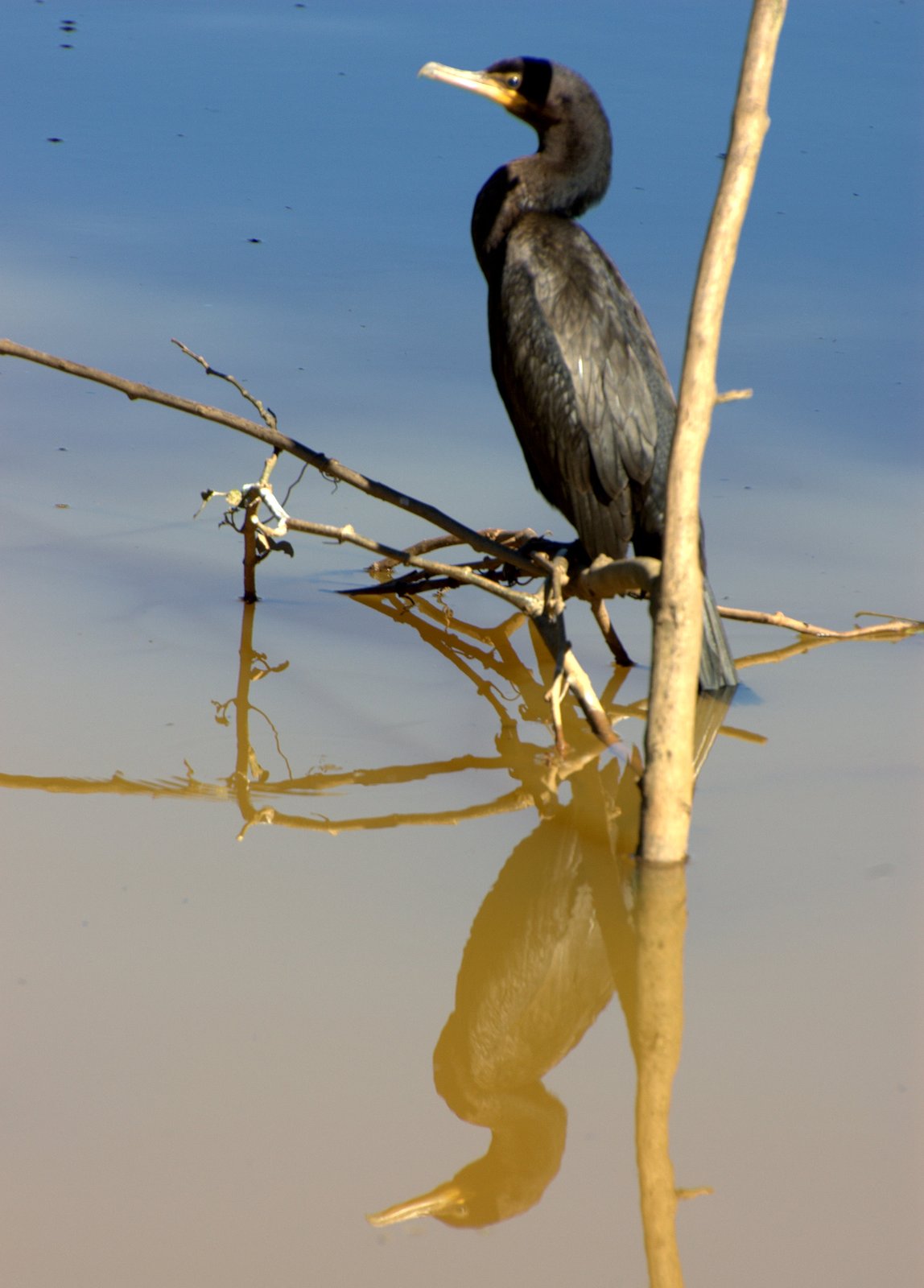
The Neotropic Cormorant is the commonest and most widespread cormorant in the guide area. It lives on almost any open water, from the Pacific coast and mangroves to rivers in Amazonia and lakes high on the altiplano, such as Lake Titicaca. It often fishes in groups and roosts in large numbers on trees, rocks or jetties.
Voice
Usually silent away from colonies. At the nest and at roosts low, pig-like grunts.
Recording: Guillermo Treboux — CC BY-NC-SA 4.0 · xeno-canto
Identification
58–73 cm, a slender, fairly small cormorant with a relatively long tail and a thin, hook-tipped bill. Adults are black with a greenish or bronzy gloss on the back and wings. The gular pouch is dull yellow to brownish yellow and ends in a point at the rear; in the breeding season it is bordered by a narrow white edge, and the bird has fine white plumes on the side of the head. The sexes are alike. Juveniles are brown, paler to dingy white below, especially on the neck and breast.
Confusion species
Anhinga Anhinga anhinga has a thinner, longer neck, a pointed bill without a hook, a longer tail and a silvery-white wing pattern. Guanay Cormorant Leucocarbo bougainvilliorum is larger, with white underparts and pink feet. Red-legged Cormorant Poikilocarbo gaimardi is grey, with red legs and a white neck patch. On Galápagos only Flightless Cormorant Nannopterum harrisi occurs, which is larger and cannot fly.
Habitat
Open fresh, brackish and salt water from sea level to above 4000 m: coasts, bays, estuaries, mangrove, lagoons, rivers, lakes, reservoirs, rice fields, fish farms and harbours. It dives from the surface for fish, sometimes in groups that drive a shoal together. It nests in colonies, with stick nests in trees or shrubs over water, in mangroves or on rocks and islets.
Where the bird is most at home, classified by the vegetation units of the Andes and the west coast.


Range and movements
In Colombia widespread in the lowlands and Andean valleys, also on high-plateau lakes. In Ecuador along the whole coast and in the western lowlands, in the Amazonian lowlands and locally on Andean lakes. In Peru numerous along the coast, widespread in the Amazonian lowlands and on Andean lakes up to Lake Titicaca. In Bolivia in the lowlands and on the lakes of the altiplano. Absent from Galápagos. Outside the guide area from the southern United States to Tierra del Fuego.
- Resident
- dark = core range, pale = thinly spread
How and when to look
Found on almost every lake, along every large river and along the coast; in fishing harbours on the Peruvian coast and on Lake Titicaca groups often sit on posts and boats. Look for the pointed gular pouch with its white edge.
Conservation status
Least Concern (LC). The species is numerous and locally benefits from reservoirs, rice fields and fish farms; it is sometimes persecuted as a competitor of fishermen.
Scientific name
Nannopterum brasilianum | (Gmelin, 1789) (GBIF: Phalacrocorax brasilianus)
Gmelin described the species in 1789 as Procellaria brasiliana; because it was later moved to another genus, the author and year stand in brackets. The genus Nannopterum was introduced in 1899 by Sharpe. The genus name comes from Greek nannos, 'dwarf', and pteron, 'wing', for the small wings of the Flightless Cormorant. The species name refers to Brazil. The specimen the first description was based on came from Brazil.