All species › Gannets and cormorants › Cormorants and shags › Guanay Cormorant
Guanay Cormorant | Leucocarbo bougainvilliorum
Guanoaalscholver | Cormorán guanay | Biguá-guanay
The Guanay Cormorant is the most numerous seabird of the Humboldt Current and the main producer of guano on the islands off the coast of Peru. It nests in very dense colonies of tens to hundreds of thousands of pairs and fishes for anchovy shoals in long lines flying low over the sea. Its population size closely tracks the anchovy stock.
Voice
Silent at sea. In the colonies a constant chorus of low, guttural and grunting sounds.
No recording with a suitable Creative Commons licence is available for this species yet.
Identification
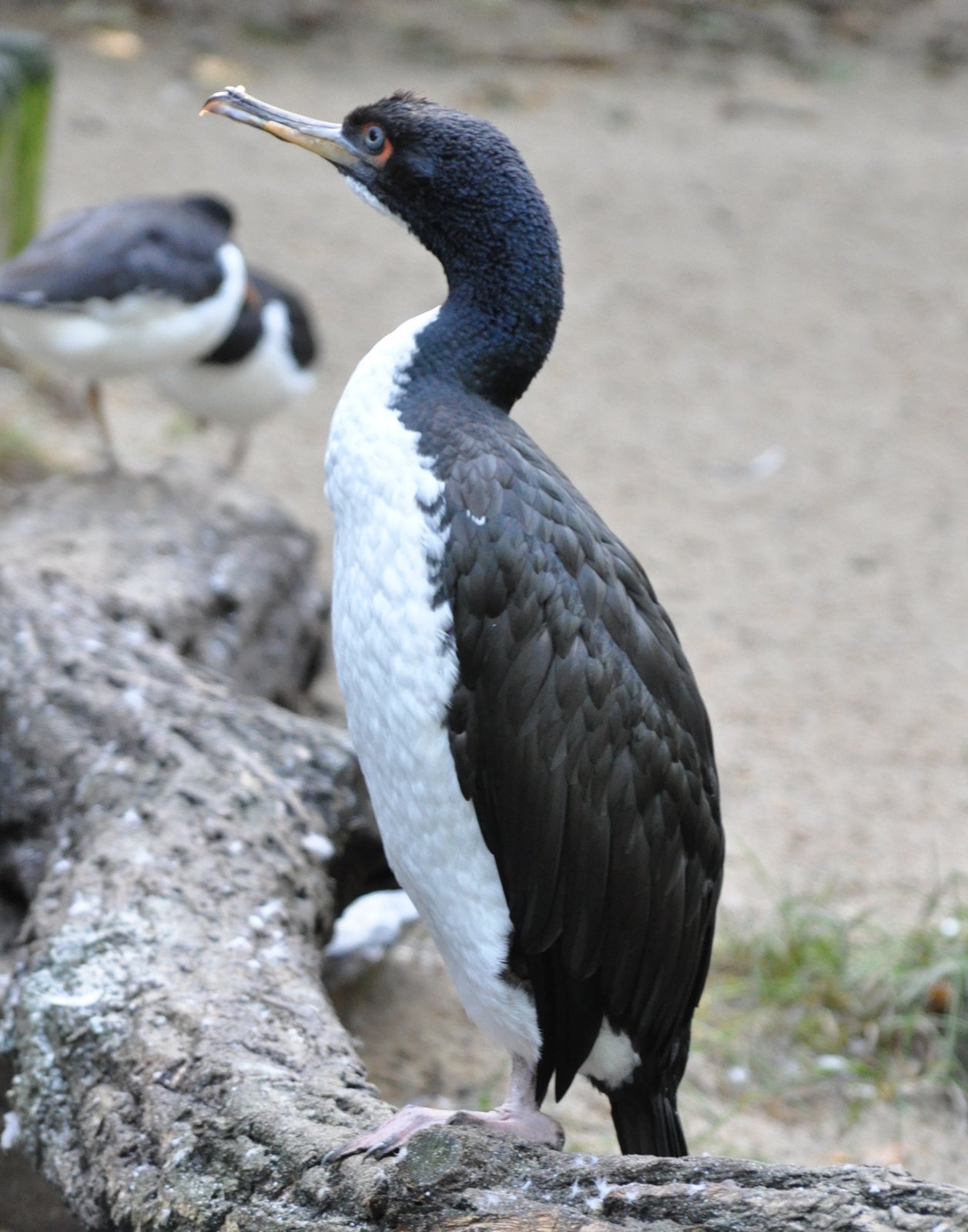
76 cm, large and heavily built. The upperparts, head and neck are glossy blue-black, the underparts bright white; a white throat patch extends to the chin, and there is a white patch on the thigh. Around the eye there is red bare skin with a green eye-ring. The bill is greyish and the feet are pink. In the breeding season it has a short crest and a few white plumes behind the eye. The sexes are alike. Juveniles are duller brownish black above and dingy white below.
Confusion species
Red-legged Cormorant Poikilocarbo gaimardi is smaller and mostly grey, with red legs and a white neck patch. Neotropic Cormorant Nannopterum brasilianum is smaller and all black as an adult. Peruvian Booby Sula variegata nests in the same colonies, but has a white head, a brown-and-white scaled back, a conical bill and plunge-dives into the sea from a height.
Habitat
Cool, food-rich inshore waters over the continental shelf, mostly within a few tens of kilometres of the coast. It nests on flat parts of rocky islands and headlands, such as the guano islands, where the nests of guano and feathers are packed close together. It dives in groups for anchovy and other small shoaling fish.
Where the bird is most at home, classified by the vegetation units of the Andes and the west coast.


Range and movements
In Peru along the entire coast, with the large colonies on the guano islands of the central and southern parts. In Ecuador an irregular visitor along the south-western coast, mainly when food is short in El Niño years. In Colombia at most a rare vagrant along the Pacific coast. Absent from Bolivia and Galápagos. Outside the guide area along the coast of Chile and, with a small population, in Patagonia in Argentina.
- Resident
- dark = core range, pale = thinly spread
How and when to look
From a boat trip to the Ballestas Islands off Paracas the colonies can be seen at close range. Along the Peruvian coast long lines often pass low over the sea in the early morning.
Conservation status
Near Threatened. The population depends on anchovy and fluctuates strongly: during El Niño events the cold water fails and large numbers die. Overfishing of anchovy, disturbance of colonies and drowning in fishing nets are further threats.
Scientific name
Leucocarbo bougainvilliorum | (Lesson, 1837)
Lesson described the species in 1837 as Carbo Bougainvillii; because it was later moved to another genus, the author and year stand in brackets. The genus Leucocarbo was introduced in 1857 by Bonaparte. The genus name comes from Greek leukos, 'white', and Latin carbo, 'charcoal', used in ornithology for cormorants. The species name means 'of the Bougainvilles' and honours the French navigator Louis Antoine de Bougainville (1729–1811) and his son, naval officer Hyacinthe de Bougainville (1781–1846). The specimen the first description was based on came from Valparaíso, Chile.