All species › Pelicans, herons and ibises › Ibises and spoonbills › Scarlet Ibis
Scarlet Ibis | Eudocimus ruber
Rode ibis | Ibis escarlata | Guará
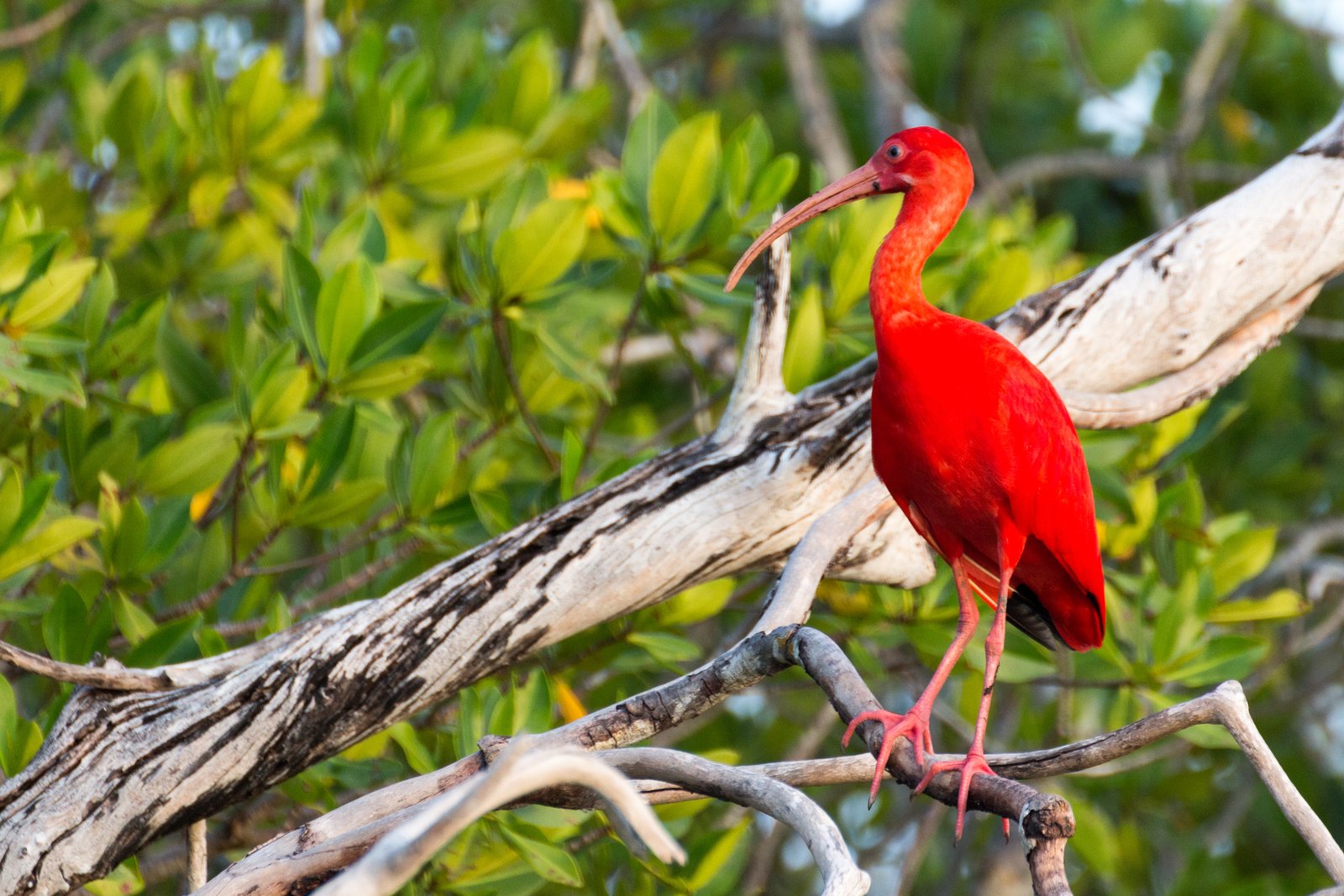
The Scarlet Ibis is the only ibis with entirely scarlet plumage; the colour comes from carotenoids in the crustaceans it eats. It lives in coastal lagoons, mangroves and the wet savannas of the llanos, and often forms large flocks and mixed colonies with herons. It is closely related to American White Ibis, with which it hybridises locally.
Voice
Mostly silent; when flushed and at colonies it gives hoarse, nasal calls such as honk-honk and a soft gabbling.
Recording: David Darrell-Lambert — CC BY-NC-SA 4.0 · xeno-canto
Identification
56–61 cm. Adults are entirely scarlet, with black tips to the outer primaries. The bare face and the long, decurved bill are reddish, the bill blackish in the breeding season; the legs are red. The sexes are alike; the male is larger and longer-billed. Juveniles are greyish brown with a white rump and belly and gradually turn rosy red in their second year.
Confusion species
Juveniles closely resemble young American White Ibis Eudocimus albus; a pink tinge on the rump or back indicates Scarlet Ibis. Hybrids with American White Ibis are pink or blotched with red. Roseate Spoonbill Platalea ajaja is paler pink, with a white neck and a flat, spoon-shaped bill.
Habitat
Mangroves, coastal lagoons, mudflats and estuaries, and inland shallow marshes and flooded savannas. It probes by touch in mud and shallow water for crabs, shrimps, insects and small fish. It breeds in colonies in mangroves or shrubs over water, with a loose nest of twigs, and roosts in large flocks in trees.
Where the bird is most at home, classified by the vegetation units of the Andes and the west coast.


Range and movements
In Colombia on the Caribbean coast, mainly in La Guajira, and in the llanos of Arauca, Casanare, Meta and Vichada. Elsewhere in the guide area at most a rare vagrant; absent from Bolivia and the Galápagos. Outside the guide area in Venezuela, on Trinidad, in the Guianas and along the north coast of Brazil.
- Resident
- dark = core range, pale = thinly spread
How and when to look
In the llanos of Arauca and Casanare flocks can be seen in the dry season (Dec–Apr) at shrinking pools, often together with herons and storks. On the coast of La Guajira it feeds in the lagoons near Riohacha. At dusk flocks fly in long lines to their roost trees.
Conservation status
Least Concern. Numbers are declining locally owing to hunting, egg collecting and the degradation of mangroves and wetlands.
Scientific name
Eudocimus ruber | (Linnaeus, 1758)
Linnaeus described the species in 1758 as Scolopax rubra; because it was later moved to another genus, the author and year stand in brackets. The genus Eudocimus was introduced in 1832 by Wagler. The genus name comes from Greek eudokimos, 'famous, highly esteemed', from eu, 'good', and dokimos, 'esteemed'. The species name is Latin ruber, 'red'. The specimen the first description was based on came from Bahamas.