All species › Pelicans, herons and ibises › Ibises and spoonbills › American White Ibis
American White Ibis | Eudocimus albus
Witte ibis | Ibis blanco | Guará-branco
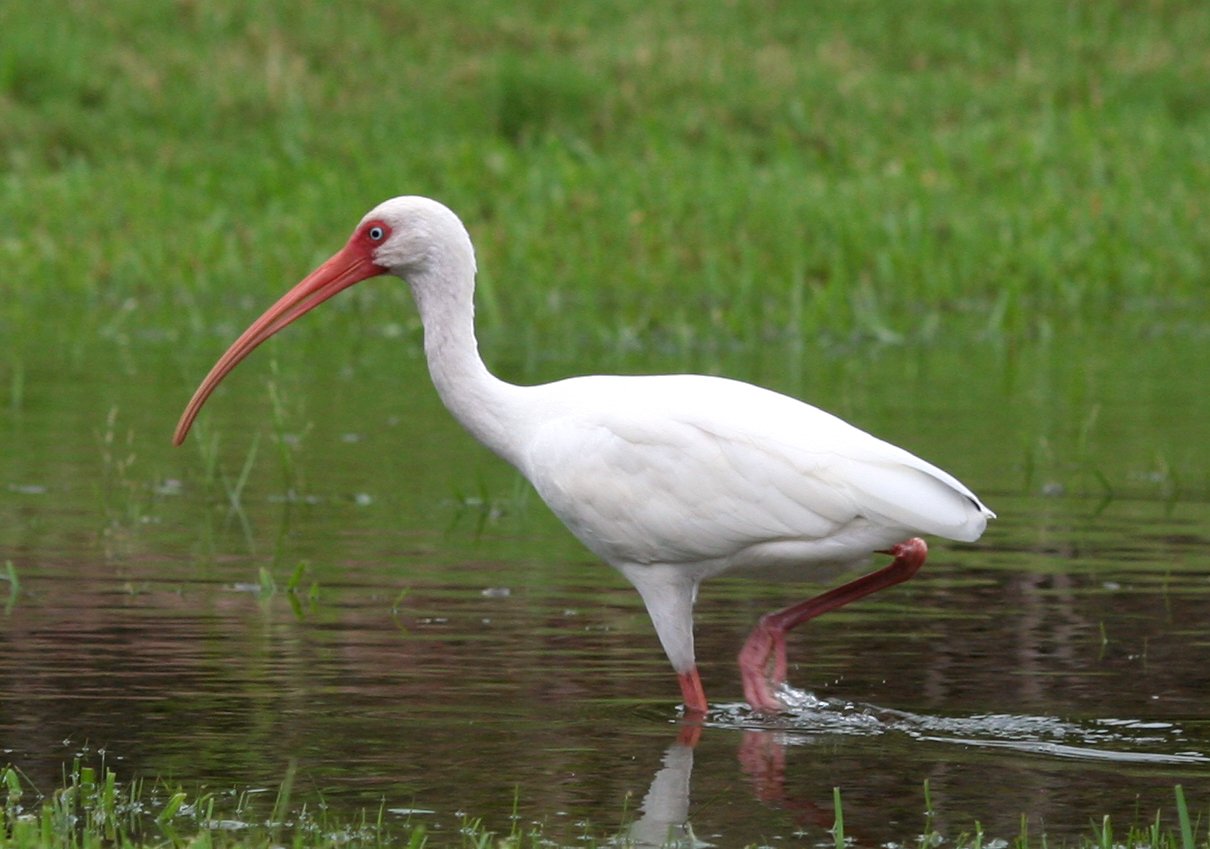
The American White Ibis lives along the coasts of the Caribbean and along the Pacific coast from Colombia to north-western Peru. It feeds in flocks with quick, probing movements of its red, decurved bill. It is closely related to Scarlet Ibis; some authors treat the two as one species.
Voice
A nasal, hoarse honk-honk-honk, mainly in flight; grunting sounds at colonies.
Recording: PT xiao — CC BY-NC-SA 4.0 · xeno-canto
Identification
56–68 cm. Adults are white, with black tips to the outer primaries that show mainly in flight. The bare face, the long, decurved bill and the legs are pink to red and turn deeper red in the breeding season. The sexes are alike; the male is larger. Juveniles are brown with a white belly and rump and a brown-streaked neck; birds in transitional plumage are white with brown blotches.
Confusion species
Great Egret Ardea alba and Snowy Egret Egretta thula have straight bills and fly with the neck retracted, whereas ibises fly with the neck extended. Juveniles resemble young Scarlet Ibis Eudocimus ruber, which often show a pink tinge on the rump. Bare-faced Ibis Phimosus infuscatus is entirely dark.
Habitat
Mangroves, coastal lagoons, mudflats, rice fields and freshwater marshes in the lowlands, mostly below 500 m. It eats crabs, crayfish, insects and small fish, which it finds by touch in mud and shallow water. It breeds in colonies in mangroves or shrubs over water, often together with herons; the nest is a platform of twigs.
Where the bird is most at home, classified by the vegetation units of the Andes and the west coast.


Range and movements
In Colombia on the Caribbean coast and in the Magdalena lowlands, locally also along the Pacific coast. In Ecuador in the mangroves and wetlands along the coast, mainly around the Gulf of Guayaquil. In Peru in the mangroves of Tumbes in the far north-west. Absent from Bolivia and the Galápagos. Outside the guide area from the south-eastern United States through Mexico, Central America and the Caribbean to Venezuela.
- Resident
- dark = core range, pale = thinly spread
How and when to look
In the Ciénaga Grande de Santa Marta in Colombia and in the mangroves of Manglares Churute in Ecuador it feeds in flocks on the mudflats at low tide. In Peru it can be seen in the mangroves of Puerto Pizarro near Tumbes.
Conservation status
Least Concern. Locally the species suffers from the loss of mangroves and wetlands, partly to shrimp farms, and from hunting.
Scientific name
Eudocimus albus | (Linnaeus, 1758)
Linnaeus described the species in 1758 as Scolopax alba; because it was later moved to another genus, the author and year stand in brackets. The genus Eudocimus was introduced in 1832 by Wagler. The genus name comes from Greek eudokimos, 'famous, highly esteemed', from eu, 'good', and dokimos, 'esteemed'. The species name is Latin albus, 'white'. The specimen the first description was based on came from Carolina, United States.