All species › Pelicans, herons and ibises › Ibises and spoonbills › Plumbeous Ibis
Plumbeous Ibis | Theristicus caerulescens
Grijze ibis | Bandurria mora | Curicaca-real
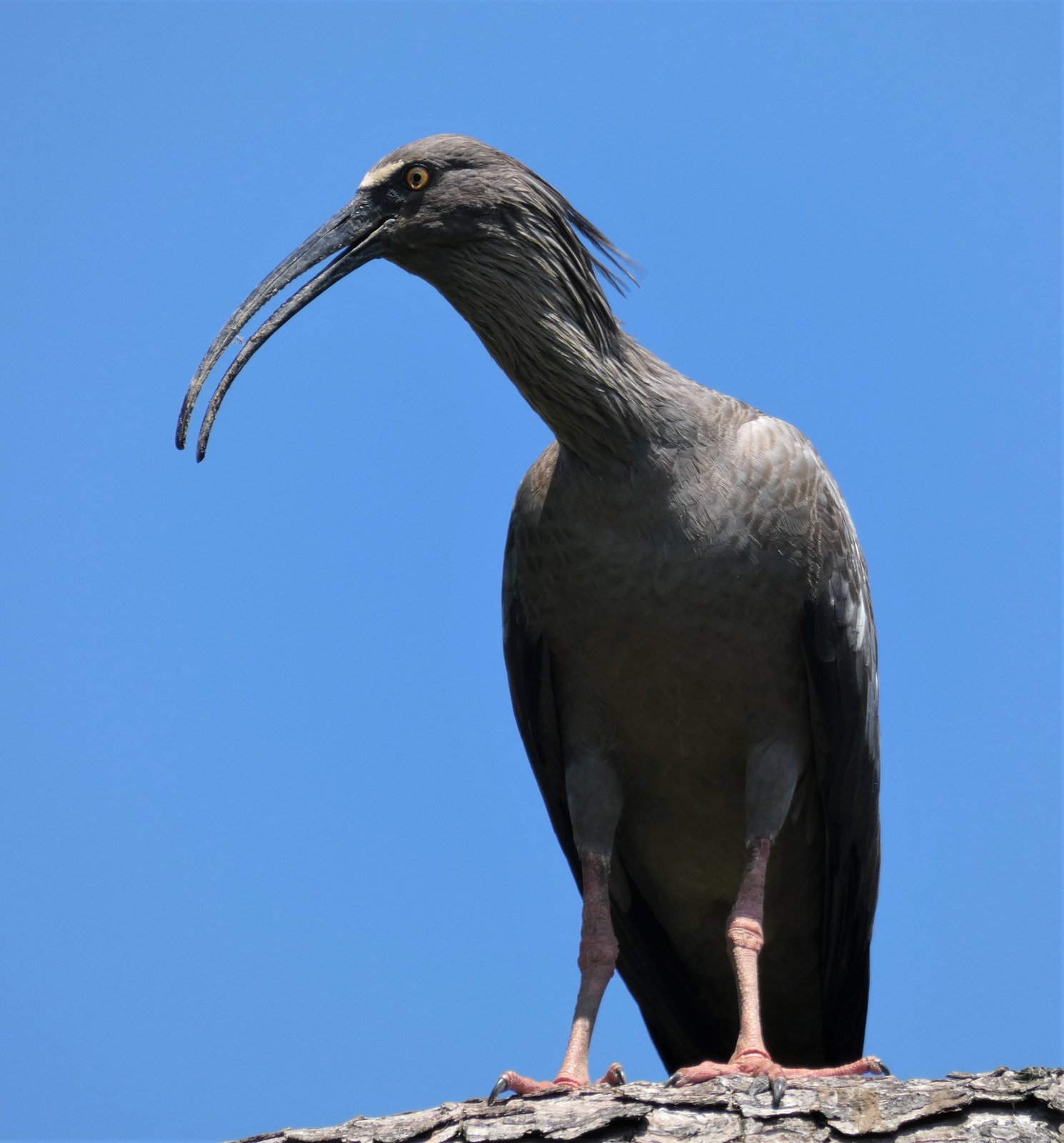
The Plumbeous Ibis is a large grey ibis of the wet savannas of central South America. It has a white band across the forehead and a shaggy crest on the nape. Pairs and small groups walk over open ground and give loud, ringing calls.
Voice
Loud, ringing, trumpet-like calls, often in duet, such as a repeated too-too-too; also a short, hoarse croak.
Recording: Dante Buzzetti — CC BY-NC-SA 4.0 · xeno-canto
Identification
71–76 cm. The plumage is leaden grey, with a narrow white band across the forehead and a crest of long, narrow feathers on the nape. The wing coverts are paler grey, the flight feathers darker with a greenish gloss. The long, decurved bill is blackish, the eye orange and the short legs orange-red. The sexes are alike; juveniles are duller with a smaller crest.
Confusion species
Buff-necked Ibis Theristicus caudatus has a buff head and neck, a rufous crown and white wing patches. Green Ibis Mesembrinibis cayennensis is smaller and dark greenish, with shorter legs, and lives in forest along water. Bare-faced Ibis Phimosus infuscatus is smaller and dark, with a pink bare face and a pink bill.
Habitat
Wet savannas, marshes, banks of rivers and lakes and pastures in the lowlands, below 500 m. It eats insects, snails, frogs, snakes and other small animals, which it seeks on foot on the ground and in shallow water. It breeds singly or in loose groups; the nest is a platform of sticks in a tree.
Where the bird is most at home, classified by the vegetation units of the Andes and the west coast.


Range and movements
In Bolivia in the savannas of Beni and Santa Cruz in the north and east. In Peru rare in the Pampas del Heath in Madre de Dios, on the border with Bolivia. Absent from Colombia, Ecuador and the Galápagos. Outside the guide area in the Pantanal of Brazil, in Paraguay, Uruguay and northern Argentina.
- Resident
- dark = core range, pale = thinly spread
How and when to look
In the savannas around Trinidad in Beni it often stands on fence posts, dead trees or along roads, and gives itself away with its loud calls. The Pampas del Heath are the only known site in Peru.
Conservation status
Least Concern. The species is fairly common in large parts of its range; the conversion of savannas into farmland may play a role locally.
Scientific name
Theristicus caerulescens | (Vieillot, 1817)
Vieillot described the species in 1817 as Ibis coerulescens; because it was later moved to another genus, the author and year stand in brackets. The genus Theristicus was introduced in 1832 by Wagler. The genus name comes from Greek theristikos, 'of reaping', after the sickle-shaped bill. The species name is Latin caerulescens, 'bluish', after the blue-grey plumage. The specimen the first description was based on came from Paraguay.