All species › Pelicans, herons and ibises › Ibises and spoonbills › Buff-necked Ibis
Buff-necked Ibis | Theristicus caudatus
Geelhalsibis | Bandurria común | Curicaca
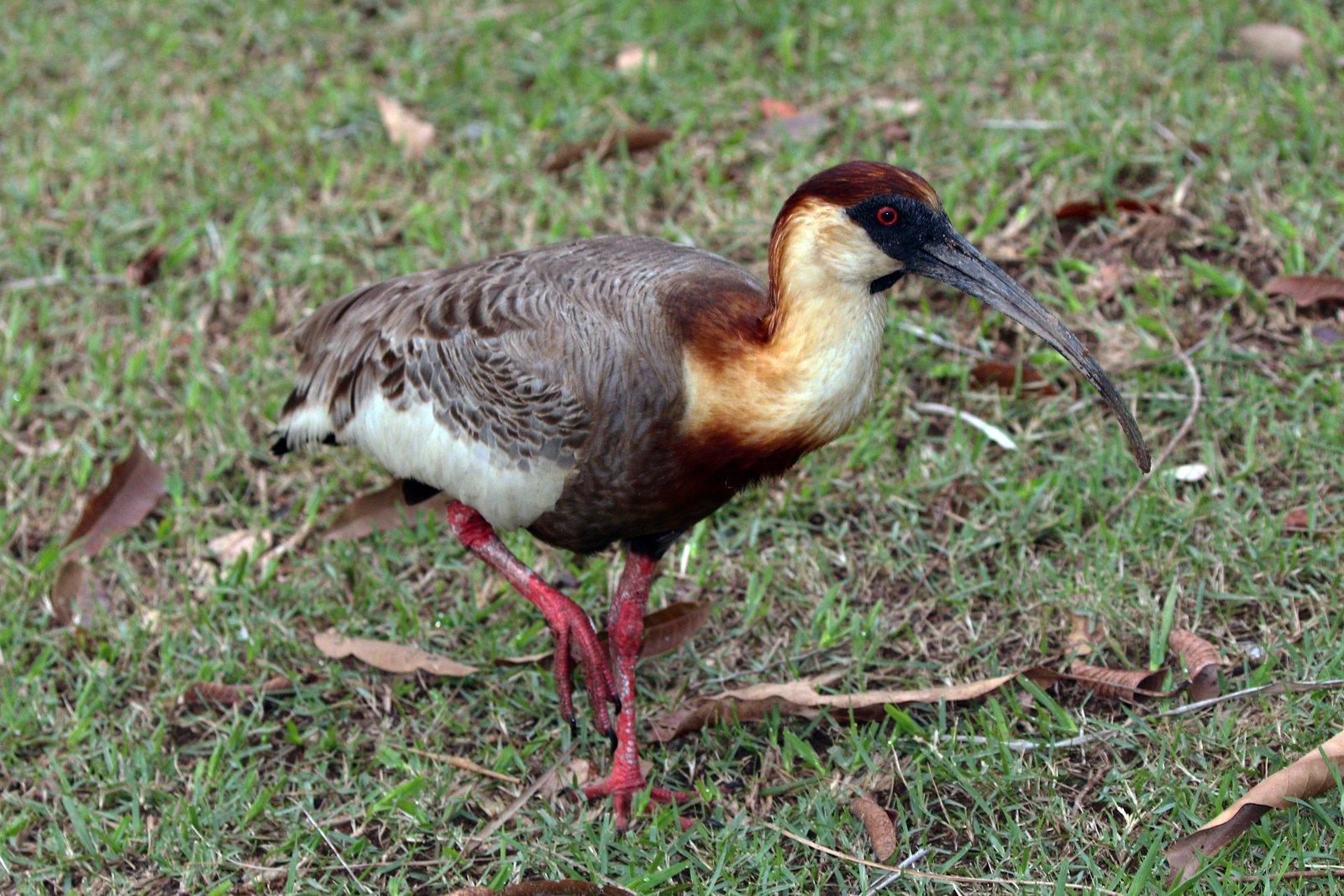
The Buff-necked Ibis is a large ibis of open savannas and pastures, with a buff head and neck and large white wing patches. It often feeds on dry grassland, far from water. Pairs and groups give loud, metallic calls, especially when taking off and at the roost.
Voice
Loud, metallic calls such as kwak-kwak or tok-tok, often by several birds at once; a loud cackling in flight and at the roost.
Recording: JAYRSON ARAUJO DE OLIVEIRA — CC BY-NC-SA 4.0 · xeno-canto
Identification
71–81 cm. The head and neck are buff, the crown and hindneck rufous; the bare face is black. The back and lesser wing coverts are grey, the greater coverts white and the flight feathers black, so that a large white panel shows on the wing in flight. The belly and tail are blackish. The decurved bill is blackish, the short legs red. The sexes are alike; juveniles are duller, with dark streaks on the neck.
Confusion species
Black-faced Ibis Theristicus melanopis of the high mountains and the Pacific coast has a grey breast band, shorter legs and, in the nominate form, a black throat wattle; the two hardly overlap anywhere in the guide area. Plumbeous Ibis Theristicus caerulescens is entirely grey, with a white forehead band and a nape crest.
Habitat
Open savannas, wet and dry grasslands, pastures and edges of marshes and rivers in the lowlands, mostly below 1000 m. It eats insects and their larvae, frogs, lizards and other small animals, which it extracts from the ground with its bill. It breeds singly or in loose groups; the nest is a platform of sticks in a tree or palm.
Where the bird is most at home, classified by the vegetation units of the Andes and the west coast.


Range and movements
In Colombia in the llanos east of the Andes and in the Caribbean lowlands. In Ecuador and Peru scarce to rare in the eastern lowlands. In Bolivia widespread in the savannas and open country of Beni, Santa Cruz and the Chaco. Absent from the Galápagos. Outside the guide area in Venezuela, the Guianas, Brazil, Paraguay, Uruguay and northern Argentina.
- Resident
- dark = core range, pale = thinly spread
How and when to look
In the llanos of Casanare and Meta in Colombia and in the savannas around Trinidad in Beni it feeds on open grassland and in pastures; groups often rest in dead trees and can be heard from far away.
Conservation status
Least Concern. The species benefits locally from deforestation and the creation of pasture.
Scientific name
Theristicus caudatus | (Boddaert, 1783)
Boddaert described the species in 1783 as Scolopax caudatus; because it was later moved to another genus, the author and year stand in brackets. The genus Theristicus was introduced in 1832 by Wagler. The genus name comes from Greek theristikos, 'of reaping', after the sickle-shaped bill. The species name is Latin caudatus, 'tailed'. The specimen the first description was based on came from Cayenne, French Guiana.