All species › Pelicans, herons and ibises › Ibises and spoonbills › Black-faced Ibis
Black-faced Ibis | Theristicus melanopis
Zwartmaskeribis | Bandurria austral | Curicaca-de-cara-preta
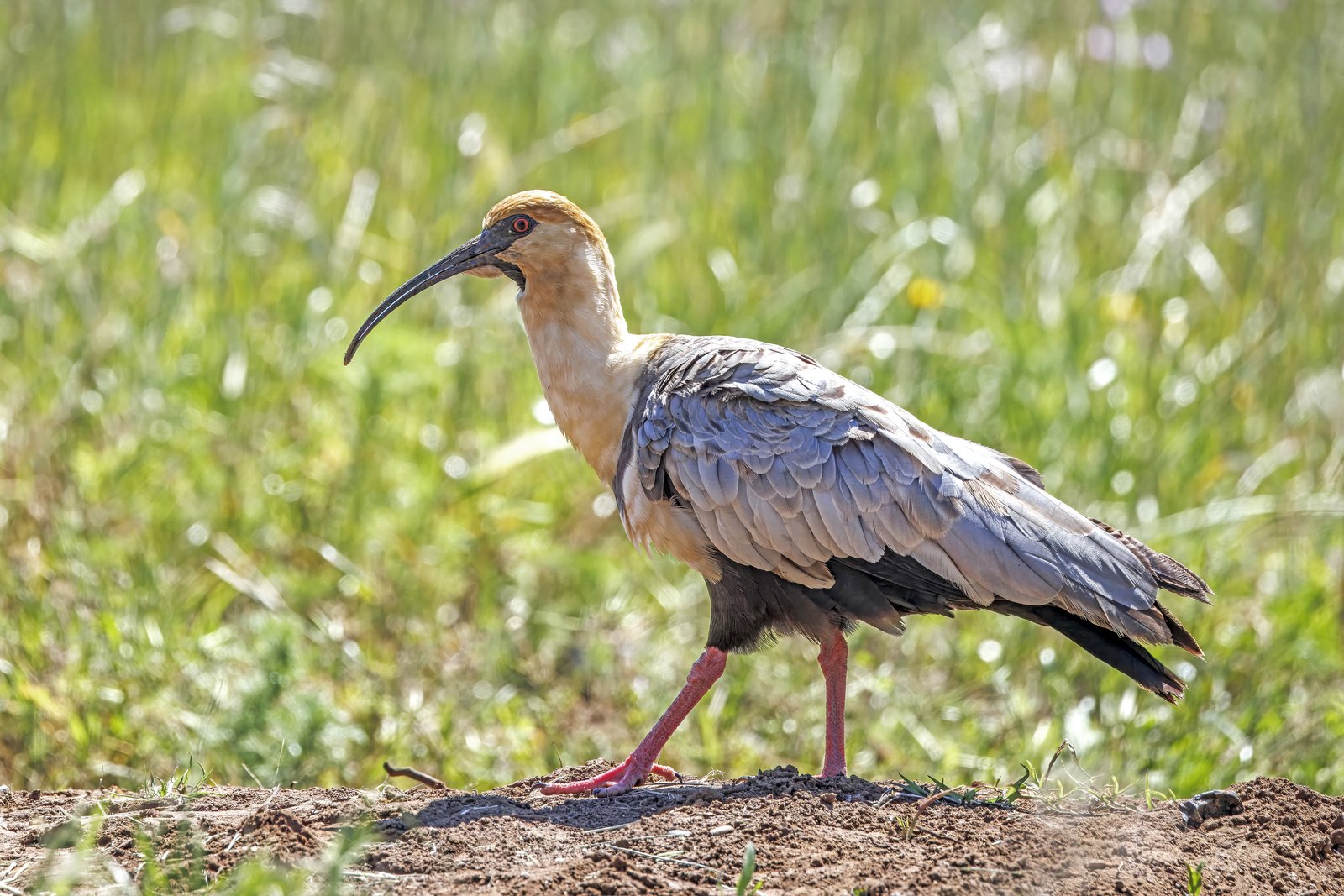
The Black-faced Ibis is a large ibis with a buff neck and a black bare face. In the guide area it is mainly represented by the Andean form branickii of the puna and páramo, often treated as a separate species (Andean Ibis); the nominate form lives in the south of the continent and in small numbers along the coast of Peru. Pairs and groups feed on grassland and in bofedales and give loud, metallic calls.
Voice
Loud, metallic calls such as kwak or kling-kling, often in duet or by the whole group, especially when taking off and in flight.
Recording: Meena Haribal — CC BY-NC-SA 4.0 · xeno-canto
Identification
71–76 cm. The head and neck are buff with a rufous crown; the bare face and throat are black, with a wattle under the throat in the nominate form. The back and lesser wing coverts are grey, the greater coverts white and the flight feathers black, showing a white panel on the wing in flight. A grey band crosses the breast, and the belly and thighs are blackish. The decurved bill is black and the legs are red; in the Andean form the legs are shorter and the throat wattle smaller or absent. The sexes are alike; juveniles are duller, with a streaked neck.
Confusion species
Buff-necked Ibis Theristicus caudatus lives in the lowlands and has longer legs, no grey breast band and no throat wattle; the two hardly overlap anywhere in the guide area. Puna Ibis Plegadis ridgwayi is smaller and entirely dark chestnut with a green gloss and a dark red bill.
Habitat
The Andean form lives on humid puna, grasslands, bofedales and lake shores, mostly between 3500 and 4800 m, in Ecuador in the páramo. It eats insects, larvae, worms, frogs and other small animals, which it extracts from the ground and soft soil. It breeds on ledges on rock faces, often in small colonies, with a nest of sticks and grass. The nominate form in Peru lives in coastal valleys and on farmland.
Where the bird is most at home, classified by the vegetation units of the Andes and the west coast.


Range and movements
In Ecuador rare and local in the páramo of the central Andes. In Peru in the puna of the central and southern Andes, including Junín, Cusco and Puno; the nominate form occurs in small numbers along the southern coast. In Bolivia on the altiplano and in the high Andes of La Paz, Oruro, Cochabamba and Potosí. Absent from Colombia and the Galápagos. Outside the guide area in northern Chile and Argentina (Andean form) and in central and southern Chile and Argentina to Tierra del Fuego (nominate form).
- Resident
- dark = core range, pale = thinly spread
How and when to look
In Peru it feeds in the grasslands and bofedales around Lake Junín and on the altiplano of Puno; in Bolivia along the shores of Lake Titicaca. In Ecuador it can be seen in the Antisana reserve.
Conservation status
Least Concern. Treated separately, the Andean form is assessed as Near Threatened because of its small, fragmented population; the coastal form in Peru has become very rare. Threats include hunting, disturbance of breeding sites and overgrazing and drainage of bofedales.
Scientific name
Theristicus melanopis | (Gmelin, 1789)
Gmelin described the species in 1789 as Tantalus melanopis; because it was later moved to another genus, the author and year stand in brackets. The genus Theristicus was introduced in 1832 by Wagler. The genus name comes from Greek theristikos, 'of reaping', after the sickle-shaped bill. The species name comes from Greek melas, 'black', and ōps, 'face', after the black face. The specimen the first description was based on came from New Year Islands, Tierra del Fuego, Argentina.