All species › Gannets and cormorants › Frigatebirds › Great Frigatebird
Great Frigatebird | Fregata minor
Grote fregatvogel | Rabihorcado Grande | Tesourão-grande
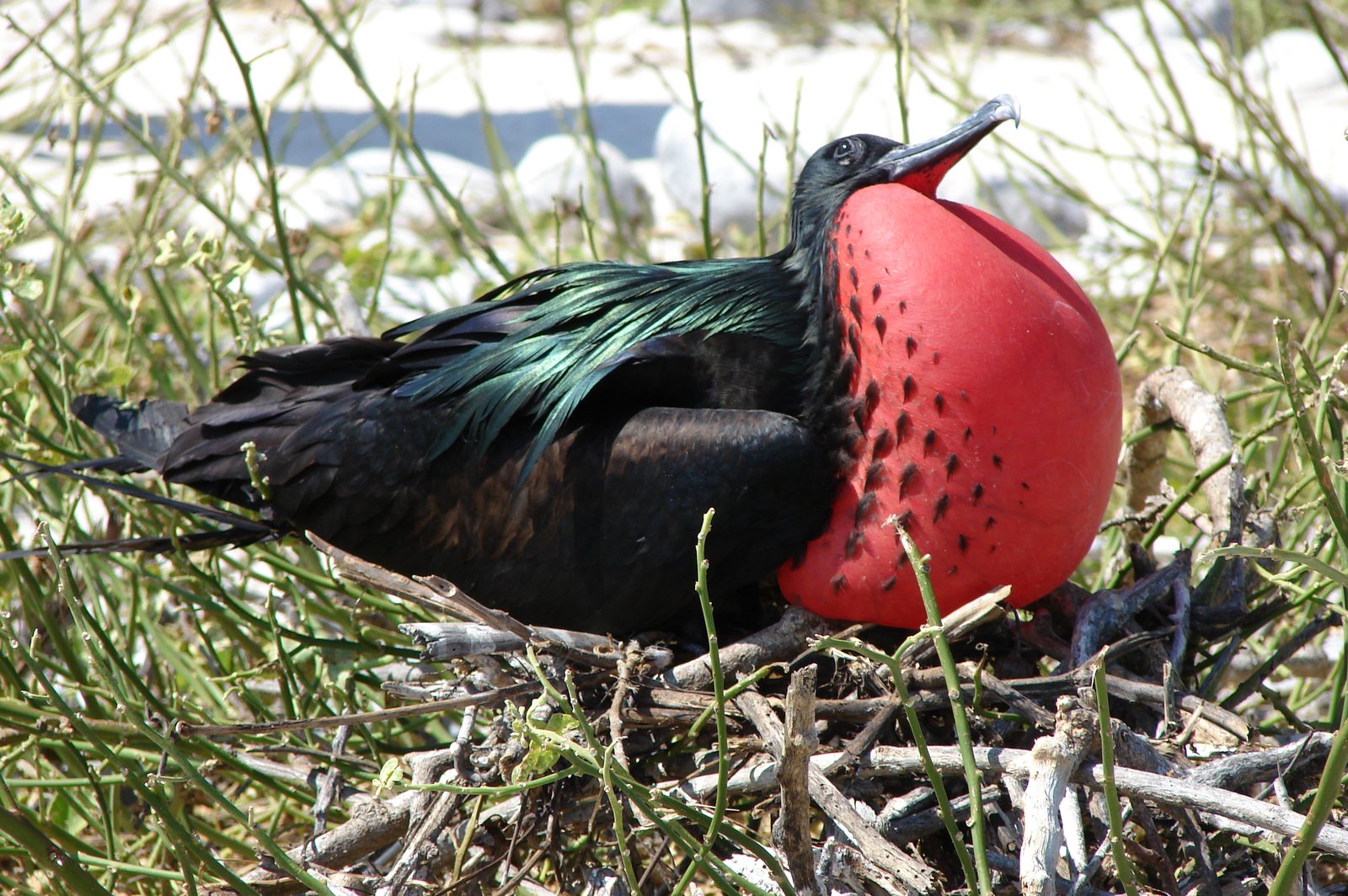
The Great Frigatebird is a seabird of the open tropical oceans that in the guide area breeds mainly on Galápagos. With its long, angular wings and deeply forked tail it glides effortlessly over the sea, yet it cannot land on the water. In the breeding colonies the males inflate a bright red throat pouch to attract females.
Voice
In the colony, males with inflated pouches give a quavering, yodelling warble and a rattling bill-clatter. Silent at sea.
Recording: AUDEVARD Aurélien — CC BY-NC-SA 4.0 · xeno-canto
Identification
85–105 cm, with very long, narrow, angled wings, a long, deeply forked tail that is usually held closed, and a long, hooked bill. The male is all black with a green sheen on the back and scapulars, a dull brownish bar across the upperwing and a red throat pouch that is inflated into a large balloon in display. The female is larger, blackish brown with a white breast and a white to greyish-white throat, and a red eye-ring. Juveniles have a white head and breast, the head often tinged rusty. Adult plumage is reached only after several years.
Confusion species
Magnificent Frigatebird Fregata magnificens is the common frigatebird along the mainland coast and also occurs on Galápagos. The male has a purple rather than green sheen on the back and lacks the pale wing bar; the female has a black throat, so the white is restricted to the breast, and a blue rather than red eye-ring. Juveniles are very similar; young Great Frigatebirds more often show a rusty tinge on the head and breast.
Habitat
Breeds in colonies in low scrub, saltbush and mangrove on coasts and small islands; the nests are untidy platforms of twigs. It forages far out at sea over warm water. It snatches flying fish and squid from the surface without landing, and chases other seabirds, especially boobies, until they drop their prey.
Where the bird is most at home, classified by the vegetation units of the Andes and the west coast.


Range and movements
On Galápagos a common breeding bird, with colonies on Genovesa, North Seymour and San Cristóbal, among others. Along the coasts of Ecuador, Colombia and northern Peru rare and mainly offshore; most frigatebirds there are Magnificent Frigatebirds. Absent from Bolivia. Outside the guide area widespread on tropical islands in the Pacific and Indian Oceans, and on a few islands in the South Atlantic.
How and when to look
On Genovesa and North Seymour, males with inflated red pouches sit in the bushes beside the trails during the breeding season. Magnificent Frigatebirds also breed on North Seymour, so the two species can be compared side by side there.
Conservation status
Least Concern. The world population is large; locally, introduced predators and disturbance on breeding islands are a threat. The Galápagos colonies are protected.
Scientific name
Fregata minor | (Gmelin, 1789)
Gmelin described the species in 1789 as Pelecanus minor; because it was later moved to another genus, the author and year stand in brackets. The genus Fregata was introduced in 1799 by De Lacépède. The genus name comes from French frégate (Italian fregata), 'frigate', a fast warship, a name sailors gave to these birds. The species name comes from Latin minor, 'smaller'. The specimen the first description was based on came from Christmas Island, Indian Ocean.