All species › Gannets and cormorants › Frigatebirds › Magnificent Frigatebird
Magnificent Frigatebird | Fregata magnificens
Amerikaanse fregatvogel | Fragata magnífica | Tesourão
The Magnificent Frigatebird is the frigatebird of the mainland coasts: over harbours, bays and mangroves it hangs in the wind with hardly a wingbeat. It has the lowest weight relative to wing area of any bird and can stay aloft for days, yet it cannot land on the water. It steals much of its food from other seabirds.
Voice
Silent at sea. In the colony, males with inflated pouches give a dry, rattling bill-clatter and a drumming sound.
Recording: Leonardo Ordóñez-Delgado — CC BY-NC-SA 4.0 · xeno-canto
Identification
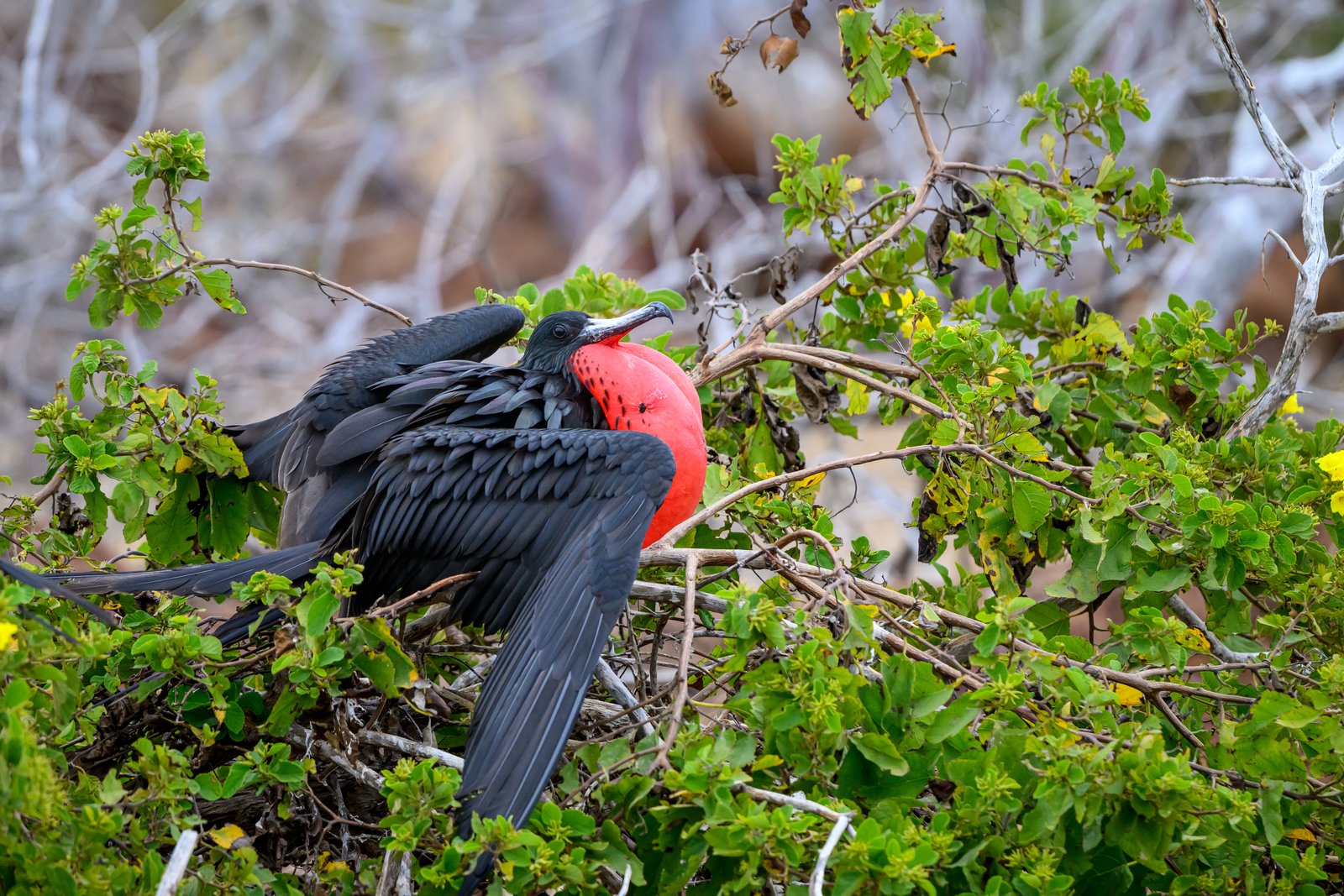
89–114 cm, with very long, narrow, angled wings, a long, deeply forked tail and a long grey hooked bill. The male is all black with a purple gloss on the back and a red throat pouch that is inflated into a large balloon in display. The female is larger, blackish brown with a black throat, a white breast that extends as a V onto the flanks, and a blue eye-ring. Juveniles have a white head and a white breast and belly. Adult plumage is reached only after four to six years.
Confusion species
Great Frigatebird Fregata minor breeds in the guide area mainly on Galápagos and is rare along the mainland. The male has a green gloss on the back and a pale bar across the upperwing; the female has a white to greyish-white throat and a red eye-ring. Juveniles can be separated only with care; young Great Frigatebirds more often show a rusty tinge on the head and breast.
Habitat
Inshore waters, bays, estuaries and mangroves, also over harbours and fishing villages; rarely far out at sea. It takes fish, squid and young turtles from the surface without landing, eats fish scraps at fishing boats and chases boobies, pelicans and terns until they drop their prey. It breeds in colonies in mangroves and low scrub on islands; the nest is a platform of twigs.
Where the bird is most at home, classified by the vegetation units of the Andes and the west coast.


Range and movements
In Ecuador along the whole coast, with colonies on Isla de la Plata and in the Gulf of Guayaquil, among others, and common on Galápagos, for example on North Seymour. In Colombia along the Caribbean and Pacific coasts and around the islands. In Peru mainly along the north coast, scarcer further south. Absent from Bolivia. Outside the guide area along the tropical coasts of the Atlantic and the eastern Pacific, from Mexico and Florida to Brazil, and on the Cape Verde Islands.
- Resident
- dark = core range, pale = thinly spread
How and when to look
Flocks hang in the wind over the harbours of Puerto López, Salinas and Manta and over the mangroves of Tumbes. On North Seymour they breed alongside Great Frigatebirds, so males of both species with inflated pouches can be compared.
Conservation status
Least Concern. The world population is large. Locally, mangrove clearance, disturbance of breeding islands and introduced predators are threats.
Scientific name
Fregata magnificens | Mathews, 1914
Mathews described the species in 1914 and placed it straight away in the genus where it still stands. The genus Fregata was introduced in 1799 by De Lacépède. The genus name comes from French frégate (Italian fregata), 'frigate', a fast warship, a name sailors gave to these birds. The species name comes from Latin magnificens, 'grand, stately'. The specimen the first description was based on came from Isla Santa Fe, Galápagos.