All species › Storks › Storks › Maguari Stork
Maguari Stork | Ciconia maguari
Magoeari | Cigüeña maguari | Maguari
The Maguari Stork is a stork of the wet grasslands and savannas of South America that closely resembles the White Stork of Europe in shape and behaviour. In the guide area it occurs mainly in the Llanos of Colombia and the Beni savannas. Unlike the other storks of the region, it nests low in marsh vegetation rather than high in trees.
Voice
Usually silent. Bill-clattering at the nest; when disturbed a hoarse, squeaky hiss.
No recording with a suitable Creative Commons licence is available for this species yet.
Identification
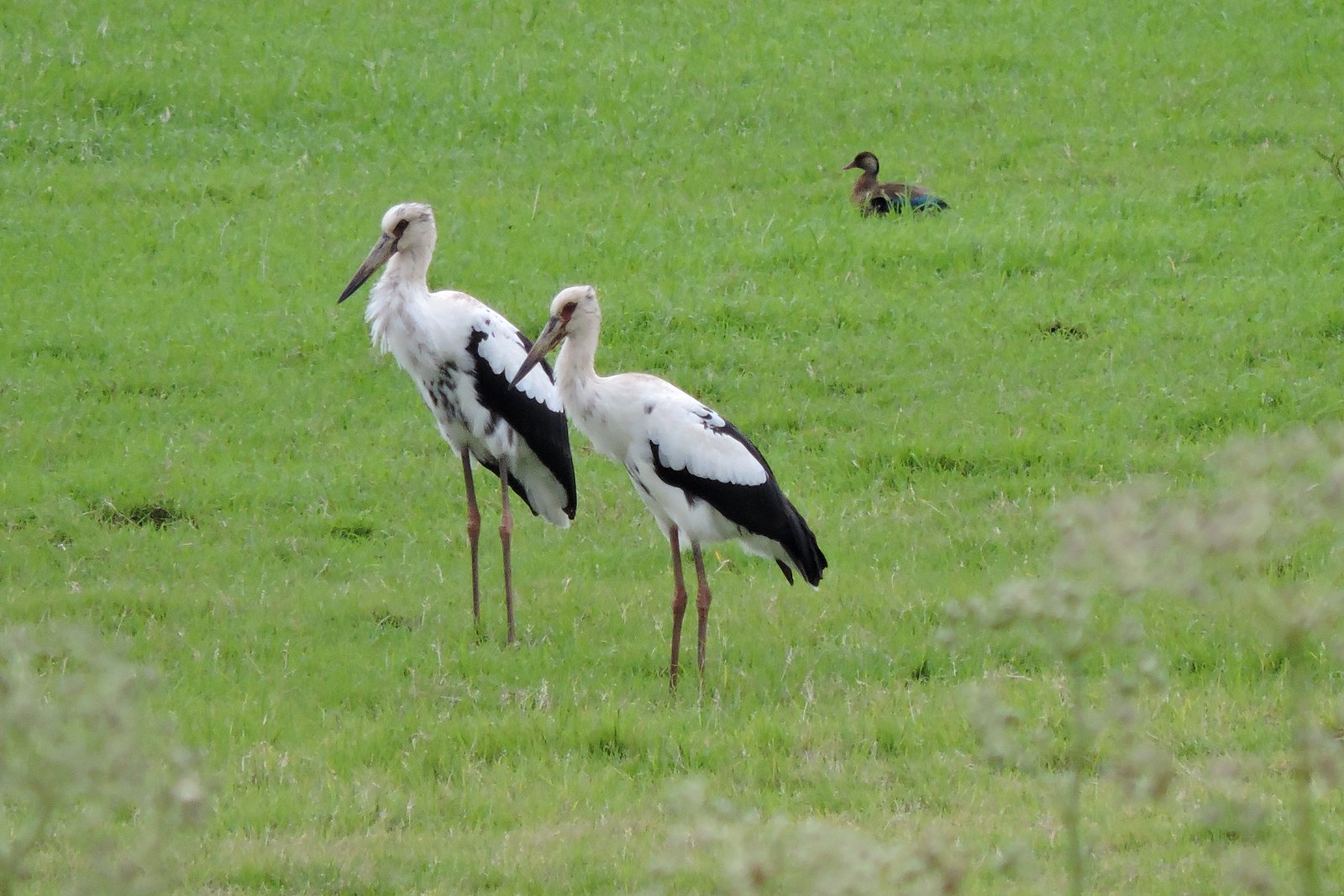
95–110 cm, a large black-and-white stork with a straight, pointed grey bill with a dark red base. The head, neck and body are white; the scapulars, flight feathers and forked tail are black with a green gloss. The bare face around the eye is red to orange, the eye white. The legs are long and red. The sexes are alike. Juveniles are black at first and later a duller black and white with grey legs. In flight it shows black flight feathers and scapulars, outstretched neck and long red legs.
Confusion species
Wood Stork Mycteria americana has a bare grey head, a thick bill decurved at the tip, a white back and dark legs. Jabiru Jabiru mycteria is larger, has all-white wings, a bare black head and neck with a red band, and black legs.
Habitat
Wet grasslands, flooded savannas, marshes and shallow pools in the lowlands, also pastures and rice fields, up to about 500 m. It walks slowly and takes fish, frogs, snakes, rodents, large insects and crayfish. It nests singly or in loose groups on a platform of reeds and sticks in a marsh, low above the water or on the ground, sometimes in a low bush.
Where the bird is most at home, classified by the vegetation units of the Andes and the west coast.


Range and movements
In Colombia in the Llanos, in Arauca, Casanare, Meta and Vichada, locally common. In Ecuador not established; at most a vagrant. In Peru rare in the southeast, mainly in the Pampas del Heath (Madre de Dios). In Bolivia common in the savannas of Beni and Santa Cruz. Outside the guide area in Venezuela and the Guianas and from eastern and southern Brazil to Paraguay, Uruguay and northern and central Argentina.
- Resident
- dark = core range, pale = thinly spread
How and when to look
In the Beni savannas around Trinidad and Santa Ana del Yacuma, Maguari Storks walk over wet pastures and along pools in the dry season, often next to Jabirus and Wood Storks, so the three species can be compared.
Conservation status
Least Concern. The species is widespread in the wet savannas of South America. Locally, wetland drainage, conversion of savanna to cropland and hunting are threats.
Scientific name
Ciconia maguari | (Gmelin, 1789)
Gmelin described the species in 1789 as Ardea Maguari; because it was later moved to another genus, the author and year stand in brackets. The genus Ciconia was introduced in 1760 by Brisson. The genus name is Latin ciconia, 'stork'. The species name comes from the Tupí names maguarí or baguarí, 'heavy bill', for this stork; via Buffon's 'Maguari', which goes back to Marcgrave (1648). The specimen the first description was based on came from northeastern Brazil.