All species › Storks › Storks › Jabiru
Jabiru | Jabiru mycteria
Jabiroe | Jabirú | Tuiuiú
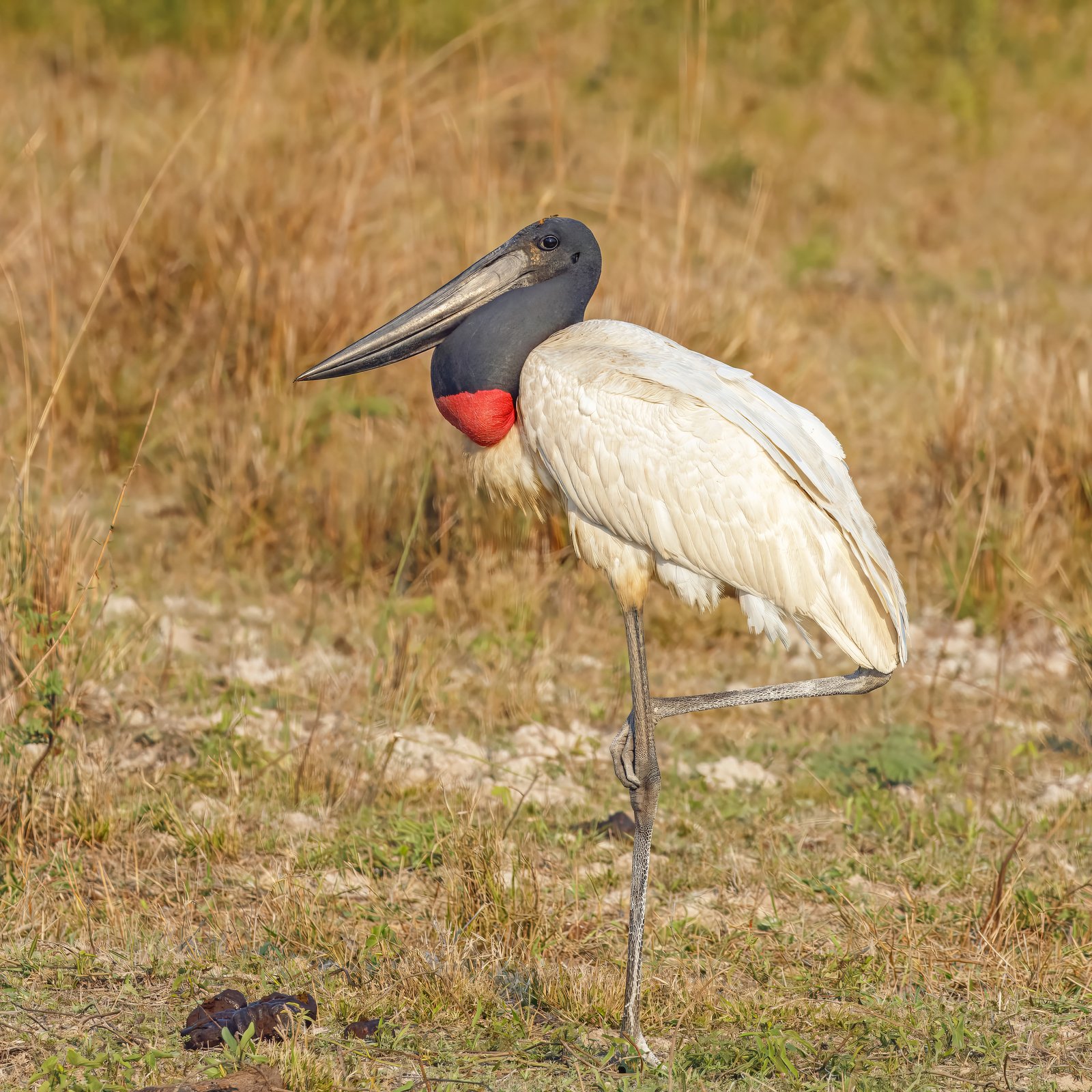
The Jabiru is the largest stork in the Americas and one of the largest flying birds on the continent. With its black bare head, red neck band and huge, slightly upturned bill it can be recognized from far away in the wet lowland savannas. Pairs build a large stick nest high in a solitary tree and use it for years.
Voice
Usually silent. At the nest both partners clatter their bills; young beg with hoarse squeaks.
Recording: JAYRSON ARAUJO DE OLIVEIRA — CC BY-NC-SA 4.0 · xeno-canto
Identification
122–140 cm, very large, with a massive black bill that is slightly upturned. The plumage is all white. The head and neck are bare and black, with a broad, red, distensible band of skin at the base of the neck that becomes brighter when the bird is excited. The legs are long and black. The male is clearly larger than the female. Juveniles are greyish brown with a dark head and neck and gradually become white. In flight it shows all-white wings, outstretched neck and long legs.
Confusion species
Wood Stork Mycteria americana is smaller, has black flight feathers and tail, a grey, scaly head without a red band and a bill slightly decurved at the tip. Maguari Stork Ciconia maguari is smaller, has a white, feathered neck, black flight feathers and scapulars, a red face and red legs.
Habitat
Flooded savannas, marshes and the shores of lowland lakes and rivers, locally in pastures, up to about 500 m. It strides through shallow water and catches fish, eels, frogs, snakes, young caimans and large invertebrates. The nest is a large platform of sticks in a tall, often solitary tree, sometimes a palm.
Where the bird is most at home, classified by the vegetation units of the Andes and the west coast.


Range and movements
In Colombia in the Llanos and the Caribbean lowlands, scarce. In Ecuador very rare, with a few records from the eastern lowlands. In Peru rare in the southeast, mainly in the Pampas del Heath (Madre de Dios). In Bolivia fairly common in the Beni savannas and northern Santa Cruz. Outside the guide area from southern Mexico through Central America to Venezuela, the Guianas, Brazil (especially the Pantanal), Paraguay and northern Argentina.
- Resident
- dark = core range, pale = thinly spread
How and when to look
In the Beni savannas around Trinidad and in the Llanos of Colombia, Jabirus stand along shrinking pools in the dry season, often with Wood Storks and herons. Nests in solitary trees in the savanna can be seen from far away.
Conservation status
Least Concern. The world population is fairly large, but in Central America and the north of the range numbers have declined sharply because of hunting, disturbance and wetland drainage.
Scientific name
Jabiru mycteria | (Lichtenstein, 1819)
Lichtenstein described the species in 1819 as Ciconia mycteria; because it was later moved to another genus, the author and year stand in brackets. The genus Jabiru was introduced in 1906 by Hellmayr. The genus name comes from jabiru, the Tupi-Guarani name of the bird, said to mean 'swollen neck'. The species name comes from Greek muktēr, 'snout, nose', after the large bill. The specimen the first description was based on came from Brazil.