All species › Storks › Storks › Wood Stork
Wood Stork | Mycteria americana
Kaalkopooievaar | Cigüeña americana | Cabeça-seca
The Wood Stork is the only American stork that also ranges far to the north. It feeds by touch: wading with its bill half open in murky water, it snaps it shut in a fraction of a second as soon as it feels a fish. It breeds in colonies in trees over water and depends heavily on drying pools, where fish become concentrated.
Voice
Adults are usually silent; they hiss and clatter their bills at the nest. Young in the colony give a constant loud begging, like a chorus of nyeh-nyeh.
No recording with a suitable Creative Commons licence is available for this species yet.
Identification
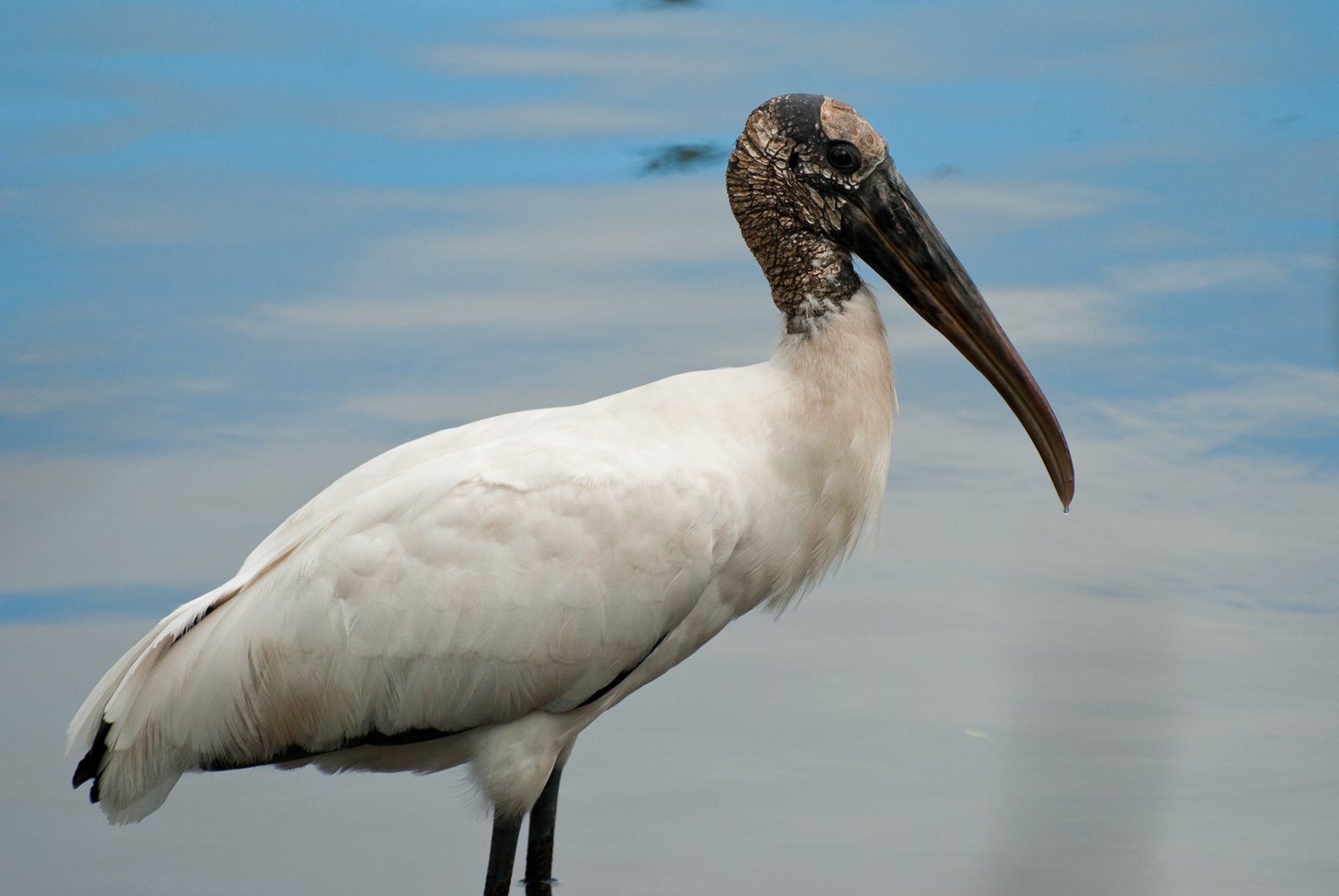
85–100 cm, a large white stork with a long, thick bill that is slightly decurved at the tip. The head and upper neck are bare, the skin dark grey and scaly; adults have a pale, horny patch on the crown. The flight feathers and tail are black with a green to purple gloss, the rest of the plumage is white. The legs are dark with pink feet. The sexes are alike. Juveniles have a yellowish bill and a greyish-brown feathered head and neck. It flies with neck and legs outstretched and often soars high on thermals, showing a black trailing edge and wing tips.
Confusion species
Maguari Stork Ciconia maguari has a straight grey bill with a red base, a feathered head, red bare face and red legs, and a black back. Jabiru Jabiru mycteria is much larger, all white with a black head and neck, a red band at the base of the neck and a slightly upturned bill. American White Ibis Eudocimus albus is much smaller and has a red, strongly decurved bill. In flight, King Vulture Sarcoramphus papa can resemble a Wood Stork at a distance, but it flies with the head drawn in and has a short tail.
Habitat
Marshes, shallow lakes, flooded savannas, rice fields, lagoons and mangroves in the lowlands, mostly below 500 m. It feeds mainly on fish, also crayfish, frogs and aquatic insects, caught by touch in shallow water. It breeds in colonies, often with herons, in trees in swamps or mangroves; the nest is a platform of sticks.
Where the bird is most at home, classified by the vegetation units of the Andes and the west coast.


Range and movements
In Colombia widespread in the Caribbean lowlands, the Magdalena Valley and the Llanos, locally along the Pacific coast. In Ecuador mainly in the western lowlands, in the Guayas basin, scarce in the east. In Peru in the northwest (Tumbes, Piura) and scattered in the Amazonian lowlands. In Bolivia in the lowlands of Beni, Santa Cruz and Pando. Outside the guide area from the southeastern United States through Mexico and Central America to northern Argentina.
- Resident
- dark = core range, pale = thinly spread
How and when to look
In the dry season flocks gather at drying pools, for example in the Llanos of Colombia, the Beni savannas and the rice fields and marshes around the Gulf of Guayaquil. On warm mornings flocks circle high on thermals.
Conservation status
Least Concern. The species is widespread but sensitive to wetland drainage and changes in water regimes, which strongly determine breeding success.
Scientific name
Mycteria americana | Linnaeus, 1758
Linnaeus described the species in 1758 and placed it straight away in the genus where it still stands. He introduced the genus Mycteria in that same work. The genus name comes from Greek muktēr, 'snout, nose'. The species name refers to America. The specimen the first description was based on came from Brazil.