All species › Tubenoses › Petrels, shearwaters and diving petrels › Juan Fernandez Petrel
Juan Fernandez Petrel | Pterodroma externa
Juan Fernández-stormvogel | Petrel de Juan Fernández | Grazina-de-juan-fernández
The Juan Fernandez Petrel is a large, grey-and-white petrel that breeds only on Alejandro Selkirk Island off Chile. Outside the breeding season it migrates far north, into the tropical Pacific north of the equator. In the guide area it is a rare vagrant far offshore.
Voice
Silent at sea.
Recording: David Boyle — CC BY-NC-SA 4.0 · xeno-canto
Identification
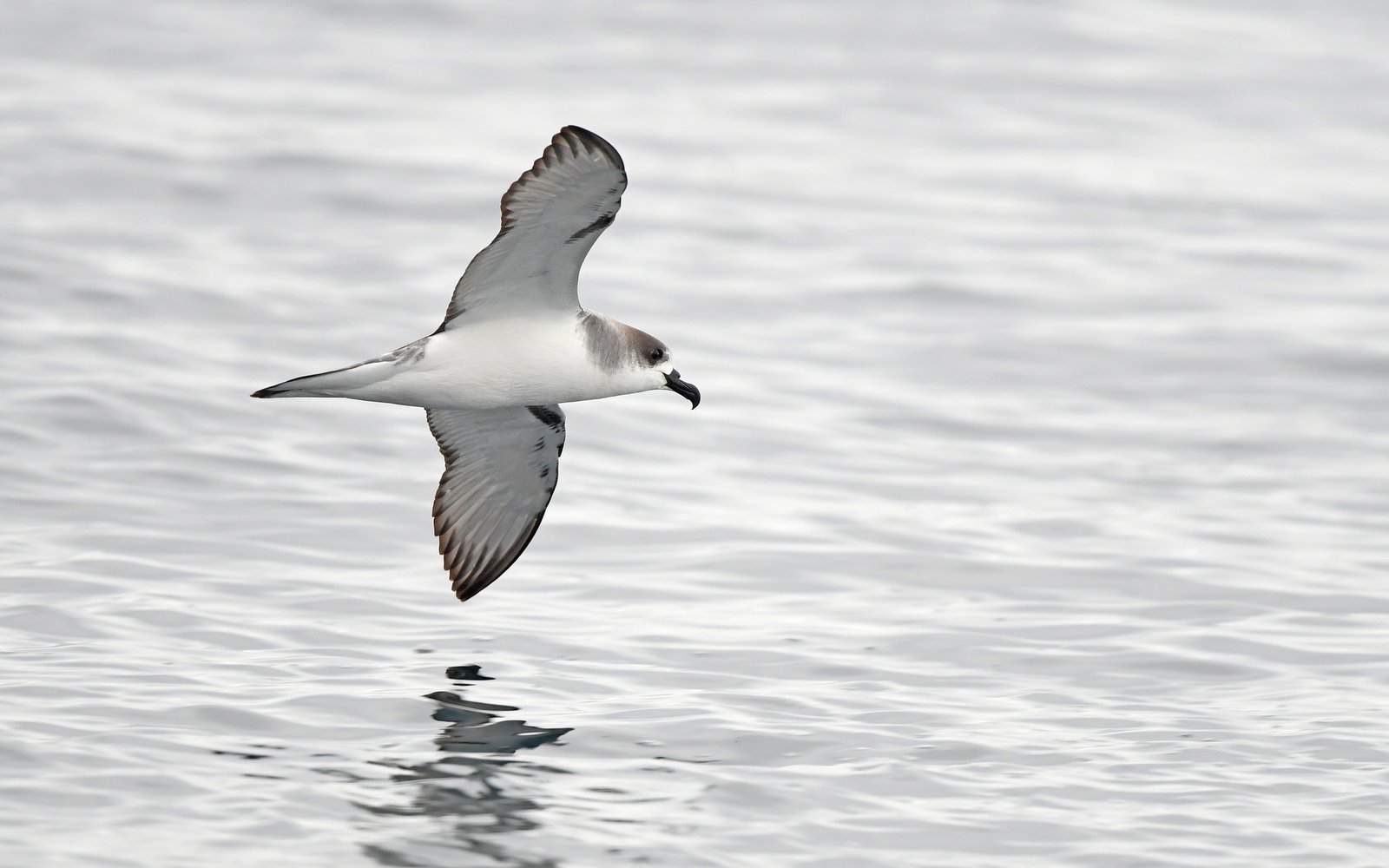
43 cm, a large petrel with long, narrow wings, a fairly long, wedge-shaped tail and a heavy black bill. The crown, hindneck and mantle are grey, the forehead is white and a small blackish patch surrounds the eye; the cap is not sharply demarcated. The upperparts are grey, with a dark M across the wings and back; the tail is dark grey. The underparts are white. The underwing is white, with a narrow dark trailing edge, a dark wingtip and a short dark bar at the carpal. It flies in high arcs with few wingbeats. The sexes are alike.
Confusion species
Galapagos Petrel Pterodroma phaeopygia has a blackish, sharply demarcated cap, darker upperparts and more black on the underwing, with a distinct dark diagonal bar. Masatierra Petrel Pterodroma defilippiana and Cook's Petrel Pterodroma cookii have a similar pattern but are much smaller. The pale morph of Wedge-tailed Shearwater Ardenna pacifica has a thin, pale bill and browner upperparts without a distinct M.
Habitat
Open ocean, far from the coast, often over warm, tropical water. It feeds mainly on squid and fish, picked from the surface, sometimes together with tuna or dolphins that drive prey upwards. It breeds in burrows in the highlands of Alejandro Selkirk.
Where the bird is most at home, classified by the vegetation units of the Andes and the west coast.

Range and movements
Rare vagrant far offshore in the guide area; there are few documented records. Not in Bolivia. It does not breed in the guide area. Outside the guide area it breeds on Alejandro Selkirk in the Juan Fernández archipelago off Chile; outside the breeding season it ranges over the central and eastern tropical Pacific, north to around Hawaii.
How and when to look
On long pelagic trips far beyond the continental shelf, look for large, grey-and-white petrels with high, arcing flight, and photograph the underwing and head.
Conservation status
Vulnerable. The entire world population breeds on a single island, where introduced cats and rats kill eggs, chicks and adults. Bycatch in fisheries is a possible additional threat.
Scientific name
Pterodroma externa | (Salvin, 1875)
Salvin described the species in 1875 as Oestrelata externa; because it was later moved to another genus, the author and year stand in brackets. The genus Pterodroma was introduced in 1856 by Bonaparte. The genus name comes from Greek pteron, 'wing', and dromos, 'runner', after the fast flight. The species name is Latin externus, 'outer', after Masafuera ('farther out'), the outer island of the Juan Fernández group. The specimen the first description was based on came from Juan Fernández Islands, Chile.